
Metaphor
Mathematics as Metaphor 豆瓣 谷歌图书
作者: Yuri I. Manin 出版社: American Mathematical Society 2007 - 11
The book includes fifteen essays and an interview. The essays are grouped in three parts: Mathematics; Mathematics and Physics; and Language, Consciousness, and Book reviews. Most of the essays are about some aspects of epistemology and the history of sciences, mainly mathematics, physics, and the history of language. English translations of some of the essays, originally published in Russian, appear for the first time in this selection. One of them is the introduction to the book Computable and Uncomputable, where the idea of a quantum computer was first proposed in 1980. Another is an essay on the mythological trickster figure, where the evolutionary role of manipulative behavior is discussed in connection with the problem of the origin of human language. With the foreword by Freeman Dyson, this book will be of interest to anyone interested in the philosophy and history of mathematics, physics, and linguistics.
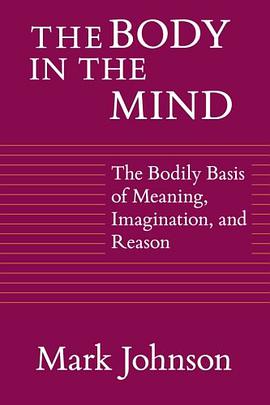
The Body in the Mind 豆瓣
作者: Mark Johnson 出版社: University Of Chicago Press 1990 - 4
"There are books--few and far between--which carefully, delightfully, and genuinely turn your head inside out. This is one of them. It ranges over some central issues in Western philosophy and begins the long overdue job of giving us a radically new account of meaning, rationality, and objectivity."--Yaakov Garb, San Francisco Chronicle
Washing the Brain - Metaphor and Hidden Ideology 豆瓣
作者: Prof. Dr. Andrew Goatly 出版社: John Benjamins Publishing Company 2008 - 7
Contemporary metaphor theory has recently begun to address the relation between metaphor, culture and ideology. In this wide-ranging book, Andrew Goatly, using lexical data from his database Metalude, investigates how conceptual metaphor themes construct our thinking and social behaviour in fields as diverse as architecture, engineering, education, genetics, ecology, economics, politics, industrial time-management, medicine, immigration, race, and sex. He argues that metaphor themes are created not only through the universal body but also through cultural experience, so that an apparently universal metaphor such as event-structure as realized in English grammar is, in fact, culturally relative, compared with e.g. the construal of 'cause and effect' in the Algonquin language Blackfoot. Moreover, event-structure as a model is both scientifically reactionary and, as the basis for technological mega-projects, has proved environmentally harmful. Furthermore, the ideologies of early capitalism created or exploited a selection of metaphor themes historically traceable through Hobbes, Hume, Smith, Malthus and Darwin. These metaphorical concepts support neo-Darwinian and neo-conservative ideologies apparent at the beginning of the 21st century, ideologies underpinning our social and environmental crises. The conclusion therefore recommends skepticism of metaphor s reductionist tendencies.