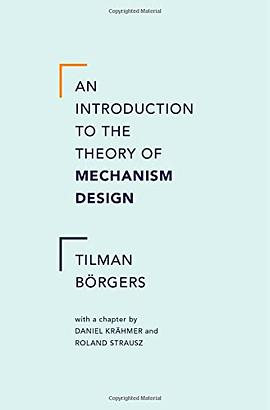
What is the best way to auction an asset? How should a group of people organize themselves to ensure the best provision of public goods? How should exchanges be organized? In An Introduction to the Theory of Mechanism Design, Tilman Börgers addresses these questions and more through an exploration of the economic theory of mechanism design. Mechanism design is reverse game theory. Whereas game theory takes the rules of the game as a given and makes predictions about the behavior of strategic players, the theory of mechanism design goes a step further and selects the optimal rules of the game.
A relatively new economic theory, mechanism design studies the instrument itself as well as the results of the instrument. An Introduction to the Theory of Mechanism Design provides rigorous but accessible explanations of classic results in the theory of mechanism design, such as Myerson's theorem on expected revenue maximizing auctions, Myerson and Satterthwaite's theorem on the impossibility of ex post efficient bilateral trade with asymmetric information, and Gibbard and Satterthwaite's theorem on the non-existence of dominant strategy voting mechanisms. Börgers also provides an examination of the frontiers of current research in the area with an original and unified perspective that will appeal to advanced students of economics.
"Tilman Borgers offers the first book-length introduction into the theory of mechanism design. Written in a very personal and masterful style, he carefully covers the main developments in theory of mechanism design-the theory of how to choose the rules of the game-over the past decades. It will be an ideal textbook for advanced undergraduate and graduate courses for many years to come."
Dirk Bergemann, Douglass and Marion Campbell Professor of Economics and Chair, Yale University
"Tilman Borgers gives a beautifully lucid and elegant development of mechanism design in this wonderful book. His masterful exposition provides a unified and cohesive treatment of modern mechanism design, starting from first principles and working through topics at the leading edge of the research frontier. This book is a delight and an invaluable resource for those new to the field and experts alike."
Chris Shannon, Richard and Lisa Steiny Professor of Economics and Professor of Mathematics, University of California, Berkeley
"This book provides an integrated treatment of the theory of mechanism design by a leading practitioner in this area. It covers the core theory together with chapters on recent developments in robust mechanism design and dynamic mechanism design. The core theory is built up in an original and pedagogically successful way, starting with screening in chapter 2 and immediately using those tools to develop leading applications of Bayesian mechanism design-auctions, bilateral trade, and public goods-in chapter 3. These results can then naturally be adapted to dominant strategies in chapter 4. Chapters 5, 6, and 7 then deal with the general theories of incentive compatibility, Bayesian mechanism design, and dominant strategy mechanism design.
The first seven chapters of the book focus on the quasi-linear environments studied in most economic applications, with more general environments ('non-transferable utility') postponed to chapter 8. This ordering of material reflects not the historical development of the subject but a natural and effective path to learn the material. Borgers develops a unified treatment of core material without attempting to be exhaustive. Valuable endnotes at the end of each chapter then explain the historical context and relation to the literature more broadly. It will serve as an excellent textbook for graduate students and advanced undergraduates, and an invaluable reference for researchers."
Stephen Morris, Professor of Economics, Princeton University