Man and the Natural World 豆瓣
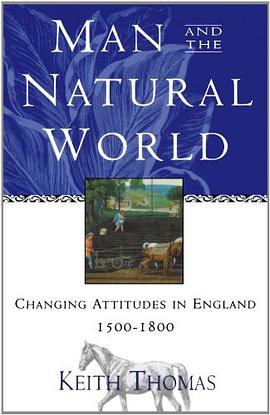
Throughout the ages man has struggled with his perceived place in the natural world. The idea of humans cultivating the Earth to suit specific needs is one of the greatest points of contention in this struggle. For how would have civilization progressed, if not by the clearance of the forests, the cultivation of the soil, and the conservation of wild landscape into human settlement? Yet what of the healing powers of unexploited nature, its long-term importance in the perpetuation of human civilization, and the inherent beauty of wild scenery? At no time were these questions addressed as pointedly and with such great consequence as in England between the sixteenth and late eighteenth centuries. "Between 1500 and 1800 there occurred a whole cluster of changes in the way in which men and women, at all social levels, perceived and classified the natural world around them," explains Keith Thomas. "New sensibilities arose toward animals, plants, and landscape. The relationship of man to other species was redefined; and his right to exploit those species for his own advantage was sharply challenged."
Man and the Natural World aims not just to explain present interest in preserving the environment and protecting the rights of animals, but to reconstruct an earlier mental world. Thomas seeks to expose the assumptions beneath the perceptions, reasonings, and feelings of the inhabitants of early modern England toward the animals, birds, vegetation, and physical landscape among which they spent their lives, often in conditions of proximity which are now difficult for us to appreciate. It was a time when a conviction of man's ascendancy over the natural world gave way to a new concern for the environment and sense of kinship with other species. Here, for example, Thomas illustrates the changing attitudes toward the woodlands. John Morton observed in 1712, "In a country full of civilized inhabitants" timber could not be "suffered to grow. It must give way to fields and pastures, which are of more immediate use and concern to life." Shortly thereafter, in 1763, Edwin Lascelles pronounced the "The beauty of a country consists chiefly in the wood." People's relationships with animals were also in the process of dramatic change as seen in their growing obsession with pet keeping. The use of human names for animals, the fact that pets were rarely eaten, though not for gastronomic reasons, and pets being included in family portraits and often fed better than the servants all demonstrated a major shift in man's position on human uniqueness.
The issues raised in this fascinating work are even more alive today than they were just ten years ago. Preserving the environment, saving the rain forests, and preventing the extinction of species may seem like fairly recent concerns, however, Man and the Natural World explores how these ideas took root long ago. These issues have much to offer not only environmental activists, but historians as well, for it is impossible to disentangle what the people of the past thought about plants and animals from what they thought about themselves.
Man and the Natural World aims not just to explain present interest in preserving the environment and protecting the rights of animals, but to reconstruct an earlier mental world. Thomas seeks to expose the assumptions beneath the perceptions, reasonings, and feelings of the inhabitants of early modern England toward the animals, birds, vegetation, and physical landscape among which they spent their lives, often in conditions of proximity which are now difficult for us to appreciate. It was a time when a conviction of man's ascendancy over the natural world gave way to a new concern for the environment and sense of kinship with other species. Here, for example, Thomas illustrates the changing attitudes toward the woodlands. John Morton observed in 1712, "In a country full of civilized inhabitants" timber could not be "suffered to grow. It must give way to fields and pastures, which are of more immediate use and concern to life." Shortly thereafter, in 1763, Edwin Lascelles pronounced the "The beauty of a country consists chiefly in the wood." People's relationships with animals were also in the process of dramatic change as seen in their growing obsession with pet keeping. The use of human names for animals, the fact that pets were rarely eaten, though not for gastronomic reasons, and pets being included in family portraits and often fed better than the servants all demonstrated a major shift in man's position on human uniqueness.
The issues raised in this fascinating work are even more alive today than they were just ten years ago. Preserving the environment, saving the rain forests, and preventing the extinction of species may seem like fairly recent concerns, however, Man and the Natural World explores how these ideas took root long ago. These issues have much to offer not only environmental activists, but historians as well, for it is impossible to disentangle what the people of the past thought about plants and animals from what they thought about themselves.