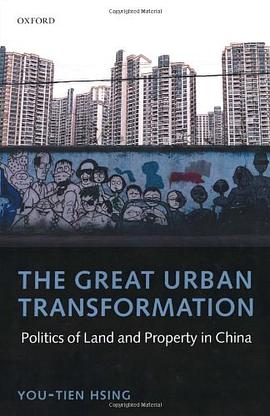
The Great Urban Transformation 豆瓣
作者:
You-tien Hsing
出版社:
Oxford University Press
2010
- 3
Product Description
As China is transformed, relations between society, the state, and the city have become central. The Great Urban Transformation investigates what is happening in cities, the urban edges, and the rural fringe in order to explain these relations. In the inner city of major metropolitan centers, municipal governments battle high-ranking state agencies to secure land rents from redevelopment projects, while residents mobilize to assert property and residential rights. At the urban edge, as metropolitan governments seek to extend control over their rural hinterland through massive-scale development projects, villagers strategize to profit from the encroaching property market. At the rural fringe, township leaders become brokers of power and property between the state bureaucracy and villages, while large numbers of peasants are dispossessed, dispersed, and deterritorialized, and their mobilizational capacity is consequently undermined.
The Great Urban Transformation explores these issues, and provides an integrated analysis of the city and the countryside, elite politics and grassroots activism, legal-economic and socio-political issues of property rights, and the role of the state and the market in the property market.
About the Author
You-tien Hsing is Associate Professor of Geography at University of California at Berkeley. She is the author of Making Capitalism in China: The Taiwan Connection (1998, Oxford University Press) and co-editor (with Ching Kwan Lee) of Reclaiming Chinese Society: Politics of Redistribution, Recognition, and Representation (Forthcoming, Routledge).
As China is transformed, relations between society, the state, and the city have become central. The Great Urban Transformation investigates what is happening in cities, the urban edges, and the rural fringe in order to explain these relations. In the inner city of major metropolitan centers, municipal governments battle high-ranking state agencies to secure land rents from redevelopment projects, while residents mobilize to assert property and residential rights. At the urban edge, as metropolitan governments seek to extend control over their rural hinterland through massive-scale development projects, villagers strategize to profit from the encroaching property market. At the rural fringe, township leaders become brokers of power and property between the state bureaucracy and villages, while large numbers of peasants are dispossessed, dispersed, and deterritorialized, and their mobilizational capacity is consequently undermined.
The Great Urban Transformation explores these issues, and provides an integrated analysis of the city and the countryside, elite politics and grassroots activism, legal-economic and socio-political issues of property rights, and the role of the state and the market in the property market.
About the Author
You-tien Hsing is Associate Professor of Geography at University of California at Berkeley. She is the author of Making Capitalism in China: The Taiwan Connection (1998, Oxford University Press) and co-editor (with Ching Kwan Lee) of Reclaiming Chinese Society: Politics of Redistribution, Recognition, and Representation (Forthcoming, Routledge).