Principles of Computational Modelling in Neuroscience Douban
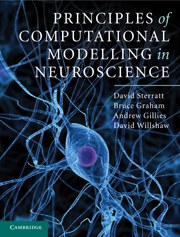
"The nervous system is made up of a large number of interacting elements. To understand how such a complex system functions requires the construction and analysis of computational models at many different levels. This book provides a step-by-step account of how to model the neuron and neural circuitry to understand the nervous system at all levels, from ion channels to networks. Starting with a simple model of the neuron as an electrical circuit, gradually more details are added to include the effects of neuronal morphology, synapses, ion channels and intracellular signaling. The principle of abstraction is explained through chapters on simplifying models, and how simplified models can be used in networks. This theme is continued in a final chapter on modeling the development of the nervous system. Requiring an elementary background in neuroscience and some high school mathematics, this textbook is an ideal basis for a course on computational neuroscience." (Amazon)
"This is a wonderful, clear and compelling text on mathematically-minded computational modelling in neuroscience. It is beautifully aimed at those engaged in capturing quantitatively, and thus simulating, complex neural phenomena at multiple spatial and temporal scales, from intracellular calcium dynamics and stochastic ion channels, through compartmental modelling, all the way to aspects of development. It takes particular care to define the processes, potential outputs and even some pitfalls of modelling; and can be recommended for containing the key lessons and pointers for people seeking to build their own computational models. By eschewing issues of coding and information processing, it largely hews to concrete biological data, and it nicely avoids sacrificing depth for breadth. It is very suitably pitched as a Master's level text, and its two appendices, on mathematical methods and software resources, will rapidly become dog-eared."
Peter Dayan, University College London
"This is a wonderful, clear and compelling text on mathematically-minded computational modelling in neuroscience. It is beautifully aimed at those engaged in capturing quantitatively, and thus simulating, complex neural phenomena at multiple spatial and temporal scales, from intracellular calcium dynamics and stochastic ion channels, through compartmental modelling, all the way to aspects of development. It takes particular care to define the processes, potential outputs and even some pitfalls of modelling; and can be recommended for containing the key lessons and pointers for people seeking to build their own computational models. By eschewing issues of coding and information processing, it largely hews to concrete biological data, and it nicely avoids sacrificing depth for breadth. It is very suitably pitched as a Master's level text, and its two appendices, on mathematical methods and software resources, will rapidly become dog-eared."
Peter Dayan, University College London