Typology
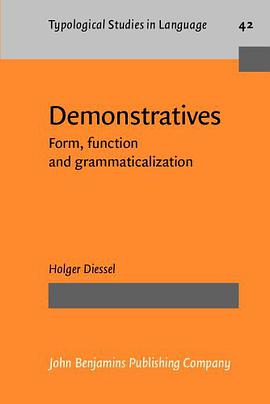
Demonstratives 豆瓣
作者: Holger Diessel 出版社: John Benjamins Publishing Company 1999
All languages have demonstratives, but their form, meaning and use vary tremendously across the languages of the world. This book presents the first large- scale analysis of demonstratives from a cross-linguistic and diachronic perspective. The first part of the book analyzes demonstratives from a synchronic point of view, examining their morphological structures, semantic features, syntactic functions, and pragmatic uses in spoken and written discourse. The second part concentrates on diachronic issues, in particular on the development of demonstratives into grammatical markers. Across languages demonstratives provide a frequent historical source for definite articles, relative and third person pronouns, nonverbal copulas, sentence connectives, directional preverbs, focus markers, expletives, and many other grammatical markers. The book describes the different mechanisms by which demonstratives grammaticalize and argues that the evolution of grammatical markers from demonstratives is crucially distinct from other cases of grammaticalization.
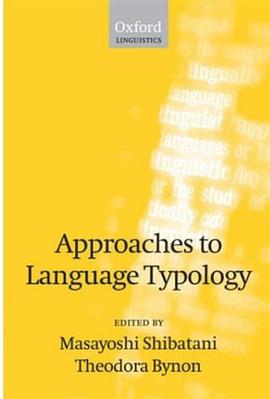
Approaches to Language Typology 豆瓣
作者: Shibatani, Masayoshi; Bynon, Theodora; 出版社: Oxford University Press, USA 1999 - 6
What do all languages have in common, and what gives each language its individuality? Language typology, which has developed in response to these fundamental questions, is concerned with the construction of theoretical frameworks capable of delimiting the range of possible human languages and of capturing constraints on cross-linguistic variation. Language typology is a major concern of all contemporary schools of linguistics, yet a coherent image of the field is difficult to form because of the diversity of theoretical orientations and practical methodologies. This collection brings together for the first time original contributions from major schools of typological research, from the Prague School to the Generative Grammar tradition. Leading scholars offer first-hand accounts of the theoretical foundations and substantive findings of their particular school of thought, clarifying basic assumptions which are often not explicitly stated in the literature. The collection as a whole provices both a survey of the place of individual typological schools in the historiography of the subject and a comprehensive account of the present state of language typology in an international context. It gives an overview of both the underlying unity of and the differences in the methods employed in the field.