architecture+theory
Architectural Principles in the Age of Humanism 豆瓣
作者: Rudolf Wittkower 出版社: W. W. Norton & Company 1971 - 9
"Professor Wittkower's....studies of humanist architecture are masterpieces of scholarship."-Sir Kenneth Clark, Architectural Review.

A fourth edition of the forty-year-old classic.

Focusing on the principal architects of that time-from Alberti to Palladio-this bestselling classic explains the true significance of certain architectural forms, bringing to light the connections between the architecture and culture of the period. With publication scheduled to coincide with that of Architectonics of Humanism, this important reference is superbly reproduced in a new, large square format.

The late RUDOLF WITTKOWER was a college professor and eminent scholar residing in London, England.
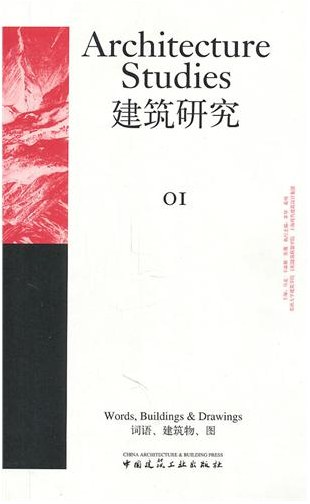
建筑研究 01 豆瓣
作者: [英]马克·卡森斯 / 陈薇 出版社: 中国建筑工业出版社 2011 - 5
《建筑研究》为年刊,是“当代建筑理论论坛”的研究成果。
第一期《建筑研究》的内容,主要来自2010年3月30日至4月4日,在南京和上海两地举行的第一节“当代建筑理论论坛”国际研讨会。研讨会包括两个中心议题,“词语与建筑物”和“建筑再现与绘图”。
Notes on the Synthesis of Form 豆瓣
作者: Christopher Alexander 出版社: Harvard University Press 1964 - 10
"These notes are about the process of design: the process of inventing things which display new physical order, organization, form, in response to function." This book, opening with these words, presents an entirely new theory of the process of design. In the first part of the book, Mr. Alexander discusses the process by which a form is adapted to the context of human needs and demands that has called it into being. He shows that such an adaptive process will be successful only if it proceeds piecemeal instead of all at once. It is for this reason that forms from traditional unselfconscious cultures, molded not by designers but by the slow pattern of changes within tradition, are so beautifully organized and adapted. When the designer, in our own self-conscious culture, is called on to create a form that is adapted to its context he is unsuccessful, because the preconceived categories out of which he builds his picture of the problem do not correspond to the inherent components of the problem, and therefore lead only to the arbitrariness, willfulness, and lack of understanding which plague the design of modern buildings and modern cities. In the second part, Mr. Alexander presents a method by which the designer may bring his full creative imagination into play, and yet avoid the traps of irrelevant preconception. He shows that, whenever a problem is stated, it is possible to ignore existing concepts and to create new concepts, out of the structure of the problem itself, which do correspond correctly to what he calls the subsystems of the adaptive process. By treating each of these subsystems as a separate subproblem, the designer can translate the new concepts into form. The form, because of the process, will be well-adapted to its context, non-arbitrary, and correct. The mathematics underlying this method, based mainly on set theory, is fully developed in a long appendix. Another appendix demonstrates the application of the method to the design of an Indian village.
Architecture Theory since 1968 豆瓣
作者: K.Michael Hays 出版社: The MIT Press 2000 - 2
In the discussion of architecture, there is a prevailing sentiment that, since 1968, cultural production in its traditional sense can no longer be understood to rise spontaneously, as a matter of social course, but must now be constructed through ever more self-conscious theoretical procedures. The development of interpretive modes of various stripes--post-structuralist, Marxian, phenomenological, psychoanalytic, as well as others dissenting or eccentric--has given scholars a range of tools for rethinking architecture in relation to other fields and for reasserting architectures general importance in intellectual discourse.This anthology presents forty-seven of the primary texts of architecture theory, introducing each with an explication of the concepts and categories necessary for its understanding and evaluation. It also presents twelve documents of projects or events that had major theoretical repercussions for the period. Several of the essays appear here in English for the first time.Contributors : Diana Agrest, Stanford Anderson, Archizoom, George Baird, Jennifer Bloomer, Massimo Cacciari, Jean-Louis Cohen, Beatriz Colomina, Alan Colquhoun, Maurice Culot, Jacques Derrida, Ignasi de Sola-Morales, Peter Eisenman, Robin Evans, Michel Foucault, Kenneth Frampton, Mario Gandelsonas, Frank Gehry, Jurgen Habermas, John Hejduk, Denis Hollier, Bernard Huet, Catherine Ingraham, Fredric Jameson, Charles A. Jencks, Jeffrey Kipnis, Fred Koetter, Rem Koolhaas, Leon Krier, Sanford Kwinter, Henri Lefebvre, Daniel Libeskind, Mary McLeod, Alberto Perez-Gomez, Jose Quetglas, Aldo Rossi, Colin Rowe, Massimo Scolari, Denise Scott Brown, Robert Segrest, Jorge Silvetti, Robert Somol, Martin Steinmann, Robert A. M. Stern, James Stirling, Manfredo Tafuri, Georges Teyssot, Bernard Tschumi, Anthony Vidler, Paul Virilio, Mark Wigley.
The Projective Cast 豆瓣
作者: Robin Evans 出版社: The MIT Press 2000 - 8
Winner of the 1997 Alice Davis Hitchcock MedallionAnyone reviewing the history of architectural theory, Robin Evans observes, would have to conclude that architects do not produce geometry, but rather consume it. In this long-awaited book, completed shortly before its author's death, Evans recasts the idea of the relationship between geometry and architecture, drawing on mathematics, engineering, art history, and aesthetics to uncover processes in the imagining and realizing of architectural form. He shows that geometry does not always play a stolid and dormant role but, in fact, may be an active agent in the links between thinking and imagination, imagination and drawing, drawing and building. He suggests a theory of architecture that is based on the many transactions between architecture and geometry as evidenced in individual buildings, largely in Europe, from the fifteenth to the twentieth century.From the Henry VII chapel at Westminster Abbey to Le Corbusier's Ronchamp, from Raphael's S. Eligio and the work of Piero della Francesca and Philibert Delorme to Guarino Guarini and the painters of cubism, Evans explores the geometries involved, asking whether they are in fact the stable underpinnings of the creative, intuitive, or rhetorical aspects of architecture. In particular he concentrates on the history of architectural projection, the geometry of vision that has become an internalized and pervasive pictorial method of construction and that, until now, has played only a small part in the development of architectural theory.Evans describes the ambivalent role that pictures play in architecture and urges resistance to the idea that pictures provide all that architects need, suggesting that there is much more within the scope of the architect's vision of a project than what can be drawn. He defines the different fields of projective transmission that concern architecture, and investigates the ambiguities of projection and the interaction of imagination with projection and its metaphors.