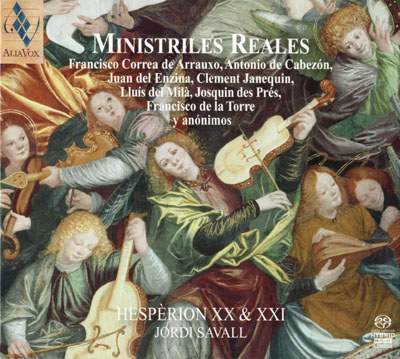
Ministriles Reales Douban
萨瓦尔 Jordi Savall
/
HESPÈRION XX & XXI
genre:
Classical
release date 2009-01-01
publisher:
Alia Vox
Release notes
ROYAL MINSTRELS 1450 - 1690 Birth and development of the Renaissance and pre-Baroque instrumental ensemble of the Golden Age.
One of the most interesting new developments on the 15th and 16th century musical scene was the affirmation and development of instrumental music as an independent language, with the flourishing of new forms of musical expression based on vocal forms or improvisation and dance. Just as in 15th-16th century Italy, vocal song inspired the development of Canzoni da sonare and Madrigali passeggiati, from the middle of the 15th century, during the heyday of Alfonso V the Magnanimous’s newly installed court in Naples, the courts that had close contacts with Italian culture, such as those of Flanders and Catalonia-Aragon, saw the emergence a new and increasingly specific repertory which, during the Golden Age of the 15th and 16th centuries, was to become popular and spread throughout the Iberian peninsula and, particularly at the courts of Castile, Aragon, Catalonia and Valencia, as well as those countries where the latter maintained a political presence, such as Flanders, Naples and Sicily. At the same time, it is no mere coincidence that the first paintings and frescoes depicting early versions of the viola da gamba, one of the first typically Renaissance instruments, are to be found in various forms in the region of Valencia and Gandía, two cities which had close ties with Italian culture.
Our professional involvement with this repertory goes back to our early discoveries and experiences (1966-67) with the Barcelona-based ensemble ARS MUSICÆ (with Enric Gispert), followed by our studies, research and experimentation at the SCHOLA CANTORUM BASILIENSIS (1968-70), and later (in 1974) with the creation of HESPÈRION XX (with Montserrat Figueras, Hopkinson Smith and Lorenzo Alpert). During more than 40 years researching and reviving the musical legacy of the Hesperides (the name that the ancient Greeks gave to the Iberian and Italic peninsulas) in the company of our fellow musicians in HESPÈRION XX and, since 2001, HESPÈRION XXI, we have been able to trace the key significance and importance of the instrumental legacy of the ministriles, dating back to the mid-15th century, through works such as the different versions of the Hautes Danses (performed on wind instruments, with their predominantly brilliant, high-pitched sound) and the Basses danses (typically rendered by viol ensembles, with their deeper, more serious sound) which developed as improvisational counterpoint on the basis of Gregorian chant (“In exitu Israel”) or more popular melodies transformed into “cantus firmus”, such as “la Spagna”, “la Romanesca”, “Las Vacas”, the “Passamezzo” and “Mappa mundi”, not forgetting the fanfares peculiar to each individual court and city (“Dit le bourguynon”, “Vive le Roy”, “Propiñan de Melyor”, “Chiave, chiave”) and the popular dances (“Collinetto”, “La Perra mora”, “La Folia”), as well as those of courtly origin (Pavanes, Galliards, Saltarellos, etc.) to which the fantasias, tientos, batallas, diferencias and glosados were added from the middle of the 16th century.
In order to give a balanced picture of the early years of this process (1450-1550), for which there are few printed sources, we have added to the wonderful examples by Johannes Cornago, Hayne van Ghizeghem, Josquin des Prés and Bartolomé Ramos de Pareja a selection of villancicos and canciones from the 15th and the early 16th centuries, performed here in an instrumental version inspired in the masterly adaptations to be found in later publications by Luys de Narváez (1538), Diego Ortiz (Roma 1553), Luis Venegas de Henestrosa (1557), Tomás de Santa María (1565), Antonio and Hernando de Cabezón (1578).
Many of these works have featured as instrumental interludes in our recordings of Golden Age vocal music, and particularly in our albums devoted to the principal songbooks: Colombina, Juan del Enzina, Palacio, Calabria, Medinaceli and Sablonara. In this new programme on the repertory of the MINISTRILES REALES, they are heard together for the first time, thus forming an independent corpus, one in which the pieces are selected and grouped according to a contrasted musical concept respecting the musical space of each work, and ordered according to mainly chronological criteria. This approach serves further to highlight the originality, beauty and great variety of forms and styles of a repertory which is not only important in its own right, but also because it signals the birth and glorious development of a new art, that of las músicas para tañer (music to be played), an art which was to lay the foundations for the development throughout the 17th and 18th centuries of the extraordinarily rich instrumental chamber music and orchestral repertory.
JORDI SAVALL
Paris/Seoul, December, 2008
Translated by Jacqueline Minett
ROYAL MINSTRELS 1450 - 1690 Birth and development of the Renaissance and pre-Baroque instrumental ensemble of the Golden Age.
One of the most interesting new developments on the 15th and 16th century musical scene was the affirmation and development of instrumental music as an independent language, with the flourishing of new forms of musical expression based on vocal forms or improvisation and dance. Just as in 15th-16th century Italy, vocal song inspired the development of Canzoni da sonare and Madrigali passeggiati, from the middle of the 15th century, during the heyday of Alfonso V the Magnanimous’s newly installed court in Naples, the courts that had close contacts with Italian culture, such as those of Flanders and Catalonia-Aragon, saw the emergence a new and increasingly specific repertory which, during the Golden Age of the 15th and 16th centuries, was to become popular and spread throughout the Iberian peninsula and, particularly at the courts of Castile, Aragon, Catalonia and Valencia, as well as those countries where the latter maintained a political presence, such as Flanders, Naples and Sicily. At the same time, it is no mere coincidence that the first paintings and frescoes depicting early versions of the viola da gamba, one of the first typically Renaissance instruments, are to be found in various forms in the region of Valencia and Gandía, two cities which had close ties with Italian culture.
Our professional involvement with this repertory goes back to our early discoveries and experiences (1966-67) with the Barcelona-based ensemble ARS MUSICÆ (with Enric Gispert), followed by our studies, research and experimentation at the SCHOLA CANTORUM BASILIENSIS (1968-70), and later (in 1974) with the creation of HESPÈRION XX (with Montserrat Figueras, Hopkinson Smith and Lorenzo Alpert). During more than 40 years researching and reviving the musical legacy of the Hesperides (the name that the ancient Greeks gave to the Iberian and Italic peninsulas) in the company of our fellow musicians in HESPÈRION XX and, since 2001, HESPÈRION XXI, we have been able to trace the key significance and importance of the instrumental legacy of the ministriles, dating back to the mid-15th century, through works such as the different versions of the Hautes Danses (performed on wind instruments, with their predominantly brilliant, high-pitched sound) and the Basses danses (typically rendered by viol ensembles, with their deeper, more serious sound) which developed as improvisational counterpoint on the basis of Gregorian chant (“In exitu Israel”) or more popular melodies transformed into “cantus firmus”, such as “la Spagna”, “la Romanesca”, “Las Vacas”, the “Passamezzo” and “Mappa mundi”, not forgetting the fanfares peculiar to each individual court and city (“Dit le bourguynon”, “Vive le Roy”, “Propiñan de Melyor”, “Chiave, chiave”) and the popular dances (“Collinetto”, “La Perra mora”, “La Folia”), as well as those of courtly origin (Pavanes, Galliards, Saltarellos, etc.) to which the fantasias, tientos, batallas, diferencias and glosados were added from the middle of the 16th century.
In order to give a balanced picture of the early years of this process (1450-1550), for which there are few printed sources, we have added to the wonderful examples by Johannes Cornago, Hayne van Ghizeghem, Josquin des Prés and Bartolomé Ramos de Pareja a selection of villancicos and canciones from the 15th and the early 16th centuries, performed here in an instrumental version inspired in the masterly adaptations to be found in later publications by Luys de Narváez (1538), Diego Ortiz (Roma 1553), Luis Venegas de Henestrosa (1557), Tomás de Santa María (1565), Antonio and Hernando de Cabezón (1578).
Many of these works have featured as instrumental interludes in our recordings of Golden Age vocal music, and particularly in our albums devoted to the principal songbooks: Colombina, Juan del Enzina, Palacio, Calabria, Medinaceli and Sablonara. In this new programme on the repertory of the MINISTRILES REALES, they are heard together for the first time, thus forming an independent corpus, one in which the pieces are selected and grouped according to a contrasted musical concept respecting the musical space of each work, and ordered according to mainly chronological criteria. This approach serves further to highlight the originality, beauty and great variety of forms and styles of a repertory which is not only important in its own right, but also because it signals the birth and glorious development of a new art, that of las músicas para tañer (music to be played), an art which was to lay the foundations for the development throughout the 17th and 18th centuries of the extraordinarily rich instrumental chamber music and orchestral repertory.
JORDI SAVALL
Paris/Seoul, December, 2008
Translated by Jacqueline Minett