eng
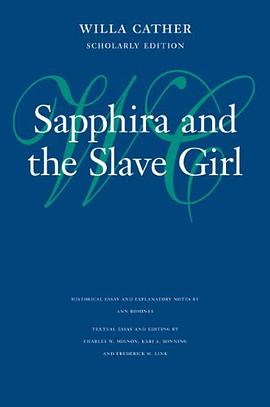
Sapphira and the Slave Girl (Willa Cather Scholarly Edition) 豆瓣
作者: Willa Cather 出版社: University of Nebraska Press 2009 - 7
Willa Cather's twelfth and final novel, "Sapphira and the Slave Girl," is her most intense fictional engagement with political and personal conflict. Set in Cather's Virginia birthplace in 1856, the novel draws on family and local history and the escalating conflicts of the last years of slavery--conflicts in which Cather's family members were deeply involved, both as slave owners and as opponents of slavery. Cather, at five years old, appears as a character in an unprecedented first-person epilogue. Tapping her earliest memories, Cather powerfully and sparely renders a Virginia world that is simultaneously beautiful and, as she said, "terrible." The historical essay and explanatory notes explore the novel's grounding in family, local, and national history; show how southern cultures continually shaped Cather's life and work, culminating with this novel; and trace the progress of Cather's research and composition during years of grief and loss that she described as the worst of her life. More early drafts, including manuscript fragments, are available for "Sapphira and the Slave Girl" than for any other Cather novel, and the revealing textual essay draws on this rich resource to provide new insights into Cather's composition process.
Washing the Brain - Metaphor and Hidden Ideology 豆瓣
作者: Prof. Dr. Andrew Goatly 出版社: John Benjamins Publishing Company 2008 - 7
Contemporary metaphor theory has recently begun to address the relation between metaphor, culture and ideology. In this wide-ranging book, Andrew Goatly, using lexical data from his database Metalude, investigates how conceptual metaphor themes construct our thinking and social behaviour in fields as diverse as architecture, engineering, education, genetics, ecology, economics, politics, industrial time-management, medicine, immigration, race, and sex. He argues that metaphor themes are created not only through the universal body but also through cultural experience, so that an apparently universal metaphor such as event-structure as realized in English grammar is, in fact, culturally relative, compared with e.g. the construal of 'cause and effect' in the Algonquin language Blackfoot. Moreover, event-structure as a model is both scientifically reactionary and, as the basis for technological mega-projects, has proved environmentally harmful. Furthermore, the ideologies of early capitalism created or exploited a selection of metaphor themes historically traceable through Hobbes, Hume, Smith, Malthus and Darwin. These metaphorical concepts support neo-Darwinian and neo-conservative ideologies apparent at the beginning of the 21st century, ideologies underpinning our social and environmental crises. The conclusion therefore recommends skepticism of metaphor s reductionist tendencies.