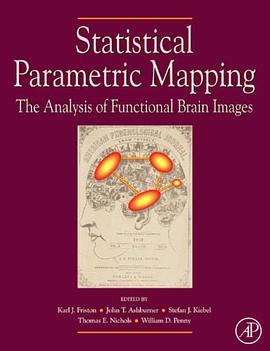
Statistical Parametric Mapping 豆瓣
作者:
Karl J. Friston
/
John T. Ashburner
…
出版社:
Academic Press
2006
Book Description
Describes the theoretical background behind Statistical Parametric Mapping and provides operational guidelines and technical details on data analysis.
Product Description
In an age where the amount of data collected from brain imaging is increasing constantly, it is of critical importance to analyse those data within an accepted framework to ensure proper integration and comparison of the information collected. This book describes the ideas and procedures that underlie the analysis of signals produced by the brain. The aim is to understand how the brain works, in terms of its functional architecture and dynamics. This book provides the background and methodology for the analysis of all types of brain imaging data, from functional magnetic resonance imaging to magnetoencephalography. Critically, Statistical Parametric Mapping provides a widely accepted conceptual framework which allows treatment of all these different modalities. This rests on an understanding of the brain's functional anatomy and the way that measured signals are caused experimentally. The book takes the reader from the basic concepts underlying the analysis of neuroimaging data to cutting edge approaches that would be difficult to find in any other source. Critically, the material is presented in an incremental way so that the reader can understand the precedents for each new development. This book will be particularly useful to neuroscientists engaged in any form of brain mapping; who have to contend with the real-world problems of data analysis and understanding the techniques they are using. It is primarily a scientific treatment and a didactic introduction to the analysis of brain imaging data. It can be used as both a textbook for students and scientists starting to use the techniques, as well as a reference for practicing neuroscientists. The book also serves as a companion to the software packages that have been developed for brain imaging data analysis.
* An essential reference and companion for users of the SPM software
* Provides a complete description of the concepts and procedures entailed by the analysis of brain images
* Offers full didactic treatment of the basic mathematics behind the analysis of brain imaging data
* Stands as a compendium of all the advances in neuroimaging data analysis over the past decade
* Adopts an easy to understand and incremental approach that takes the reader from basic statistics to state of the art approaches such as Variational Bayes
* Structured treatment of data analysis issues that links different modalities and models
* Includes a series of appendices and tutorial-style chapters that makes even the most sophisticated approaches accessible
From the Back Cover
In an age where the amount of data collected from brain imaging is increasing constantly, it is of critical importance to analyse those data within an accepted framework to ensure proper integration and comparison of the information collected. This book describes the ideas and procedures that underlie the analysis of signals produced by the brain. The aim is to understand how the brain works, in terms of its functional architecture and dynamics. This book provides the background and methodology for the analysis of all types of brain imaging data, from functional magnetic resonance imaging to magnetoencephalography. Critically, Statistical Parametric Mapping provides a widely accepted conceptual framework which allows treatment of all these different modalities. This rests on an understanding of the brain's functional anatomy and the way that measured signals are caused experimentally. The book takes the reader from the basic concepts underlying the analysis of neuroimaging data to cutting edge approaches that would be difficult to find in any other source. Critically, the material is presented in an incremental way so that the reader can understand the precedents for each new development. This book will be particularly useful to neuroscientists engaged in any form of brain mapping; who have to contend with the real-world problems of data analysis and understanding the techniques they are using. It is primarily a scientific treatment and a didactic introduction to the analysis of brain imaging data. It can be used as both a textbook for students and scientists starting to use the techniques, as well as a reference for practicing neuroscientists. The book also serves as a companion to the software packages that have been developed for brain imaging data analysis.
Key Features:
* An essential reference and companion for users of the SPM software
* Provides a complete description of the concepts and procedures entailed by the analysis of brain images
* Offers full didactic treatment of the basic mathematics behind the analysis of brain imaging data
* Stands as a compendium of all the advances in neuroimaging data analysis over the past decade
* Adopts an easy to understand and incremental approach that takes the reader from basic statistics to state of the art approaches such as Variational Bayes
* Structured treatment of data analysis issues that links different modalities and models
* Includes a series of appendices and tutorial-style chapters that makes even the most sophisticated approaches accessible
Describes the theoretical background behind Statistical Parametric Mapping and provides operational guidelines and technical details on data analysis.
Product Description
In an age where the amount of data collected from brain imaging is increasing constantly, it is of critical importance to analyse those data within an accepted framework to ensure proper integration and comparison of the information collected. This book describes the ideas and procedures that underlie the analysis of signals produced by the brain. The aim is to understand how the brain works, in terms of its functional architecture and dynamics. This book provides the background and methodology for the analysis of all types of brain imaging data, from functional magnetic resonance imaging to magnetoencephalography. Critically, Statistical Parametric Mapping provides a widely accepted conceptual framework which allows treatment of all these different modalities. This rests on an understanding of the brain's functional anatomy and the way that measured signals are caused experimentally. The book takes the reader from the basic concepts underlying the analysis of neuroimaging data to cutting edge approaches that would be difficult to find in any other source. Critically, the material is presented in an incremental way so that the reader can understand the precedents for each new development. This book will be particularly useful to neuroscientists engaged in any form of brain mapping; who have to contend with the real-world problems of data analysis and understanding the techniques they are using. It is primarily a scientific treatment and a didactic introduction to the analysis of brain imaging data. It can be used as both a textbook for students and scientists starting to use the techniques, as well as a reference for practicing neuroscientists. The book also serves as a companion to the software packages that have been developed for brain imaging data analysis.
* An essential reference and companion for users of the SPM software
* Provides a complete description of the concepts and procedures entailed by the analysis of brain images
* Offers full didactic treatment of the basic mathematics behind the analysis of brain imaging data
* Stands as a compendium of all the advances in neuroimaging data analysis over the past decade
* Adopts an easy to understand and incremental approach that takes the reader from basic statistics to state of the art approaches such as Variational Bayes
* Structured treatment of data analysis issues that links different modalities and models
* Includes a series of appendices and tutorial-style chapters that makes even the most sophisticated approaches accessible
From the Back Cover
In an age where the amount of data collected from brain imaging is increasing constantly, it is of critical importance to analyse those data within an accepted framework to ensure proper integration and comparison of the information collected. This book describes the ideas and procedures that underlie the analysis of signals produced by the brain. The aim is to understand how the brain works, in terms of its functional architecture and dynamics. This book provides the background and methodology for the analysis of all types of brain imaging data, from functional magnetic resonance imaging to magnetoencephalography. Critically, Statistical Parametric Mapping provides a widely accepted conceptual framework which allows treatment of all these different modalities. This rests on an understanding of the brain's functional anatomy and the way that measured signals are caused experimentally. The book takes the reader from the basic concepts underlying the analysis of neuroimaging data to cutting edge approaches that would be difficult to find in any other source. Critically, the material is presented in an incremental way so that the reader can understand the precedents for each new development. This book will be particularly useful to neuroscientists engaged in any form of brain mapping; who have to contend with the real-world problems of data analysis and understanding the techniques they are using. It is primarily a scientific treatment and a didactic introduction to the analysis of brain imaging data. It can be used as both a textbook for students and scientists starting to use the techniques, as well as a reference for practicing neuroscientists. The book also serves as a companion to the software packages that have been developed for brain imaging data analysis.
Key Features:
* An essential reference and companion for users of the SPM software
* Provides a complete description of the concepts and procedures entailed by the analysis of brain images
* Offers full didactic treatment of the basic mathematics behind the analysis of brain imaging data
* Stands as a compendium of all the advances in neuroimaging data analysis over the past decade
* Adopts an easy to understand and incremental approach that takes the reader from basic statistics to state of the art approaches such as Variational Bayes
* Structured treatment of data analysis issues that links different modalities and models
* Includes a series of appendices and tutorial-style chapters that makes even the most sophisticated approaches accessible