semiotics
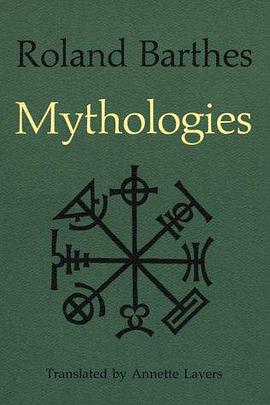
Mythologies 豆瓣
作者: Barthes Roland 译者: Annette Lavers 出版社: Hill & Wang 1972 - 1
"[Mythologies] illustrates the beautiful generosity of Barthes's progressive interest in the meaning (his word is signification) of practically everything around him, not only the books and paintings of high art, but also the slogans, trivia, toys, food, and popular rituals (cruises, striptease, eating, wrestling matches) of contemporary life . . . For Barthes, words and objects have in common the organized capacity to say something; at the same time, since they are signs, words and objects have the bad faith always to appear natural to their consumer, as if what they say is eternal, true, necessary, instead of arbitrary, made, contingent. Mythologies finds Barthes revealing the fashioned systems of ideas that make it possible, for example, for 'Einstein's brain' to stand for, be the myth of, 'a genius so lacking in magic that one speaks about his thought as a functional labor analogous to the mechanical making of sausages.' Each of the little essays in this book wrenches a definition out of a common but constructed object, making the object speak its hidden, but ever-so-present, reservoir of manufactured sense."--Edward W. Said

This text refers to the Paperback edition.
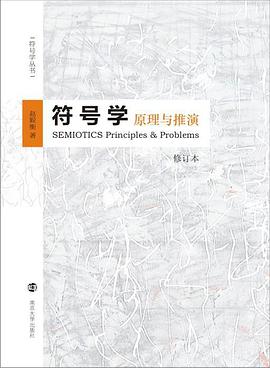
符号学 豆瓣
8.9 (9 个评分) 作者: 赵毅衡 出版社: 南京大学出版社 2016 - 1
本书分为上下两编,原理编扩展了一百年来符号学发展的理论基础,融合中西方符号学理论,建立一个可用于分析人类意义活动的符号学体系;推演编具体讨论了符号在人类文化中扮演的复杂作用,让读者理论与应用兼得。该著作是应有符号学理论分析文化的典范。符号学作为文科公分母,必须应用于更为广大的文化及多媒介文本。这本著作强调创新,也强调符号学理论的分析应用,将独创的符号学理论系统地应用到文化研究。
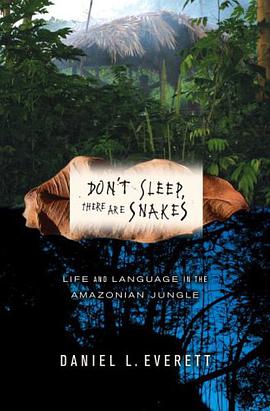
Don't Sleep, There Are Snakes 豆瓣
作者: Daniel L. Everett 出版社: Vintage; 1 edition 2008 - 11
SignatureReviewed by Christine KenneallyThe ways language and thought intertwine have long intrigued scientists. Does language shape the way we see the world? Does the world influence the structure of language? Do we think in words? Such lofty questions pondered in many an ivory tower would go unanswered without the mostly anonymous work of field linguists. These scholars venture into isolated communities and wrestle with culture shock, broken tape recorders and dysentery—all to learn an unfamiliar language from the ground up. Their work is painstaking, and no matter how smart or how educated they are, their projects must begin with the most elementary communicative tactics—they point at a rock or a tree or a bird, and whether they are in Australia's Western Desert, the remote islands of Indonesia or the jungles of Brazil, their interlocutor will respond, rock or tree or bird in the native tongue. Dan Everett's life as a field linguist began when he entered a Pirahã village in the Amazonian jungle in December 1977. After being greeted by a happy, chattering crowd, he walked over to a man cooking on a small fire. First, he tapped his own chest and said, Daniel, then he pointed at the animal being cooked on the fire. Káixihí, said the man. Everett pointed at a stick. Xií said the man. Everett dropped the stick and said, I drop the xii. Xií xi bigí kíobíi, his new friend replied, meaning stick it ground falls. Thus began 30 years of dedication to the Pirahã and their native tongue, a mystifying system of sound and rules unrelated to any other language in the world. In this fascinating and candid account of life with the Pirahã, Everett describes how he learned to speak fluent Pirahã (pausing occasionally to club the snakes that harassed him in his Amazonian office). He also explains his discoveries about the language—findings that have kicked off more than one academic brouhaha. Everett learned that Pirahã does not use what are supposed to be universal aspects of grammar, an observation that runs counter to linguistic dogma about how culture, the brain and language connect. For Everett, Pirahã is evidence that culture plays a crucial and previously unacknowledged role in the creation of language.Everett's life with the Pirahã cost him dearly. He almost lost two family members to malaria, and his first marriage broke down after years of highly productive shared field work. But life in the Amazon taught him a great deal about human nature, too, perhaps more about his own than that of the Pirahã. Everett began his linguistic work as a Christian missionary, but the Pirahã were marvelously impervious to his promise of a life with Jesus. They pointed out that Everett simply had no proof for the supernatural world he described, and in the end he found himself agreeing with them. He left the church, choosing a world that more honestly integrated his goals as a scholar with the world view of his Pirahã friends—one where evidence matters. (Nov. 11)Christine Kenneally is the author of The First Word: The Search for the Origins of Language, a finalist for the L.A. Times Book Prize.
Copyright © Reed Business Information, a division of Reed Elsevier Inc. All rights reserved. --This text refers to the Hardcover edition.