机器学习
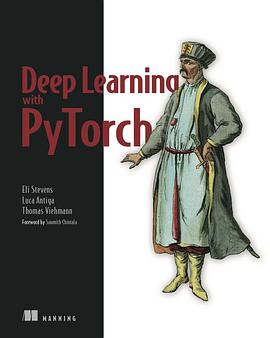
Deep Learning with PyTorch 豆瓣 Goodreads
作者: Eli Stevens / Luca Antiga Manning Publications 2020 - 6
Deep Learning with PyTorch teaches you how to implement deep learning algorithms with Python and PyTorch. This book takes you into a fascinating case study: building an algorithm capable of detecting malignant lung tumors using CT scans. As the authors guide you through this real example, you'll discover just how effective and fun PyTorch can be. After a quick introduction to the deep learning landscape, you'll explore the use of pre-trained networks and start sharpening your skills on working with tensors. You'll find out how to represent the most common types of data with tensors and how to build and train neural networks from scratch on practical examples, focusing on images and sequences.
After covering the basics, the book will take you on a journey through larger projects. The centerpiece of the book is a neural network designed for cancer detection. You'll discover ways for training networks with limited inputs and start processing data to get some results. You'll sift through the unreliable initial results and focus on how to diagnose and fix the problems in your neural network. Finally, you'll look at ways to improve your results by training with augmented data, make improvements to the model architecture, and perform other fine tuning.
what's inside
Using the PyTorch tensor API
Understanding automatic differentiation in PyTorch
Training deep neural networks
Monitoring training and visualizing results
Implementing modules and loss functions
Loading data in Python for PyTorch
Interoperability with NumPy
Deploying a PyTorch model for inference
2020年7月7日 在读 PyTorch
@PyTorch
·
6h
The full version of the Deep Learning with PyTorch book from Luca Antiga, Eli Stevens, and Thomas Viehmann is now available! New chapters include in-depth real-world examples and production deployment. Grab a free digital copy on:
AI 机器学习 计算机科学 2020
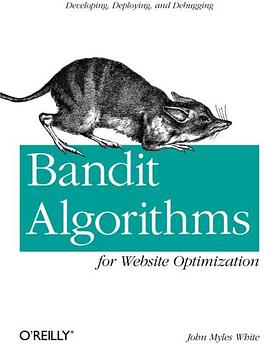
Bandit Algorithms for Website Optimization 豆瓣
作者: John Myles White O'Reilly Media 2013 - 1
This book shows you how to run experiments on your website using A/B testing - and then takes you a huge step further by introducing you to bandit algorithms for website optimization. Author John Myles White shows you how this family of algorithms can help you boost website traffic, convert visitors to customers, and increase many other measures of success. This is the first developer-focused book on bandit algorithms, which have previously only been described in research papers. You'll learn about several simple algorithms you can deploy on your own websites to improve your business including the epsilon-greedy algorithm, the UCB algorithm and a contextual bandit algorithm. All of these algorithms are implemented in easy-to-follow Python code and be quickly adapted to your business's specific needs. You'll also learn about a framework for testing and debugging bandit algorithms using Monte Carlo simulations, a technique originally developed by nuclear physicists during World War II. Monte Carlo techniques allow you to decide whether A/B testing will work for your business needs or whether you need to deploy a more sophisticated bandits algorithm.
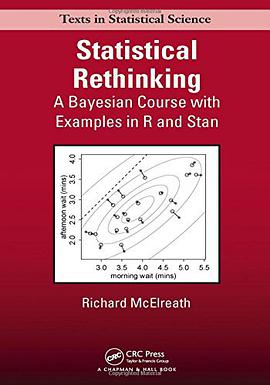
Statistical Rethinking 豆瓣
作者: Richard McElreath Chapman and Hall/CRC 2015
Statistical Rethinking: A Bayesian Course with Examples in R and Stan builds readers’ knowledge of and confidence in statistical modeling. Reflecting the need for even minor programming in today’s model-based statistics, the book pushes readers to perform step-by-step calculations that are usually automated. This unique computational approach ensures that readers understand enough of the details to make reasonable choices and interpretations in their own modeling work.
The text presents generalized linear multilevel models from a Bayesian perspective, relying on a simple logical interpretation of Bayesian probability and maximum entropy. It covers from the basics of regression to multilevel models. The author also discusses measurement error, missing data, and Gaussian process models for spatial and network autocorrelation.
By using complete R code examples throughout, this book provides a practical foundation for performing statistical inference. Designed for both PhD students and seasoned professionals in the natural and social sciences, it prepares them for more advanced or specialized statistical modeling.
统计学习方法(第2版) 豆瓣
8.0 (6 个评分) 作者: 李航 清华大学出版社 2019 - 5
统计学习方法即机器学习方法,是计算机及其应用领域的一门重要学科。本书分为监督学 习和无监督学习两篇,全面系统地介绍了统计学习的主要方法。包括感知机、k 近邻法、朴素贝叶斯法、决策树、逻辑斯谛回归与最大熵模型、支持向量机、提升方法、EM 算法、隐马尔可夫模型和条件随机场,以及聚类方法、奇异值分解、主成分分析、潜在语义分析、概率潜在语义分析、马尔可夫链蒙特卡罗法、潜在狄利克雷分配和 PageRank 算法等。除有关统计学习、监督学习和无监督学习的概论和总结的四章外,每章介绍一种方法。叙述力求从具体问题或实例入手, 由浅入深,阐明思路,给出必要的数学推导,便于读者掌握统计学习方法的实质,学会运用。 为满足读者进一步学习的需要,书中还介绍了一些相关研究,给出了少量习题,列出了主要参考文献。 本书是统计机器学习及相关课程的教学参考书,适用于高等院校文本数据挖掘、信息检索及自然语言处理等专业的大学生、研究生,也可供从事计算机应用相关专业的研发人员参考。
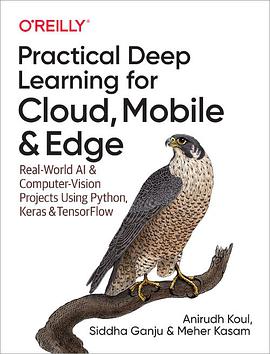
Practical Deep Learning for Cloud and Mobile 豆瓣
作者: Anirudh Koul / Siddha Ganju O'Reilly Media 2019 - 11
Whether you’re a software engineer aspiring to enter the world of artificial intelligence, a veteran data scientist, or a hobbyist with a simple dream of making the next viral AI app, you might have wondered where do I begin? This step-by-step guide teaches you how to build practical applications using deep neural networks for the cloud and mobile using a hands-on approach.
Relying on years of industry experience transforming deep learning research into award-winning applications, Anirudh Koul, Siddha Ganju, and Meher Kasam guide you through the process of converting an idea into something that people can use in the real world. Train, optimize, and deploy computer vision models with Keras, TensorFlow, CoreML, TensorFlow Lite, and MLKit, rapidly taking your system from zero to production quality.
Develop AI applications for the desktop, cloud, smartphones, browser, and smart robots using Raspberry Pi, Jetson Nano, and Google Coral
Perform Object Classification, Detection, Segmentation in real-time
Learn by building examples such as Silicon Valley’s "Not Hotdog" app, image search engines, and Snapchat filters
Train an autonomous car in a video game environment and then build a real mini version
Use transfer learning to train models in minutes
Generate photos from sketches in your browser with Generative Adversarial Networks (GANs with pix2pix), and Body Pose Estimation (PoseNet)
Discover 50+ practical tips for data collection, model interoperability, debugging, avoiding bias, and scaling to millions of users
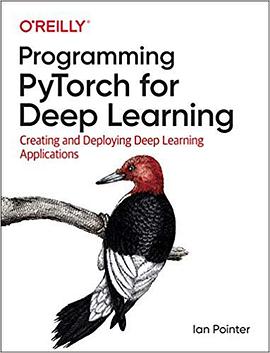
Programming PyTorch for Deep Learning 豆瓣
作者: Ian Pointer O'Reilly 2019 - 11
Deep learning is changing everything. This machine-learning method has already surpassed traditional computer vision techniques, and the same is happening with NLP. If you're looking to bring deep learning into your domain, this practical book will bring you up to speed on key concepts using Facebook's PyTorch framework.
Once author Ian Pointer helps you set up PyTorch on a cloud-based environment, you'll learn how use the framework to create neural architectures for performing operations on images, sound, text, and other types of data. By the end of the book, you'll be able to create neural networks and train them on multiple types of data.
Learn how to deploy deep learning models to production
Explore PyTorch use cases in companies other than Facebook
Learn how to apply transfer learning to images
Apply cutting-edge NLP techniques using a model trained on Wikipedia
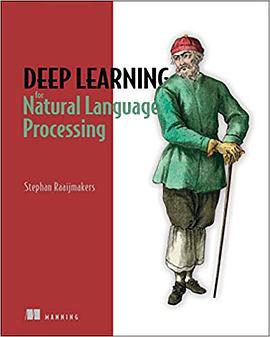
Deep Learning for Natural Language Processing 豆瓣
作者: Stephan Raaijmakers Manning Publication 2020 - 5
Deep Learning for Natural Language Processing teaches you to apply state-of-the-art deep learning approaches to natural language processing tasks. You’ll learn key NLP concepts like neural word embeddings, auto-encoders, part-of-speech tagging, parsing, and semantic inference. Then you’ll dive deeper into advanced topics including deep memory-based NLP, linguistic structure, and hyperparameters for deep NLP. Along the way, you’ll pick up emerging best practices and gain hands-on experience with a myriad of examples, all written in Python and the powerful Keras library. By the time you’re done reading this invaluable book, you’ll be solving a wide variety of NLP problems with cutting-edge deep learning techniques!
what's inside
An overview of NLP and deep learning
One-hot text representations
Word embeddings
Models for textual similarity
Sequential NLP
Semantic role labeling
Deep memory-based NLP
Linguistic structure
Hyperparameters for deep NLP
The Hundred-Page Machine Learning Book 豆瓣 Goodreads
作者: Andriy Burkov Andriy Burkov 2019 - 1
Everything you really need to know in Machine Learning in a hundred pages.
This is the first of its kind "read first, buy later" book. You can find the book online, read it, and then come back to pay for it if you liked the book or found it useful for your work, business or studies.
Review
"This book provides a great practical guide to get started and execute on ML within a few days without necessarily knowing much about ML apriori. The first five chapters are enough to get you started and the next few chapters provide you a good feel of more advanced topics to pursue. A wonderful book for engineers who want to incorporate ML in their day-to-day work without necessarily spending an enormous amount of time going through a formal degree program."--Deepak Agarwal, VP of Artificial Intelligence at LinkedIn
"This book is a great introduction to machine learning from a world-class practitioner and LinkedIn superstar Andriy Burkov. He managed to find a good balance between the math of the algorithms, intuitive visualizations, and easy-to-read explanations. This book will benefit the newcomers to the field as a thorough introduction to the fundamentals of machine learning, while the experienced professionals will definitely enjoy the practical recommendations from Andriy's rich experience in the field."--Karolis Urbonas, Head of Data Science at Amazon
"I wish such a book existed when I was a statistics graduate student trying to learn about machine learning. There is the right amount of math which demystify the centerpiece of an algorithm with succinct but very clear descriptions. I'm also impressed by the widespread coverage and good choices of important methods as an introductory book (not all machine learning books mention things like learning to rank or metric learning). Highly recommended to STEM major students."--Chao Han, VP, Head of R&D at Lucidworks
"This book provides a great practical guide to get started and execute on ML within a few days without necessarily knowing much about ML apriori. The first five chapters are enough to get you started and the next few chapters provide you a good feel of more advanced topics to pursue. A wonderful book for engineers who want to incorporate ML in their day-to-day work without necessarily spending an enormous amount of time going through a formal degree program."--Sujeet Varakhedi, Head of Engineering at eBay
"The Hundred-Page Machine Learning Book is an excellent read to get started with Machine Learning. In his book, Andriy Burkov distills the ubiquitous material on Machine Learning into concise and well-balanced intuitive, theoretical and practical elements that bring beginners, managers, and practitioners many life hacks."--Vincent Pollet, Head of Research at Nuance
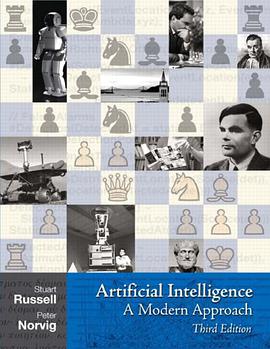
Artificial Intelligence 豆瓣 Goodreads
9.8 (8 个评分) 作者: Stuart Russell / Peter Norvig Pearson 2009
The long-anticipated revision of this #1 selling book offers the most comprehensive, state of the art introduction to the theory and practice of artificial intelligence for modern applications. Intelligent Agents. Solving Problems by Searching. Informed Search Methods. Game Playing. Agents that Reason Logically. First-order Logic. Building a Knowledge Base. Inference in First-Order Logic. Logical Reasoning Systems. Practical Planning. Planning and Acting. Uncertainty. Probabilistic Reasoning Systems. Making Simple Decisions. Making Complex Decisions. Learning from Observations. Learning with Neural Networks. Reinforcement Learning. Knowledge in Learning. Agents that Communicate. Practical Communication in English. Perception. Robotics. For computer professionals, linguists, and cognitive scientists interested in artificial intelligence.
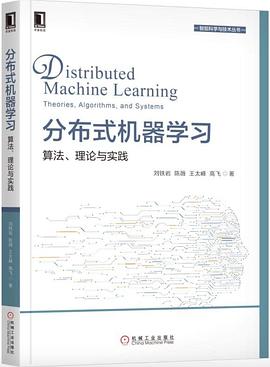
分布式机器学习:算法、理论与实践 豆瓣
作者: 刘铁岩 / 陈薇 2018 - 10
人工智能和大数据时代,解决最有挑战性问题的主流方案是分布式机器学习!本书旨在全面介绍分布式机器学习的现状,深入分析其中的核心技术问题,并且讨论该领域未来的发展方向。
由微软亚洲研究院机器学习核心团队潜心力作!鄂维南院士、周志华教授倾心撰写推荐序!
本书旨在全面介绍分布式机器学习的现状,深入分析其中的核心技术问题,并且讨论该领域未来的发展方向。
全书共12章。第1章是绪论,向大家展示分布式机器学习这个领域的全景。第2章介绍机器学习的基础知识。第3章到第8章是本书的核心部分,向大家细致地讲解分布式机器学习的框架及其各个功能模块。其中第3章给出整个分布式机器学习框架的综述,而第4章到第8章则分别针对其中的数据与模型划分模块、单机优化模块、通信模块、数据与模型聚合模块加以介绍。接下来的三章是对前面内容的总结与升华。其中第9章介绍由分布式机器学习框架中不同选项所组合出来的各式各样的分布式机器学习算法,第10章讨论这些算法的理论性质,第11章则介绍几个主流的分布式机器学习系统(包括Spark MLlib 迭代式MapReduce系统,Multiverso参数服务器系统,TensorFlow数据流系统)。最后的第12章是全书的结语,在对全书内容进行简要总结之后,着重讨论分布式机器学习这个领域未来的发展方向。
本书基于微软亚洲研究院机器学习研究团队多年的研究成果和实践经验写成,既可以作为研究生从事分布式机器学习方向研究的参考文献,也可以作为人工智能从业者进行算法选择和系统设计的工具书。
人工智能大潮中,市场上已有许多机器学习书籍,但是分布式机器学习的专门书籍还很少见。本书是希望学习和了解分布式机器学习的读者的福音。
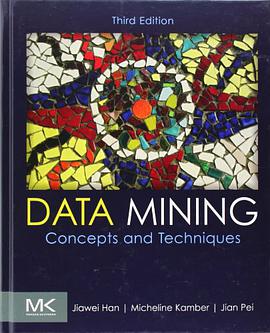
Data Mining 豆瓣
作者: Jiawei Han / Micheline Kamber Morgan Kaufmann 2011 - 7
The increasing volume of data in modern business and science calls for more complex and sophisticated tools. Although advances in data mining technology have made extensive data collection much easier, it's still always evolving and there is a constant need for new techniques and tools that can help us transform this data into useful information and knowledge. Since the previous edition's publication, great advances have been made in the field of data mining. Not only does the third of edition of Data Mining: Concepts and Techniques continue the tradition of equipping you with an understanding and application of the theory and practice of discovering patterns hidden in large data sets, it also focuses on new, important topics in the field: data warehouses and data cube technology, mining stream, mining social networks, and mining spatial, multimedia and other complex data. Each chapter is a stand-alone guide to a critical topic, presenting proven algorithms and sound implementations ready to be used directly or with strategic modification against live data. This is the resource you need if you want to apply today's most powerful data mining techniques to meet real business challenges.
* Presents dozens of algorithms and implementation examples, all in pseudo-code and suitable for use in real-world, large-scale data mining projects. * Addresses advanced topics such as mining object-relational databases, spatial databases, multimedia databases, time-series databases, text databases, the World Wide Web, and applications in several fields. *Provides a comprehensive, practical look at the concepts and techniques you need to get the most out of your data
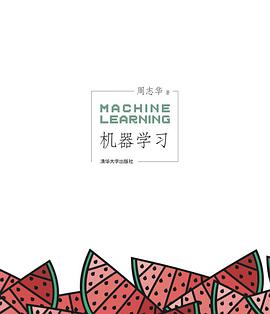
机器学习 豆瓣
8.5 (40 个评分) 作者: 周志华 清华大学出版社 2016 - 1
机器学习是计算机科学与人工智能的重要分支领域. 本书作为该领域的入门教材,在内容上尽可能涵盖机器学习基础知识的各方面。 为了使尽可能多的读者通过本书对机器学习有所了解, 作者试图尽可能少地使用数学知识. 然而, 少量的概率、统计、代数、优化、逻辑知识似乎不可避免. 因此, 本书更适合大学三年级以上的理工科本科生和研究生, 以及具有类似背景的对机器学 习感兴趣的人士. 为方便读者, 本书附录给出了一些相关数学基础知识简介.
全书共16 章,大致分为3 个部分:第1 部分(第1~3 章)介绍机器学习的基础知识;第2 部分(第4~10 章)讨论一些经典而常用的机器学习方法(决策树、神经网络、支持向量机、贝叶斯分类器、集成学习、聚类、降维与度量学习);第3 部分(第11~16 章)为进阶知识,内容涉及特征选择与稀疏学习、计算学习理论、半监督学习、概率图模型、规则学习以及强化学习等.前3章之外的后续各章均相对独立, 读者可根据自己的兴趣和时间情况选择使用. 根据课时情况, 一个学期的本科生课程可考虑讲授前9章或前10章; 研究生课程则不妨使用全书.
书中除第1章外, 每章都给出了十道习题. 有的习题是帮助读者巩固本章学习, 有的是为了引导读者扩展相关知识. 一学期的一般课程可使用这些习题, 再辅以两到三个针对具体数据集的大作业. 带星号的习题则有相当难度, 有些并无现成答案, 谨供富有进取心的读者启发思考.
本书可作为高等院校计算机、自动化及相关专业的本科生或研究生教材,也可供对机器学习感兴趣的研究人员和工程技术人员阅读参考。