编译器
Modern Compiler Implementation in Java 豆瓣
作者: Andrew W. Appel / Jens Palsberg Cambridge University Press 2002 - 10
This textbook describes all phases of a compiler: lexical analysis, parsing, abstract syntax, semantic actions, intermediate representations, instruction selection via tree matching, dataflow analysis, graph-coloring register allocation, and runtime systems. It includes good coverage of current techniques in code generation and register allocation, as well as the compilation of functional and object-oriented languages, that is missing from most books. The most accepted and successful techniques are described concisely, rather than as an exhaustive catalog of every possible variant, and illustrated with actual Java classes. The first part of the book, Fundamentals of Compilation, is suitable for a one-semester first course in compiler design. The second part, Advanced Topics, which includes the compilation of object-oriented and functional languages, garbage collection, loop optimization, SSA form, instruction scheduling, and optimization for cache-memory hierarchies, can be used for a second-semester or graduate course. This new edition has been extensively rewritten to include more discussion of Java and object-oriented programming concepts, such as visitor patterns. A unique feature is the newly redesigned compiler project in Java, for a subset of Java itself. The project includes both front-end and back-end phases, so that students can build a complete working compiler in one semester.
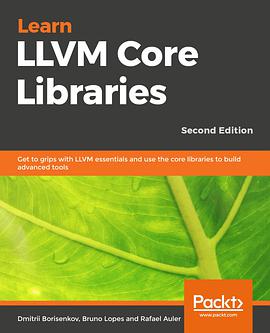
Learn LLVM Core Libraries, 2nd Edition 豆瓣
作者: Dmitrii Borisenkov / Bruno Lopes Packt Publishing 2019 - 10
Overcome the steep learning curve to start effectively using LLVM libraries and tools
Key Features
Learn how to configure, build, and use LLVM and Clang based tools,
Explore the depths of the LLVM front-end, IR, code generator, and libraries, and learn how a modern compiler is implemented in a practical way,
Customize your project to benefit from Just in Time compilation (JIT), static analysis and source-to-source transformations.
Book Description
This book is intended for enthusiasts, computer developers, and compiler engineers interested in learning about the LLVM framework internals as well as for C++ software engineers keen to use compiler-based tools for code analysis and improvement. You need a background in C++ and, although not mandatory, should know at least some compiler theory. Whether you are a newcomer or a compiler expert, this book provides a practical introduction to LLVM and avoids complex scenarios. If you are interested enough and excited about this technology, then this book is definitely for you.
LLVM is a leading compiler technology framework. Easily extendable and designed as a multitude of libraries, LLVM provides a smooth experience for compiler newcomers and reduces the steep learning curve often associated with compiler development. To start, this book will show you how to configure, build, and install LLVM libraries, tools, and external projects. Next, you will be introduced to LLVM design and how it works in practice throughout each LLVM compiler stage: frontend, optimizer, and backend. The final chapters of this book will address just-in-time compilation issues. Despite initially LLVM was not designed as a JIT-compiler, high demand for dynamic languages pushed the community to implement JIT-compilation features in LLVM. The book will summarize the current state of JIT-compilation support LLVM provides.
By the end of the book, with multiple hands-on examples and source code snippets, you will be able to put a solid and smooth first step into the LLVM compiler development framework.
What you will learn
Understand LLVM compiler high-level design
Extend the compiler frontend, optimizer and backend
Use LLVM as a just-in-time compiler
Understand an architecture description with TableGen
Use compiler-based tools to improve the quality of code in a C++ project
Understand how clang based tools could help even in non-compiler development
Understand LLVM coding style and coding practice
Who This Book Is For
This book is intended for enthusiasts, computer science students, and compiler engineers interested in learning about the LLVM framework. You need a background in C++ and, although not mandatory, should know at least some compiler theory.
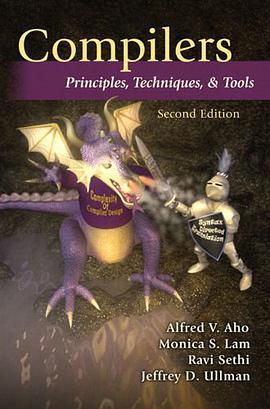
Compilers 豆瓣 Goodreads
8.4 (5 个评分) 作者: Alfred V. Aho / Monica S. Lam Addison Wesley 2006 - 9
This book provides the foundation for understanding the theory and pracitce of compilers. Revised and updated, it reflects the current state of compilation. Every chapter has been completely revised to reflect developments in software engineering, programming languages, and computer architecture that have occurred since 1986, when the last edition published. The authors, recognizing that few readers will ever go on to construct a compiler, retain their focus on the broader set of problems faced in software design and software development. Computer scientists, developers, and aspiring students that want to learn how to build, maintain, and execute a compiler for a major programming language.
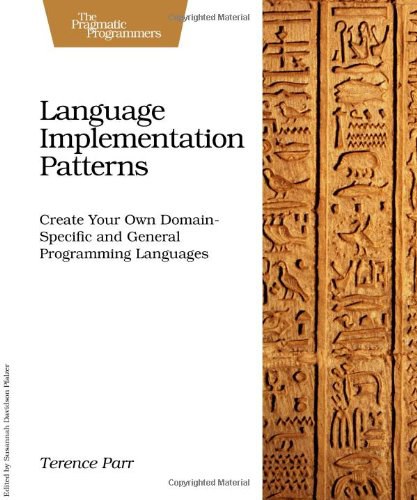
Language Implementation Patterns 豆瓣
作者: Terence Parr Pragmatic Bookshelf 2010 - 1
Knowing how to create domain-specific languages (DSLs) can give you a huge productivity boost. Instead of writing code in a general-purpose programming language, you can first build a custom language tailored to make you efficient in a particular domain. The key is understanding the common patterns found across language implementations. "Language Design Patterns" identifies and condenses the most common design patterns, providing sample implementations of each. The pattern implementations use Java, but the patterns themselves are completely general. Some of the implementations use the well-known ANTLR parser generator, so readers will find this book an excellent source of ANTLR examples as well. But this book will benefit anyone interested in implementing languages, regardless of their tool of choice. Other language implementation books focus on compilers, which you rarely need in your daily life. Instead, "Language Design Patterns" shows you patterns you can use for all kinds of language applications. You'll learn to create configuration file readers, data readers, model-driven code generators, source-to-source translators, source analyzers, and interpreters. Each chapter groups related design patterns and, in each pattern, you'll get hands-on experience by building a complete sample implementation. By the time you finish the book, you'll know how to solve most common language implementation problems.