AI
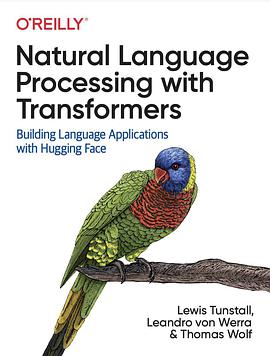
Natural Language Processing with Transformers 豆瓣
作者: Lewis Tunstall / Leandro von Werra O'Reilly Media 2022 - 4
Since their introduction in 2017, Transformers have quickly become the dominant architecture for achieving state-of-the-art results on a variety of natural language processing tasks. If you're a data scientist or machine learning engineer, this practical book shows you how to train and scale these large models using HuggingFace Transformers, a Python-based deep learning library.
Transformers have been used to write realistic news stories, improve Google Search queries, and even create chatbots that tell corny jokes. In this guide, authors Lewis Tunstall, Leandro von Werra, and Thomas Wolf use a hands-on approach to teach you how Transformers work and how to integrate them in your applications. You'll quickly learn a variety of tasks they can help you solve.
Build, debug, and optimize Transformer models for core NLP tasks, such as text classification, named entity recognition, and question answering
Learn how Transformers can be used for cross-lingual transfer learning
Apply Transformers in real-world scenarios where labeled data is scarce
Make Transformer models efficient for deployment using techniques such as distillation, pruning, and quantization
Train Transformers from scratch and learn how to scale to multiple GPUs and distributed environments
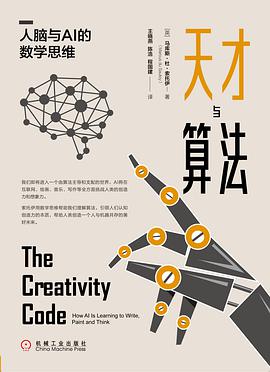
天才与算法 豆瓣
The Creativity Code: How AI Is Learning to Write, Paint and Think
作者: [英] 马库斯·杜·索托伊 译者: 王晓燕 / 陈浩 机械工业出版社 2020 - 4
★美、英两国双料院士马库斯·杜·索托伊先生巅峰作品。
★我们即将进入一个由算法主导和支配的世界,AI将在互联网、绘画、音乐、写作等全方面挑战人类的创造力和想象力。
★作者用数学思维帮助我们理解算法,引领人们认知创造力的本质,帮助人类创造一个人与机器共存的美好未来。
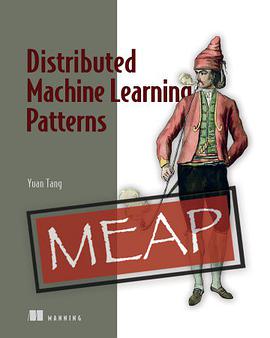
Distributed Machine Learning Patterns 豆瓣 Goodreads
作者: Yuan Tang Manning Publications 2022 - 3
Practical patterns for scaling machine learning from your laptop to a distributed cluster.
In Distributed Machine Learning Patterns you will learn how to:
Apply distributed systems patterns to build scalable and reliable machine learning projects
Construct machine learning pipelines with data ingestion, distributed training, model serving, and more
Automate machine learning tasks with Kubernetes, TensorFlow, Kubeflow, and Argo Workflows
Make trade offs between different patterns and approaches
Manage and monitor machine learning workloads at scale
Distributed Machine Learning Patterns teaches you how to scale machine learning models from your laptop to large distributed clusters. In it, you’ll learn how to apply established distributed systems patterns to machine learning projects, and explore new ML-specific patterns as well. Firmly rooted in the real world, this book demonstrates how to apply patterns using examples based in TensorFlow, Kubernetes, Kubeflow, and Argo Workflows. Real-world scenarios, hands-on projects, and clear, practical DevOps techniques let you easily launch, manage, and monitor cloud-native distributed machine learning pipelines.
about the technology
Scaling up models from standalone devices to large distributed clusters is one of the biggest challenges faced by modern machine learning practitioners. Distributing machine learning systems allow developers to handle extremely large datasets across multiple clusters, take advantage of automation tools, and benefit from hardware accelerations. In this book, Kubeflow co-chair Yuan Tang shares patterns, techniques, and experience gained from years spent building and managing cutting-edge distributed machine learning infrastructure.
about the book
Distributed Machine Learning Patterns is filled with practical patterns for running machine learning systems on distributed Kubernetes clusters in the cloud. Each pattern is designed to help solve common challenges faced when building distributed machine learning systems, including supporting distributed model training, handling unexpected failures, and dynamic model serving traffic. Real-world scenarios provide clear examples of how to apply each pattern, alongside the potential trade offs for each approach. Once you’ve mastered these cutting edge techniques, you’ll put them all into practice and finish up by building a comprehensive distributed machine learning system.
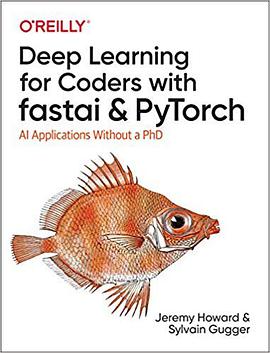
Deep Learning for Coders with fastai and PyTorch Goodreads 豆瓣
作者: Sylvain Gugger / Jeremy Howard O'Reilly Media 2020 - 2
Deep learning has the reputation as an exclusive domain for math PhDs. Not so. With this book, programmers comfortable with Python will learn how to get started with deep learning right away.
Using PyTorch and the fastai deep learning library, you’ll learn how to train a model to accomplish a wide range of tasks—including computer vision, natural language processing, tabular data, and generative networks. At the same time, you’ll dig progressively into deep learning theory so that by the end of the book you’ll have a complete understanding of the math behind the library’s functions.
2021年6月1日 在读
Jeremy的学习思路很赞,类似Bidirectional BFS。先学一点model from scratch (simple 3-layer NN) & fastai lib (transfer ResNet34), 然后bottom-up & top-down,同时深入学习,当交汇的时候就说明完整掌握了。
全书就是 Jupyter Notebook: github.com/fastai/fastbook/clean/. 直接在 Colab打开 (runtime改为GPU即可, 利用transfer learning, 所以免费instance即可)
课程见https://course.fast.ai/ 有2020版part 1
AI学术界很多Jargon,写成code就通俗易懂了。
AI 计算机科学 软件工程
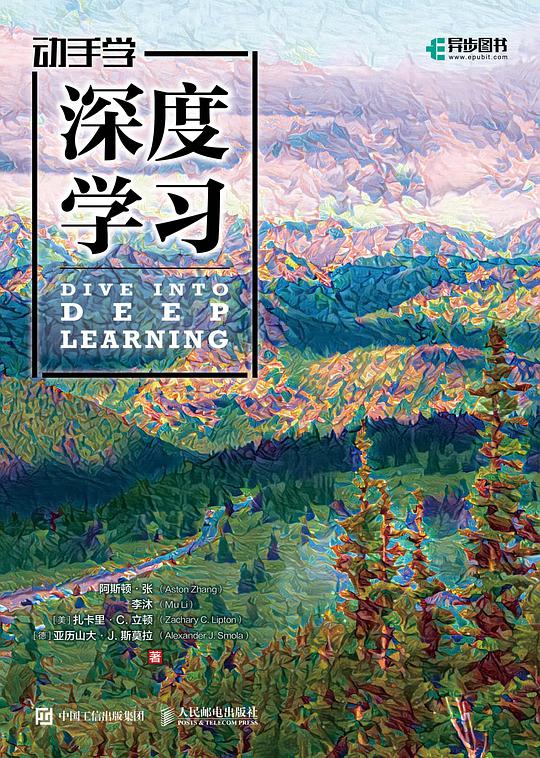
动手学深度学习 豆瓣
Dive into deep learning
9.0 (11 个评分) 作者: 阿斯顿·张(Aston Zhang) / 李沐(Mu Li) 人民邮电出版社 2019 - 6
本书旨在向读者交付有关深度学习的交互式学习体验。书中不仅阐述深度学习的算法原理,还演示它们的实现和运行。与传统图书不同,本书的每一节都是一个可以下载并运行的 Jupyter记事本,它将文字、公式、图像、代码和运行结果结合在了一起。此外,读者还可以访问并参与书中内容的讨论。
全书的内容分为3个部分:第一部分介绍深度学习的背景,提供预备知识,并包括深度学习最基础的概念和技术;第二部分描述深度学习计算的重要组成部分,还解释近年来令深度学习在多个领域大获成功的卷积神经网络和循环神经网络;第三部分评价优化算法,检验影响深度学习计算性能的重要因素,并分别列举深度学习在计算机视觉和自然语言处理中的重要应用。
本书同时覆盖深度学习的方法和实践,主要面向在校大学生、技术人员和研究人员。阅读本书需要读者了解基本的Python编程或附录中描述的线性代数、微分和概率基础。
2021年6月1日 在读
动手学深度学习-v2 在线课程 courses.d2l.ai/zh-v2/ 李沐手把手PyTorch教学 (3/20开课, 目前讲到 ResNet). 效率上课 > 看书。
AI 计算机科学
Vision 豆瓣
作者: David Marr The MIT Press 2010 - 7
David Marr's posthumously published Vision (1982) influenced a generation of brain and cognitive scientists, inspiring many to enter the field. In Vision, Marr describes a general framework for understanding visual perception and touches on broader questions about how the brain and its functions can be studied and understood. Researchers from a range of brain and cognitive sciences have long valued Marr's creativity, intellectual power, and ability to integrate insights and data from neuroscience, psychology, and computation. This MIT Press edition makes Marr's influential work available to a new generation of students and scientists. In Marr's framework, the process of vision constructs a set of representations, starting from a description of the input image and culminating with a description of three-dimensional objects in the surrounding environment. A central theme, and one that has had far-reaching influence in both neuroscience and cognitive science, is the notion of different levels of analysis--in Marr's framework, the computational level, the algorithmic level, and the hardware implementation level. Now, thirty years later, the main problems that occupied Marr remain fundamental open problems in the study of perception. Vision provides inspiration for the continuing efforts to integrate knowledge from cognition and computation to understand vision and the brain.
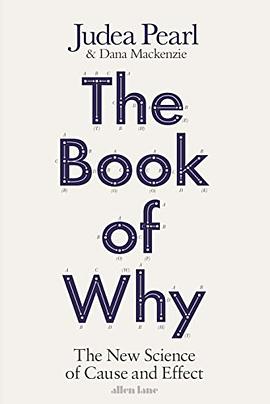
The Book of Why 豆瓣
作者: Judea Pearl / Dana Mackenzie Allen Lane 2018 - 5
A Turing Award-winning computer scientist and statistician shows how understanding causality has revolutionized science and will revolutionize artificial intelligence
"Correlation is not causation." This mantra, chanted by scientists for more than a century, has led to a virtual prohibition on causal talk. Today, that taboo is dead. The causal revolution, instigated by Judea Pearl and his colleagues, has cut through a century of confusion and established causality--the study of cause and effect--on a firm scientific basis. His work explains how we can know easy things, like whether it was rain or a sprinkler that made a sidewalk wet; and how to answer hard questions, like whether a drug cured an illness. Pearl's work enables us to know not just whether one thing causes another: it lets us explore the world that is and the worlds that could have been. It shows us the essence of human thought and key to artificial intelligence. Anyone who wants to understand either needs The Book of Why.
2021年3月14日 想读 <周末社会学聊斋:因果关系大乱炖之跨学科讨论会> Ye Wang老师做statistics的
AI
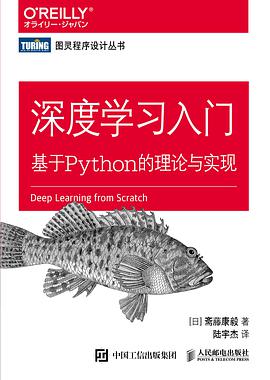
深度学习入门 豆瓣 Goodreads 谷歌图书
Deep Learning from Scratch
9.4 (21 个评分) 作者: [ 日] 斋藤康毅 译者: 陆宇杰 人民邮电出版社 2018 - 7
本书是深度学习真正意义上的入门书,深入浅出地剖析了深度学习的原理和相关技术。书中使用Python3,尽量不依赖外部库或工具,从基本的数学知识出发,带领读者从零创建一个经典的深度学习网络,使读者在此过程中逐步理解深度学习。书中不仅介绍了深度学习和神经网络的概念、特征等基础知识,对误差反向传播法、卷积神经网络等也有深入讲解,此外还介绍了深度学习相关的实用技巧,自动驾驶、图像生成、强化学习等方面的应用,以及为什么加深层可以提高识别精度等“为什么”的问题。
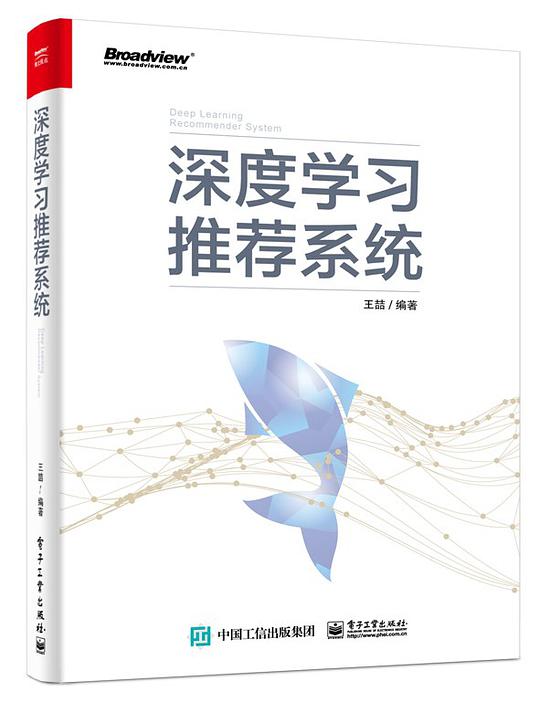
深度学习推荐系统 豆瓣
9.4 (5 个评分) 作者: 王喆 电子工业出版社 2020 - 3
深度学习在推荐系统领域掀起了一场技术革命,本书从深度学习推荐模型、Embedding技术、推荐系统工程实现、模型评估体系、业界前沿实践等几个方面介绍了这场技术革命中的主流技术要点。
《深度学习推荐系统》既适合推荐系统、计算广告和搜索领域的从业者阅读,也适合人工智能相关专业的本 科生、研究生、博士生阅读,帮助他们建立深度学习推荐系统的技术框架,通过学习前沿案例 加强深度学习理论与推荐系统工程实践的融合能力。
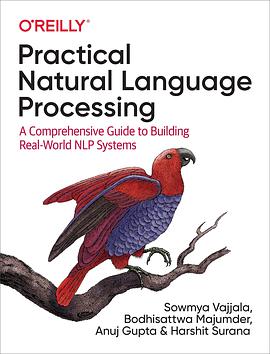
Practical Natural Language Processing 豆瓣
作者: Sowmya Vajjala / Anuj Gupta O'Reilly Media 2020 - 6
If you want to build, iterate and scale NLP systems in a business setting and to tailor them for various industry verticals, this is your guide.
Consider the task of building a chatbot or text classification system at your organization. In the beginning, there may be little or no data to work with. At this point, a basic solution that uses rule based systems or traditional machine learning will be apt. As you accumulate more data, more sophisticated—and often data intensive—ML techniques can be used including deep learning. At each step of this journey, there are dozens of alternative approaches you can take. This book helps you navigate this maze of options.
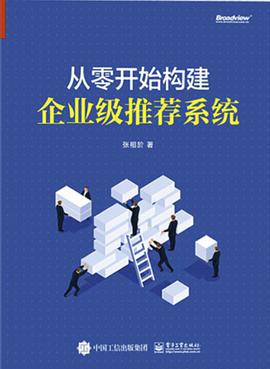
从零开始构建企业级推荐系统 豆瓣
作者: 张相於 2020 - 7
《从零开始构建企业级推荐系统》是一本面向实践的企业级推荐系统开发指南,内容包括产品设计、相关性算法、排序模型、工程架构、效果评测、系统监控等推荐系统核心部分的设计与开发,可以帮助开发者逐步构建一个完整的推荐系统,并提供了持续优化的系统性思路。本书注重从系统性和通用性的角度看待推荐系统的核心问题,希望能够帮助读者做到知其然,也知其所以然,更能够举一反三,真正掌握推荐系统的核心本质。此外,本书对于推荐系统开发中常见的问题和陷阱,以及系统构建过程,也做了重点介绍,力求让读者不仅知道做什么,而且知道怎么做。
本书的目标读者是推荐系统研发工程师、产品经理以及对推荐系统感兴趣的学生和从业者。
2020年8月13日 想读 ResysChina
AI 2020
Generative Deep Learning 豆瓣 Goodreads
作者: David Foster O'Reilly Media 2019 - 7
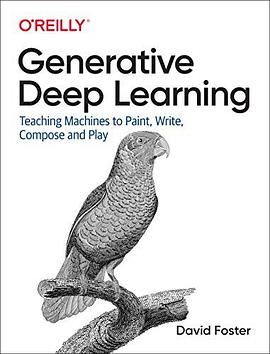
Generative modeling is one of the hottest topics in artificial intelligence. Recent advances in the field have shown how it’s possible to teach a machine to excel at human endeavors—such as drawing, composing music, and completing tasks—by generating an understanding of how its actions affect its environment.
With this practical book, machine learning engineers and data scientists will learn how to recreate some of the most famous examples of generative deep learning models, such as variational autoencoders and generative adversarial networks (GANs). You’ll also learn how to apply the techniques to your own datasets.
David Foster, cofounder of Applied Data Science, demonstrates the inner workings of each technique, starting with the basics of deep learning before advancing to the most cutting-edge algorithms in the field. Through tips and tricks, you’ll learn how to make your models learn more efficiently and become more creative.
Get a fundamental overview of deep learning
Learn about libraries such as Keras and TensorFlow
Discover how variational autoencoders work
Get practical examples of generative adversarial networks (GANs)
Understand how autoregressive generative models function
Apply generative models within a reinforcement learning setting to accomplish tasks
Artificial Intelligence (4/e) 豆瓣
作者: Stuart Russell / Peter Norvig Pearson 2020 - 5
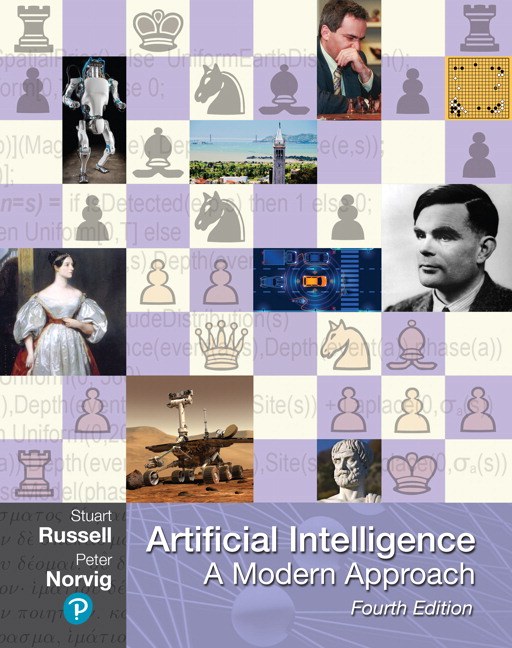
The most comprehensive, up-to-date introduction to the theory and practice of artificial intelligence
The long-anticipated revision of Artificial Intelligence: A Modern Approach explores the full breadth and depth of the field of artificial intelligence (AI). The 4th Edition brings readers up to date on the latest technologies, presents concepts in a more unified manner, and offers new or expanded coverage of machine learning, deep learning, transfer learning, multiagent systems, robotics, natural language processing, causality, probabilistic programming, privacy, fairness, and safe AI.
Deep Learning with PyTorch 豆瓣 Goodreads
作者: Eli Stevens / Luca Antiga Manning Publications 2020 - 6
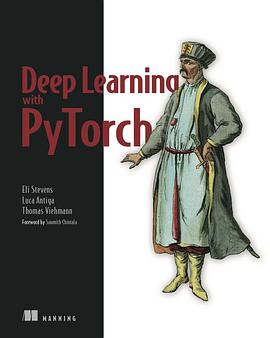
Deep Learning with PyTorch teaches you how to implement deep learning algorithms with Python and PyTorch. This book takes you into a fascinating case study: building an algorithm capable of detecting malignant lung tumors using CT scans. As the authors guide you through this real example, you'll discover just how effective and fun PyTorch can be. After a quick introduction to the deep learning landscape, you'll explore the use of pre-trained networks and start sharpening your skills on working with tensors. You'll find out how to represent the most common types of data with tensors and how to build and train neural networks from scratch on practical examples, focusing on images and sequences.
After covering the basics, the book will take you on a journey through larger projects. The centerpiece of the book is a neural network designed for cancer detection. You'll discover ways for training networks with limited inputs and start processing data to get some results. You'll sift through the unreliable initial results and focus on how to diagnose and fix the problems in your neural network. Finally, you'll look at ways to improve your results by training with augmented data, make improvements to the model architecture, and perform other fine tuning.
what's inside
Using the PyTorch tensor API
Understanding automatic differentiation in PyTorch
Training deep neural networks
Monitoring training and visualizing results
Implementing modules and loss functions
Loading data in Python for PyTorch
Interoperability with NumPy
Deploying a PyTorch model for inference
2020年7月7日 在读 PyTorch
@PyTorch
·
6h
The full version of the Deep Learning with PyTorch book from Luca Antiga, Eli Stevens, and Thomas Viehmann is now available! New chapters include in-depth real-world examples and production deployment. Grab a free digital copy on:
AI 机器学习 计算机科学 2020
Mathematics of Big Data 豆瓣
作者: Jeremy Kepner / Hayden Jananthan MIT Press 2018 - 7
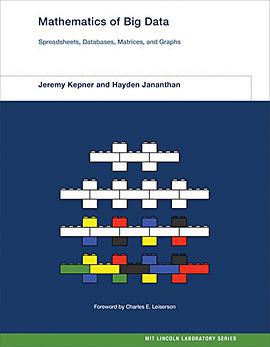
The first book to present the common mathematical foundations of big data analysis across a range of applications and technologies.
Today, the volume, velocity, and variety of data are increasing rapidly across a range of fields, including Internet search, healthcare, finance, social media, wireless devices, and cybersecurity. Indeed, these data are growing at a rate beyond our capacity to analyze them. The tools―including spreadsheets, databases, matrices, and graphs―developed to address this challenge all reflect the need to store and operate on data as whole sets rather than as individual elements. This book presents the common mathematical foundations of these data sets that apply across many applications and technologies. Associative arrays unify and simplify data, allowing readers to look past the differences among the various tools and leverage their mathematical similarities in order to solve the hardest big data challenges.
The book first introduces the concept of the associative array in practical terms, presents the associative array manipulation system D4M (Dynamic Distributed Dimensional Data Model), and describes the application of associative arrays to graph analysis and machine learning. It provides a mathematically rigorous definition of associative arrays and describes the properties of associative arrays that arise from this definition. Finally, the book shows how concepts of linearity can be extended to encompass associative arrays. Mathematics of Big Data can be used as a textbook or reference by engineers, scientists, mathematicians, computer scientists, and software engineers who analyze big data.
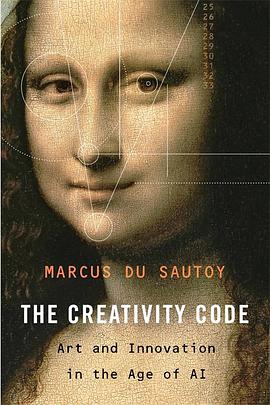
The Creativity Code 豆瓣
作者: Marcus du Sautoy Harvard University Press 2019 - 4
The award-winning author of The Music of the Primes explores the future of creativity and how machine learning will disrupt, enrich, and transform our understanding of what it means to be human.
Can a well-programmed machine do anything a human can—only better? Complex algorithms are choosing our music, picking our partners, and driving our investments. They can navigate more data than a doctor or lawyer and act with greater precision. For many years we’ve taken solace in the notion that they can’t create. But now that algorithms can learn and adapt, does the future of creativity belong to machines, too?
It is hard to imagine a better guide to the bewildering world of artificial intelligence than Marcus du Sautoy, a celebrated Oxford mathematician whose work on symmetry in the ninth dimension has taken him to the vertiginous edge of mathematical understanding. In The Creativity Code he considers what machine learning means for the future of creativity. The Pollockizer can produce drip paintings in the style of Jackson Pollock, Botnik spins off fanciful (if improbable) scenes inspired by J. K. Rowling, and the music-composing algorithm Emmy managed to fool a panel of Bach experts. But do these programs just mimic, or do they have what it takes to create? Du Sautoy argues that to answer this question, we need to understand how the algorithms that drive them work—and this brings him back to his own subject of mathematics, with its puzzles, constraints, and enticing possibilities.
While most recent books on AI focus on the future of work, The Creativity Code moves us to the forefront of creative new technologies and offers a more positive and unexpected vision of our future cohabitation with machines. It challenges us to reconsider what it means to be human—and to crack the creativity code.
Data Science with Python and Dask 豆瓣
作者: Jesse Daniel Manning Publications 2019 - 7
Summary
Dask is a native parallel analytics tool designed to integrate seamlessly with the libraries you're already using, including Pandas, NumPy, and Scikit-Learn. With Dask you can crunch and work with huge datasets, using the tools you already have. And Data Science with Python and Dask is your guide to using Dask for your data projects without changing the way you work!
Purchase of the print book includes a free eBook in PDF, Kindle, and ePub formats from Manning Publications. You'll find registration instructions inside the print book.
About the Technology
An efficient data pipeline means everything for the success of a data science project. Dask is a flexible library for parallel computing in Python that makes it easy to build intuitive workflows for ingesting and analyzing large, distributed datasets. Dask provides dynamic task scheduling and parallel collections that extend the functionality of NumPy, Pandas, and Scikit-learn, enabling users to scale their code from a single laptop to a cluster of hundreds of machines with ease.
About the Book
Data Science with Python and Dask teaches you to build scalable projects that can handle massive datasets. After meeting the Dask framework, you'll analyze data in the NYC Parking Ticket database and use DataFrames to streamline your process. Then, you'll create machine learning models using Dask-ML, build interactive visualizations, and build clusters using AWS and Docker.
What's inside
Working with large, structured and unstructured datasets
Visualization with Seaborn and Datashader
Implementing your own algorithms
Building distributed apps with Dask Distributed
Packaging and deploying Dask apps
机器学习理论导引 豆瓣
作者: 周志华 / 王魏 机械工业出版社 2020 - 6
机器学习领域著名学者周志华教授领衔的南京大学LAMDA团队四位教授合著
系统梳理机器学习理论中的七大重要概念或理论工具,并给出若干分析实例
机器学习理论内容浩瀚广博,旨在为机器学习理论研究的读者提供入门导引
本书旨在为有志于机器学习理论学习和研究的读者提供一个入门导引。在预备知识之后,全书各章分别聚焦于:可学性、(假设空间)复杂度、泛化界、稳定性、一致性、收敛率、遗憾界。 除介绍基本概念外,还给出若干分析实例,如显示如何将不同理论工具应用于支持向量机这种常见机器学习技术。
Kubeflow for Machine Learning 豆瓣
作者: Boris Lublinsky / Ilan Filonenko O'Reilly Media, Inc. 2020 - 11
If you’re training a machine learning model but aren’t sure how to put it into production, this book will get you there. Kubeflow provides a collection of cloud native tools for different stages of a model’s lifecycle, from data exploration, feature preparation, and model training to model serving. This guide helps data scientists build production-grade machine learning implementations with Kubeflow and shows data engineers how to make models scalable and reliable.
Using examples throughout the book, authors Holden Karau, Trevor Grant, Ilan Filonenko, Richard Liu, and Boris Lublinsky explain how to use Kubeflow to train and serve your machine learning models on top of Kubernetes in the cloud or in a development environment on-premises.
Understand Kubeflow’s design, core components, and the problems it solves
Learn how to set up Kubeflow on a cloud provider or on an in-house cluster
Train models using Kubeflow with popular tools including scikit-learn, TensorFlow, and Apache Spark
Learn how to add custom stages such as serving and prediction
Keep your model up-to-date with Kubeflow Pipelines
Understand how to validate machine learning pipelines
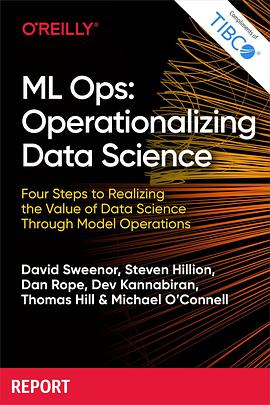
ML Ops: Operationalizing Data Science 豆瓣
作者: Michael O'Connell / David Sweenor O'Reilly Media, Inc. 2020 - 4
More than half of the analytics and machine learning (ML) models created by organizations today never make it into production. Instead, many of these ML models do nothing more than provide static insights in a slideshow. If they aren’t truly operational, these models can’t possibly do what you’ve trained them to do.
This report introduces practical concepts to help data scientists and application engineers operationalize ML models to drive real business change. Through lessons based on numerous projects around the world, six experts in data analytics provide an applied four-step approach—Build, Manage, Deploy and Integrate, and Monitor—for creating ML-infused applications within your organization.
You’ll learn how to:
Fulfill data science value by reducing friction throughout ML pipelines and workflows
Constantly refine ML models through retraining, periodic tuning, and even complete remodeling to ensure long-term accuracy
Design the ML Ops lifecycle to ensure that people-facing models are unbiased, fair, and explainable
Operationalize ML models not only for pipeline deployment but also for external business systems that are more complex and less standardized
Put the four-step Build, Manage, Deploy and Integrate, and Monitor approach into action