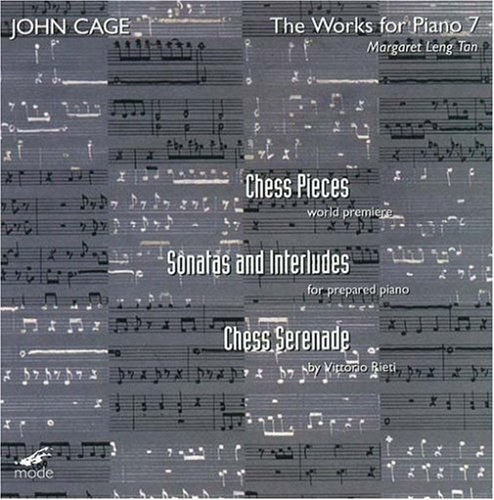
John Cage: The Works for Piano, Vol. 7 豆瓣
Margaret Leng Tan
类型:
古典
发布日期 2006年3月21日
出版发行:
Mode
A major discovery and first recording of an important Cage piece from 1944.
In 1944, John Cage was invited to participate in "The Imagery of Chess" exhibition at the Julien Levy Gallery in New York City. The artists included Calder, Noguchi, Motherwell, Breton, Duchamp, Ernst, Man Ray, Tanning and other leading surrealists.
Cage contributed a painting entitled "Chess Pieces". It was purchased at the show and went into a private collection. For decades it was deemed lost and was (almost) forgotten by Cage afficionados and scholars.
Re-assembling the original artworks for "The Imagery of Chess Revisited" show (2005-06) at the Isamu Noguchi Museum in New York led to the tracking down of the Cage painting.
Cage expert Margaret Leng Tan set about transcribing the music in the painting into a playable score which receives its premiere recording here.
Chess Pieces is from 1944, an emotional and creative year for Cage; besides echoes of Satie, Chess Pieces contains prophetic touches of minimalism and has features in common with his monumental piano piece, Four Walls, from the same year.
A renowned Cage interpreter, Ms. Tan worked closely with the composer from 1981 to 1992. Cage was particularly appreciative of her performances of his works for the prepared piano. This is Ms. Tan's long-awaited recording of Cage's prepared piano masterpiece, the Sonatas and Interludes of 1946-48.
Also included is the first recording of the only other musical score from "The Imagery of Chess" show, neo-classical composer Vittorio Rieti's Chess Serenade.
Also available as a surround sound DVD (MOD-DV158) with full performance videos of Chess Pieces and Chess Serenade, plus 2 documentaries: Mr. Cage's Prepared Piano (Ms. Tan takes an in-depth look at the prepared piano), and CAGE: Music/Art/Chess (a closeup look at Cage's and Rieti's pieces in the Noguchi Museum's "The Imagery of Chess Revisited" show).
Only on DVD
ADDITIONAL DOCUMENTARY VIDEOS:
Mr. Cage's Prepared Piano: an insightful look at the history of the prepared piano narrated and performed by Ms. Tan, who also demonstrates how to (and not to) prepare a piano, and describes the preparations in detail both visually and sonically. She prepares and performs excerpts from Bacchanale, Cage's first prepared piano work, and Sonatas & Interludes.
Cage and the Art of Chess: a visit to "The Imagery of Chess Revisited" exhibit at the Isamu Noguchi Museum with curator Larry List and Ms. Tan. Together they describe Cage's relationship to the show and examine the "Chess Pieces" painting in detail - they also discuss Rieti and his Chess Serenade. Mr. List explores a separate feature on Cage's wife, Xenia Cage, and her Chess Table (Xenia was an artist and also had a piece in the show) and sheds additional background on her life and work.
24-bit surround sound DTS and Dolby Digital surround.
Dedicated 24-bit stereo mix.
English, French, German and Spanish subtitles.
NOTE: Sonatas & Interludes is not accompanied by video.
In 1944, John Cage was invited to participate in "The Imagery of Chess" exhibition at the Julien Levy Gallery in New York City. The artists included Calder, Noguchi, Motherwell, Breton, Duchamp, Ernst, Man Ray, Tanning and other leading surrealists.
Cage contributed a painting entitled "Chess Pieces". It was purchased at the show and went into a private collection. For decades it was deemed lost and was (almost) forgotten by Cage afficionados and scholars.
Re-assembling the original artworks for "The Imagery of Chess Revisited" show (2005-06) at the Isamu Noguchi Museum in New York led to the tracking down of the Cage painting.
Cage expert Margaret Leng Tan set about transcribing the music in the painting into a playable score which receives its premiere recording here.
Chess Pieces is from 1944, an emotional and creative year for Cage; besides echoes of Satie, Chess Pieces contains prophetic touches of minimalism and has features in common with his monumental piano piece, Four Walls, from the same year.
A renowned Cage interpreter, Ms. Tan worked closely with the composer from 1981 to 1992. Cage was particularly appreciative of her performances of his works for the prepared piano. This is Ms. Tan's long-awaited recording of Cage's prepared piano masterpiece, the Sonatas and Interludes of 1946-48.
Also included is the first recording of the only other musical score from "The Imagery of Chess" show, neo-classical composer Vittorio Rieti's Chess Serenade.
Also available as a surround sound DVD (MOD-DV158) with full performance videos of Chess Pieces and Chess Serenade, plus 2 documentaries: Mr. Cage's Prepared Piano (Ms. Tan takes an in-depth look at the prepared piano), and CAGE: Music/Art/Chess (a closeup look at Cage's and Rieti's pieces in the Noguchi Museum's "The Imagery of Chess Revisited" show).
Only on DVD
ADDITIONAL DOCUMENTARY VIDEOS:
Mr. Cage's Prepared Piano: an insightful look at the history of the prepared piano narrated and performed by Ms. Tan, who also demonstrates how to (and not to) prepare a piano, and describes the preparations in detail both visually and sonically. She prepares and performs excerpts from Bacchanale, Cage's first prepared piano work, and Sonatas & Interludes.
Cage and the Art of Chess: a visit to "The Imagery of Chess Revisited" exhibit at the Isamu Noguchi Museum with curator Larry List and Ms. Tan. Together they describe Cage's relationship to the show and examine the "Chess Pieces" painting in detail - they also discuss Rieti and his Chess Serenade. Mr. List explores a separate feature on Cage's wife, Xenia Cage, and her Chess Table (Xenia was an artist and also had a piece in the show) and sheds additional background on her life and work.
24-bit surround sound DTS and Dolby Digital surround.
Dedicated 24-bit stereo mix.
English, French, German and Spanish subtitles.
NOTE: Sonatas & Interludes is not accompanied by video.