思考能力

5 books  

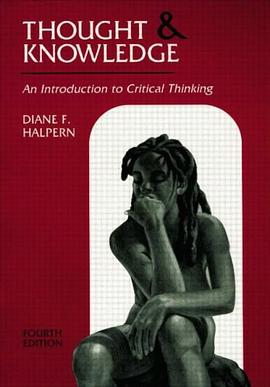
Thought and Knowledge [Book] Douban
author: Diane F. Halpern publishing house: Lawrence Erlbaum 2002 - 8
This best-selling textbook, written by award-winning educator and past president of the APA, Diane Halpern, applies theory and research from the learning sciences to teach students the thinking skills they need to succeed in today's world. This new edition retains features from earlier editions that have helped its readers become better thinkers. A rigorous academic grounding based in cognitive psychology is presented in a clear writing style with a humorous tone and supported by numerous practical examples and anecdotes. Thought & Knowledge, Fourth Edition has been revised to help students meet the challenges of a global neighborhood and make meaningful conclusions form the overwhelming quantity of information now available at the click of a mouse. The skills learned with this text will help students learn more efficiently, research more productively, and present logical, informed arguments. New features include: Template for Making Arguments. This is a crucial preparation tool for students in any subject area. For those planning on continuing to Graduate School, this feature is an essential reference. The Graduate Record Examination (GRE) now requires that all test takers write an argument on a contemporary topic. Concept Maps provide students with strategies to clarify complex information and retain long-term knowledge. Contemporary Examples, throughout the text, relate current events to the book discussions. Explanations on How to Evaluate Information found on Web sites. Revised Student Workbook. Thinking Critically About Critical Thinking, Fourth Edition is filled with new exercises to reinforce learning and practice newly acquired skills. This workbook can be purchased in a student package with the text or as a separate item. Thought & Knowledge, Fourth Edition is appropriate for use as a textbook in critical thinking courses offered in departments of psychology, philosophy, English, humanities, or as a supplement in any course where critical thinking is emphasized.
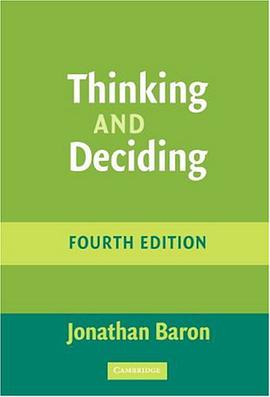
Thinking and Deciding [Book] Douban
author: Jonathan Baron publishing house: 劍橋大學出版社 2007 - 10
Beginning with its first edition and through subsequent editions, Thinking and Deciding has established itself as the required text and important reference work for students and scholars of human cognition and rationality. In this, the fourth edition, Jonathan Baron retains the comprehensive attention to the key questions addressed in the previous editions - How should we think? What, if anything, keeps us from thinking that way? How can we improve our thinking and decision making? - and his expanded treatment of topics such as risk, utilitarianism, Baye's theorem, and moral thinking. With the student in mind, the fourth edition emphasises the development of an understanding of the fundamental concepts in judgement and decision making. This book is essential reading for students and scholars in judgement and decision making and related fields, including psychology, economics, law, medicine, and business.
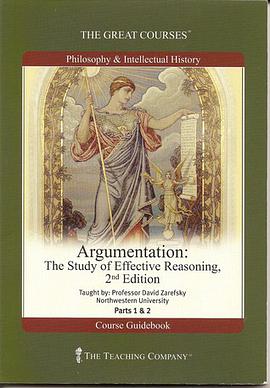
Argumentation: The Study of Effective Reasoning [Book] Douban
author: David Zarefsky publishing house: The Teaching Company 2001
What is effective argument?
* It is Abraham Lincoln at Cooper Union in 1860, marshalling many lines of evidence to make the case that Congress has the power to regulate slavery.
* It is Franklin D. Roosevelt in a 1940 "fireside chat," employing a vivid analogy to convince Americans to lend war equipment to Great Britain, then battling Nazi Germany alone.
* It is the U.S. Supreme Court in 1954, using complex reasoning to decide unanimously that segregated schools are unconstitutional in Brown v. Board of Education.
* It is any individual or organization, drawing on the theory of argumentation to reason through a position and make the best possible case for it.
Argumentation: The Study of Effective Reasoning, 2nd Edition, is a rigorous introduction to the formal study of argumentation—communication that seeks to persuade others through reasoned judgment.
In 24 lectures you learn the building blocks of an argument, the different categories of argument and the issues that are at stake in each, the kinds of evidence that serve as proof in an argument, and many other aspects of argumentation and reasoning, illustrated with examples from some of the most famous speeches, debates, and controversies in American history.
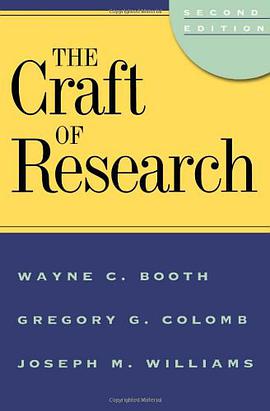
The Craft of Research, 2nd edition [Book] Douban
author: Wayne C. Booth / Joseph M. Williams publishing house: University Of Chicago Press 2003 - 3
This manual offers practical advice on the fundamentals of research to college and university students in all fields of study. The Craft of Research teaches much more than the mechanics of fact gathering: it explains how to approach a research project as an analytical process. The authors chart every stage of research, from finding a topic and generating research questions about it to marshalling evidence, constructing arguments, and writing everything up in a final report that is a model of authority. Their advice is designed for use by both beginners and seasoned practitioners, and for projects from class papers to dissertations.
This book is organized into four parts. Part One is a spirited introduction to the distinctive nature, values, and protocols of research. Part Two demystifies the art of discovering a topic. It outlines a wide range of sources, among them personal interests and passions. Parts Three and Four cover the essentials of argument—how to make a claim and support it—and ways to outline, draft, revise, rewrite, and polish the final report. Part Three is a short course in the logic, structure, uses, and common pitfalls of argumentation. The writing chapters in Part Four show how to present verbal and visual information effectively and how to shape sentences and paragraphs that communicate with power and precision.
"A well-constructed, articulate reminder of how important fundamental questions of style and approach, such as clarity and precision, are to all research."—Times Literary Supplement
Reply Quote Sept. 2, 2026