沙滩上的爱因斯坦 [Performance] Douban
Einstein on the Beach
other title:
Einstein on the Beach
troupe:
Philip Glass Ensemble 菲利普 • 格拉斯合奏团
theater:
Opéra Grand Avignon 阿维尼翁大歌剧院
director:
Robert Wilson
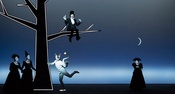
From the beginning of Glass and Wilson's collaboration, they insisted on portraying the icon purely as a historical figure, in the absence of a storyline attached to his image. While they did incorporate symbols from Einstein's life within the opera's scenery, characters, and music, they intentionally chose not to give the opera a specific plot. This is in accord with Wilson's formalist approach, which he asserts creates more truth on stage than naturalist theater. Wilson structured Einstein on the Beach as a repeating sequence of three different kinds of space. Between major acts are shorter entr'actes known as "knee plays," a signature technique that Wilson has applied throughout his oeuvre. Propelling idea of "non-plot" within Einstein on the Beach, its libretto employs solfège syllables, numbers, and short sections of poetry. In an interview, Glass comments that he originally intended for his audience to construct personal connections with Einstein as a character and with the music that he assigns to the icon. For example, the music within the first of the opera's "Knee Plays" features repeated numbers accompanied by an electric organ. Glass states that these numbers and solfège syllables were used as placeholders for texts by the singers to memorize their parts, and were kept instead of replacing them with texts. This numerical repetition, however, offers an interpretation as a reference to the mathematical and scientific breakthroughs made by Einstein himself. Of further reference to the icon's image, everything on the originally staged set of Einstein on the Beach, from costumes to lighting, depicts specific aspects that refer to Einstein's life.
Overall, the music assigned to Einstein demonstrates a circular process, a repeating cycle that constantly delays resolution. This process uses both additive and subtractive formulas. The three main scenes within the opera—"Train", "Trial", and "Field/Spaceship"—allude to Einstein's hypotheses about his theory of relativity and his unified field theory. Specifically, themes within the opera allude to nuclear weapons, science, and AM radio.
The opera consists of nine connected 20-minute scenes in four acts separated by "Knee Plays". Five "Knee Plays" frame the opera's structure and appear in between acts, while also functioning as the opening and closing scenes. Glass defines a "Knee Play" as an interlude between acts and as "the 'knee' referring to the joining function that humans' anatomical knees perform". While the "Knee Plays" helped to create the necessary time to change the scenery of Wilson's seven sets, these interludes also served a musical function. David Cunningham, a Glass scholar, writes that the intermittence of Glass's "Knee Plays" amongst the opera's four acts, serves as a "constant motif in the whole work".
The opera requires a cast of two female, one male, and one male child in speaking roles (for the Wilson production); a 16-person SATB chamber chorus with an outstanding soprano soloist and a smaller tenor solo part; three reed players: flute (doubling piccolo and bass clarinet), soprano saxophone (doubling flute), tenor saxophone (doubling alto saxophone); solo violin, and two synthesizers/electronic organs. The orchestration was originally tailored to the five members of the Philip Glass Ensemble, plus the solo violin.
Overall, the music assigned to Einstein demonstrates a circular process, a repeating cycle that constantly delays resolution. This process uses both additive and subtractive formulas. The three main scenes within the opera—"Train", "Trial", and "Field/Spaceship"—allude to Einstein's hypotheses about his theory of relativity and his unified field theory. Specifically, themes within the opera allude to nuclear weapons, science, and AM radio.
The opera consists of nine connected 20-minute scenes in four acts separated by "Knee Plays". Five "Knee Plays" frame the opera's structure and appear in between acts, while also functioning as the opening and closing scenes. Glass defines a "Knee Play" as an interlude between acts and as "the 'knee' referring to the joining function that humans' anatomical knees perform". While the "Knee Plays" helped to create the necessary time to change the scenery of Wilson's seven sets, these interludes also served a musical function. David Cunningham, a Glass scholar, writes that the intermittence of Glass's "Knee Plays" amongst the opera's four acts, serves as a "constant motif in the whole work".
The opera requires a cast of two female, one male, and one male child in speaking roles (for the Wilson production); a 16-person SATB chamber chorus with an outstanding soprano soloist and a smaller tenor solo part; three reed players: flute (doubling piccolo and bass clarinet), soprano saxophone (doubling flute), tenor saxophone (doubling alto saxophone); solo violin, and two synthesizers/electronic organs. The orchestration was originally tailored to the five members of the Philip Glass Ensemble, plus the solo violin.