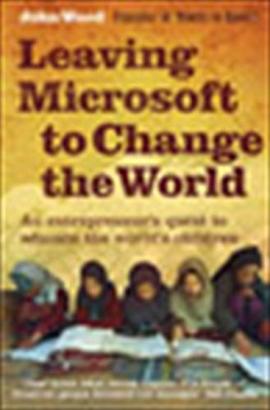
Leaving Microsoft to Change the World [Book] Douban
John Wood discovered his passion, his greatest success, and his life's work--not at business school or leading Microsoft's charge into Asia in the 1990s--but on a soul-searching trip to the Himalayas. Wood felt trapped between an all-consuming career and a desire to do something lasting and significant. Stressed from the demands of his job, he took a vacation trekking in Nepal because a friend had told him, "If you get high enough in the mountains, you can't hear Steve Ballmer yelling at you anymore." <p align=center>
<table cellpadding="4" width="100%"> <tr align="center"><td><img src="http://images.amazon.com/images/G/01/books/video-grabs/John-Wood.jpg" border="0" align="center">
See how John Wood came to start Room to Read and write Leaving Microsoft to Change the World in this video clip: high bandwidth or low bandwidth</td></tr> </table> <p align=left>
Instead of being the antidote to the rat race, that trip convinced John Wood to divert the boundless energy he was devoting to Microsoft into a cause that desperately needed to be addressed. While visiting a remote Nepalese school, Wood learned that the students had few books in their library. When he offered to run a book drive to provide the school with books, his idea was met with polite skepticism. After all, no matter how well-intentioned, why would a successful software executive take valuable time out of his life and gather books for an impoverished school?
But John Wood did return to that school and with thousands of books bundled on the back of a yak. And at that moment, Wood made the decision to walk away from Microsoft and create Room to Read-an organization that has donated more than 1.2 million books, established more than 2,600 libraries and 200 schools, and sent 1,700 girls to school on scholarship-ultimately touching the lives of 875,000 children with the lifelong gift of education.
Leaving Microsoft to Change the World chronicles John Wood's struggle to find a meaningful outlet for his managerial talents and entrepreneurial zeal. For every high-achiever who has ever wondered what life might be like giving back, Wood offers a vivid, emotional, and absorbing tale of how to take the lessons learned at a hard-charging company like Microsoft and apply them to one of the world's most pressing problems: the lack of basic literacy.
<table cellpadding="4" width="100%"> <tr align="center"><td><img src="http://images.amazon.com/images/G/01/books/video-grabs/John-Wood.jpg" border="0" align="center">
See how John Wood came to start Room to Read and write Leaving Microsoft to Change the World in this video clip: high bandwidth or low bandwidth</td></tr> </table> <p align=left>
Instead of being the antidote to the rat race, that trip convinced John Wood to divert the boundless energy he was devoting to Microsoft into a cause that desperately needed to be addressed. While visiting a remote Nepalese school, Wood learned that the students had few books in their library. When he offered to run a book drive to provide the school with books, his idea was met with polite skepticism. After all, no matter how well-intentioned, why would a successful software executive take valuable time out of his life and gather books for an impoverished school?
But John Wood did return to that school and with thousands of books bundled on the back of a yak. And at that moment, Wood made the decision to walk away from Microsoft and create Room to Read-an organization that has donated more than 1.2 million books, established more than 2,600 libraries and 200 schools, and sent 1,700 girls to school on scholarship-ultimately touching the lives of 875,000 children with the lifelong gift of education.
Leaving Microsoft to Change the World chronicles John Wood's struggle to find a meaningful outlet for his managerial talents and entrepreneurial zeal. For every high-achiever who has ever wondered what life might be like giving back, Wood offers a vivid, emotional, and absorbing tale of how to take the lessons learned at a hard-charging company like Microsoft and apply them to one of the world's most pressing problems: the lack of basic literacy.