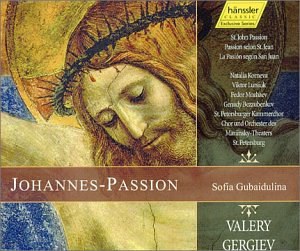
古拜杜丽娜《约翰受难曲》 [Music] Douban
Valery Gergiev
/
Orchestra of the Mariinsky Theater St. Petersburg
…
genre:
Classical
release date 2001-09-01
publisher:
Hänssler Classics
Sofia Gubaidulina belongs to the leading representatives of the new music from the former Soviet Union standing along side the late Alfred Schnittke, Edison Denisov and Valentin Silvestrov. Along with her esteemed contemporaries, her works were forbidden performance in her own country for many years, and was subjected to the severest repression. Although she has lived in Germany for some years now, Sofia Gubaidulina has remained very close to her homeland which plays such a role in her personal and musical identity. This Russian composer repeatedly emphasizes the importance of her religious beliefs in her life, as is reflected in many of her pieces: faith and religion build the basis of her compositional work. For Sofia Gubaidulina, the purpose of religion is to reunite the oneness that is lost in the "staccato of living". Ms. Gubaidulina says that the St. John Passion has reflected the “core of her life”.
Gubaidulina's St. John Passion draws heavily upon the rhythms, melodies and pacing of the Orthodox liturgy. Instead of outward drama and conflict, the music expresses a timelessness and luminosity that will appeal strongly to fans of John Tavener and Arvo Part. Scored for four soloists, two choirs, and large orchestra – including THREE Wagner Tubas, six percussionists, organ, piano and synthesizer –Gubaidulina's masterwork conveys both the magnificence of a Holy Icon and transports the listener into a mystic realm where evil and darkness are vanquished though the power of the Word. A tremendously moving experience!
“The work has, in instruments and voices (and especially percussion), a shimmering, ringing, arresting sound that ultimately overwhelms, with climaxes that linger...”
- Los Angeles Times
Gubaidulina's St. John Passion draws heavily upon the rhythms, melodies and pacing of the Orthodox liturgy. Instead of outward drama and conflict, the music expresses a timelessness and luminosity that will appeal strongly to fans of John Tavener and Arvo Part. Scored for four soloists, two choirs, and large orchestra – including THREE Wagner Tubas, six percussionists, organ, piano and synthesizer –Gubaidulina's masterwork conveys both the magnificence of a Holy Icon and transports the listener into a mystic realm where evil and darkness are vanquished though the power of the Word. A tremendously moving experience!
“The work has, in instruments and voices (and especially percussion), a shimmering, ringing, arresting sound that ultimately overwhelms, with climaxes that linger...”
- Los Angeles Times