瓦莱里·捷杰耶夫 — 导演 (4)
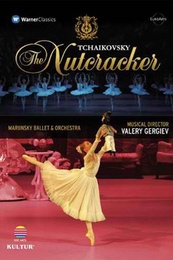
胡桃夹子 2012年马林斯基剧院3D版 [演出] 豆瓣
所属 演出: 胡桃夹子
剧团: Симфонический оркестр Мариинского театра 马林斯基剧院交响乐团 ; Балет Мариинского театра 马林斯基剧院芭蕾舞团 ; Детский хор Мариинского театра 马林斯基剧院童声合唱团 剧院: Мариинский театр 马林斯基剧院 导演: Andreas Morell / Valery Gergiev
其它标题: 2012年马林斯基剧院3D版 编剧: Marius Petipa 作曲: Pyotr Ilyich Tchaikovsky 演员: Alina Somova / Vladimir Shklyarov
Below is a synopsis based on the original 1892 libretto by Marius Petipa. The story varies from production to production, though most follow the basic outline. The names of the characters also vary. In the original E. T. A. Hoffmann story, the young heroine is called Marie Stahlbaum and Clara (Klärchen) is her doll's name. In the adaptation by Dumas on which Petipa based his libretto, her name is Marie Silberhaus. In still other productions, such as Baryshnikov's, Clara is Clara Stahlbaum rather than Clara Silberhaus.
Act I
Scene 1: The Stahlbaum Home
It is Christmas Eve. Family and friends have gathered in the parlor to decorate the beautiful Christmas tree in preparation for the party. Once the tree is finished, the children are sent for. They stand in awe of the tree sparkling with candles and decorations.
The party begins. A march is played. Presents are given out to the children. Suddenly, as the owl-topped grandmother clock strikes eight, a mysterious figure enters the room. It is Drosselmeyer, a local councilman, magician, and Clara's godfather. He is also a talented toymaker who has brought with him gifts for the children, including four lifelike dolls who dance to the delight of all. He then has them put away for safekeeping.
Clara and Fritz are sad to see the dolls being taken away, but Drosselmeyer has yet another toy for them: a wooden nutcracker carved in the shape of a little man. The other children ignore it, but Clara immediately takes a liking to it. Fritz, however, breaks it, and Clara is heartbroken.
During the night, after everyone else has gone to bed, Clara returns to the parlor to check on her beloved nutcracker. As she reaches the little bed, the clock strikes midnight and she looks up to see Drosselmeyer perched atop it. Suddenly, mice begin to fill the room and the Christmas tree begins to grow to dizzying heights. The nutcracker also grows to life size. Clara finds herself in the midst of a battle between an army of gingerbread soldiers and the mice, led by their king. They begin to eat the soldiers.
The nutcracker appears to lead the soldiers, who are joined by tin soldiers, and by dolls who serve as doctors to carry away the wounded. As the Mouse King advances on the still-wounded nutcracker, Clara throws her slipper at him, distracting him long enough for the nutcracker to stab him.
Scene 2: A Pine Forest
The mice retreat and the nutcracker is transformed into a handsome Prince. He leads Clara through the moonlit night to a pine forest in which the snowflakes dance around them, beckoning them on to his kingdom as the first act ends.
Act II
Scene 1: The Land of Sweets
Clara and the Prince travel to the beautiful Land of Sweets, ruled by the Sugar Plum Fairy in the Prince's place until his return. He recounts for her how he had been saved from the Mouse King by Clara and transformed back into himself. In honor of the young heroine, a celebration of sweets from around the world is produced: chocolate from Spain, coffee from Arabia, tea from China, and candy canes from Russia all dance for their amusement; Danish shepherdesses perform on their flutes; Mother Ginger has her children, the Polichinelles, emerge from under her enormous hoop skirt to dance; a string of beautiful flowers perform a waltz. To conclude the night, the Sugar Plum Fairy and her Cavalier perform a dance.
A final waltz is performed by all the sweets, after which the Sugar Plum Fairy ushers Clara and the Prince down from their throne. He bows to her, she kisses Clara goodbye, and leads them to a reindeer drawn sleigh. It takes off as they wave goodbye to all the subjects who wave back.
In the original libretto, the ballet's apotheosis "represents a large beehive with flying bees, closely guarding their riches". Just like Swan Lake, there have been various alternative endings created in productions subsequent to the original.
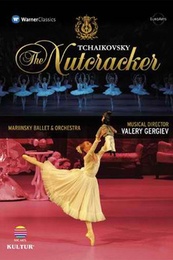
胡桃夹子 2011年马林斯基剧院版 [演出] 豆瓣
所属 演出: 胡桃夹子
剧团: Симфонический оркестр Мариинского театра 马林斯基剧院交响乐团 ; Балет Мариинского театра 马林斯基剧院芭蕾舞团 ; Детский хор Мариинского театра 马林斯基剧院儿童合唱团 剧院: Мариинский театр 马林斯基剧院 导演: Valery Gergiev
其它标题: 2011年马林斯基剧院版 编剧: Marius Petipa 作曲: Pyotr Ilyich Tchaikovsky 演员: Alina Somova / Vladimir Shklyarov
Below is a synopsis based on the original 1892 libretto by Marius Petipa. The story varies from production to production, though most follow the basic outline. The names of the characters also vary. In the original E. T. A. Hoffmann story, the young heroine is called Marie Stahlbaum and Clara (Klärchen) is her doll's name. In the adaptation by Dumas on which Petipa based his libretto, her name is Marie Silberhaus. In still other productions, such as Baryshnikov's, Clara is Clara Stahlbaum rather than Clara Silberhaus.
Act I
Scene 1: The Stahlbaum Home
It is Christmas Eve. Family and friends have gathered in the parlor to decorate the beautiful Christmas tree in preparation for the party. Once the tree is finished, the children are sent for. They stand in awe of the tree sparkling with candles and decorations.
The party begins. A march is played. Presents are given out to the children. Suddenly, as the owl-topped grandmother clock strikes eight, a mysterious figure enters the room. It is Drosselmeyer, a local councilman, magician, and Clara's godfather. He is also a talented toymaker who has brought with him gifts for the children, including four lifelike dolls who dance to the delight of all. He then has them put away for safekeeping.
Clara and Fritz are sad to see the dolls being taken away, but Drosselmeyer has yet another toy for them: a wooden nutcracker carved in the shape of a little man. The other children ignore it, but Clara immediately takes a liking to it. Fritz, however, breaks it, and Clara is heartbroken.
During the night, after everyone else has gone to bed, Clara returns to the parlor to check on her beloved nutcracker. As she reaches the little bed, the clock strikes midnight and she looks up to see Drosselmeyer perched atop it. Suddenly, mice begin to fill the room and the Christmas tree begins to grow to dizzying heights. The nutcracker also grows to life size. Clara finds herself in the midst of a battle between an army of gingerbread soldiers and the mice, led by their king. They begin to eat the soldiers.
The nutcracker appears to lead the soldiers, who are joined by tin soldiers, and by dolls who serve as doctors to carry away the wounded. As the Mouse King advances on the still-wounded nutcracker, Clara throws her slipper at him, distracting him long enough for the nutcracker to stab him.
Scene 2: A Pine Forest
The mice retreat and the nutcracker is transformed into a handsome Prince. He leads Clara through the moonlit night to a pine forest in which the snowflakes dance around them, beckoning them on to his kingdom as the first act ends.
Act II
Scene 1: The Land of Sweets
Clara and the Prince travel to the beautiful Land of Sweets, ruled by the Sugar Plum Fairy in the Prince's place until his return. He recounts for her how he had been saved from the Mouse King by Clara and transformed back into himself. In honor of the young heroine, a celebration of sweets from around the world is produced: chocolate from Spain, coffee from Arabia, tea from China, and candy canes from Russia all dance for their amusement; Danish shepherdesses perform on their flutes; Mother Ginger has her children, the Polichinelles, emerge from under her enormous hoop skirt to dance; a string of beautiful flowers perform a waltz. To conclude the night, the Sugar Plum Fairy and her Cavalier perform a dance.
A final waltz is performed by all the sweets, after which the Sugar Plum Fairy ushers Clara and the Prince down from their throne. He bows to her, she kisses Clara goodbye, and leads them to a reindeer drawn sleigh. It takes off as they wave goodbye to all the subjects who wave back.
In the original libretto, the ballet's apotheosis "represents a large beehive with flying bees, closely guarding their riches". Just like Swan Lake, there have been various alternative endings created in productions subsequent to the original.
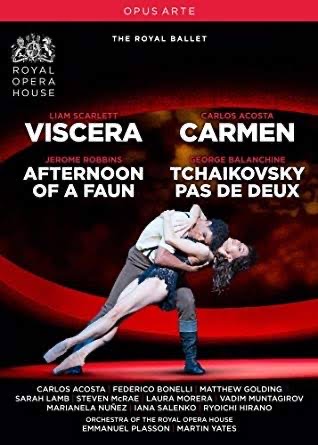
卡门 [演出] 豆瓣
Carmen
类型: 舞剧 编剧: 罗兰·佩蒂 / 普罗斯佩·梅里美
其它标题: Carmen 导演: 罗兰·佩蒂 (Roland Petit) / 芝芝·让梅尔 (Zizi Jeanmaire) 演员: 罗兰·佩蒂 / 芝芝·让梅尔 / S.佩罗 / Yuri Smekalov / Diana Vishneva
芭蕾舞剧《卡门》是在乔治·比才创作的歌剧《卡门》音乐的基础上编成。在舞蹈界,《卡门》除了被改编为热烈奔放的弗拉门戈舞,还被改编为芭蕾舞,这两种不同的舞蹈门类带给观众不同的艺术享受。

不同编舞家创造了不同的芭蕾舞剧《卡门》版本。法国芭蕾舞编导罗兰·佩蒂(Roland Petit)的版本,以及智利芭蕾舞编导玛希娅·海蒂(Marcia Haydee)的版本,都获得了巨大成功。

其中,罗兰·佩蒂创作芭蕾舞剧《卡门》时,20世纪最伟大的画家之一毕加索为该剧创作了部分布景,使得罗兰·佩蒂版的芭蕾舞剧《卡门》成为名副其实的“大师之作”。罗兰·佩蒂版的《卡门》是一部独幕五场的芭蕾舞剧,属于法国现代芭蕾的晚期代表作,1949年2月21日由巴黎芭蕾舞团首演于伦敦的王子剧院,音乐G.比才,编剧与编导罗兰·佩蒂版,吉普赛女郎卡门由R.让梅尔扮演,军官唐何塞由佩蒂扮演,斗牛士特雷多由S.佩罗扮演。舞剧的情节线索基本上来自法国作家P.梅里美1845年的小说和法国作曲家比才1875年的歌剧,简明扼要地讲述了吉普赛女郎卡门先后爱上了英俊潇洒的军官唐何塞和彪悍骁勇的斗牛士特雷多,但终因唐何塞的妒火衷烧而被刺身亡的惨烈故事。这部中型芭蕾舞剧在首演之夜便一炮打响,博得公众和舞评家们的一致赞赏,其舞-剧并举的结构与悲喜交加的表演令人眼前一亮,尤其是佩蒂为夫人让梅尔-卡门与自己-唐何塞创作的《卧室双人舞》,因大胆的性爱暗示满足了各国观众在二次大战中压抑太久的激情,而赢得了巨额的票房,并使得这部舞剧成为他最具影响力的代表作,更使整个舞团能够迅速应邀前往纽约公演。
卡门 版本4 [演出] 豆瓣
所属 演出: 卡门
剧团: the Mariinsky Ballet 导演: Valery Gergiev
其它标题: 版本4 编剧: Henri Meilhac 作曲: Georges Bizet 演员: Yuri Smekalov / Diana Vishneva
芭蕾舞剧《卡门》是在乔治·比才创作的歌剧《卡门》音乐的基础上编成。在舞蹈界,《卡门》除了被改编为热烈奔放的弗拉门戈舞,还被改编为芭蕾舞,这两种不同的舞蹈门类带给观众不同的艺术享受。

不同编舞家创造了不同的芭蕾舞剧《卡门》版本。法国芭蕾舞编导罗兰·佩蒂(Roland Petit)的版本,以及智利芭蕾舞编导玛希娅·海蒂(Marcia Haydee)的版本,都获得了巨大成功。

其中,罗兰·佩蒂创作芭蕾舞剧《卡门》时,20世纪最伟大的画家之一毕加索为该剧创作了部分布景,使得罗兰·佩蒂版的芭蕾舞剧《卡门》成为名副其实的“大师之作”。罗兰·佩蒂版的《卡门》是一部独幕五场的芭蕾舞剧,属于法国现代芭蕾的晚期代表作,1949年2月21日由巴黎芭蕾舞团首演于伦敦的王子剧院,音乐G.比才,编剧与编导罗兰·佩蒂版,吉普赛女郎卡门由R.让梅尔扮演,军官唐何塞由佩蒂扮演,斗牛士特雷多由S.佩罗扮演。舞剧的情节线索基本上来自法国作家P.梅里美1845年的小说和法国作曲家比才1875年的歌剧,简明扼要地讲述了吉普赛女郎卡门先后爱上了英俊潇洒的军官唐何塞和彪悍骁勇的斗牛士特雷多,但终因唐何塞的妒火衷烧而被刺身亡的惨烈故事。这部中型芭蕾舞剧在首演之夜便一炮打响,博得公众和舞评家们的一致赞赏,其舞-剧并举的结构与悲喜交加的表演令人眼前一亮,尤其是佩蒂为夫人让梅尔-卡门与自己-唐何塞创作的《卧室双人舞》,因大胆的性爱暗示满足了各国观众在二次大战中压抑太久的激情,而赢得了巨额的票房,并使得这部舞剧成为他最具影响力的代表作,更使整个舞团能够迅速应邀前往纽约公演。