Jacques Derrida — 作者 (123)
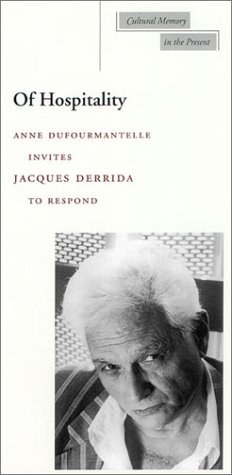
Of Hospitality [图书] 豆瓣
作者: Jacques Derrida / Anne Dufourmantelle 译者: Rachel Bowlby 出版社: Stanford University Press 2000 - 9
These two lectures by Jacques Derrida, "Foreigner Question" and "Step of Hospitality/No Hospitality," derive from a series of seminars on "hospitality" conducted by Derrida in Paris, January 1996. His seminars, in France and in America, have become something of an institution over the years, the place where he presents the ongoing evolution of his thought in a remarkable combination of thoroughly mapped-out positions, sketches of new material, and exchanges with students and interlocutors. As has become a pattern in Derrida's recent work, the form of this presentation is a self-conscious enactment of its content. The book consists of two texts on facing pages. "Invitation" by Anne Dufourmantelle appears on the left (an invitation that of course originates in a response), clarifying and inflecting Derrida's "response" on the right. The interaction between them not only enacts the "hospitality" under discussion, but preserves something of the rhythms of teaching. The volume also characteristically combines careful readings of canonical texts and philosophical topics with attention to the most salient events in the contemporary world, using "hospitality" as a means of rethinking a range of political and ethical situations. "Hospitality" is viewed as a question of what arrives at the borders, in the initial surprise of contact with an other, a stranger, a foreigner. For example, Antigone is revisited in light of the question of impossible mourning; "Oedipus at Colonus" is read via concerns that also apply to teletechnology; the trial of Socrates is brought into conjunction with the televised funeral of Francois Mitterrand.
Monolingualism of the Other [图书] 豆瓣
作者: Jacques Derrida 译者: Patrick Mensah 出版社: Stanford University Press 1998 - 8
"I have but one language--yet that language is not mine." This book intertwines theoretical reflection with historical and cultural particularity to enunciate, then analyze this conundrum in terms of the author's own relationship to the French language. The book operates on three levels. At the first level, a theoretical inquiry investigates the relation between individuals and their "own" language. It also explores the structural limits, desires, and interdictions inherent in such "possession," as well as the corporeal aspect of language (its accents, tones, and rhythms) and the question of the "countability" of languages (that is, their discreteness or factual givenness). At the second level, the author testifies to aspects of his acculturation as an Algerian Jew with respect to language acquisition, schooling, citizenship, and the dynamics of cultural-political exclusion and inclusion. At the third level, the book is comparative, drawing on statements from a wide range of figures, from the Moroccan Abdelkebir Khatibi to Franz Rosenzweig, Gershom Scholem, Hannah Arendt, and Emmanuel Levinas. Since one of the book's central themes is the question of linguistic and cultural identity, its argument touches on several issues relevant to the current debates on multiculturalism. These issues include the implementation of colonialism in the schools, the tacit or explicit censorship that excludes other (indigenous) languages from serious critical consideration, the investment in an ideal of linguistic purity, and the problematics of translation. The author also reveals the complex interplay of psychological factors that invests the subject of identity with the desire to recover a "lost" language of origin and with the ambition to master the language of the colonizer.
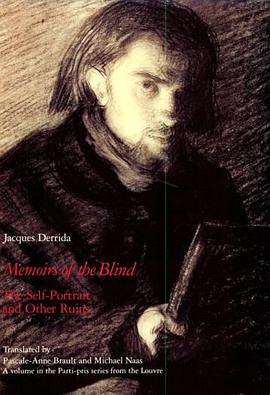
Memoirs of the Blind [图书] 豆瓣
作者: Jacques Derrida 译者: Michael Naas 出版社: University of Chicago Press 1993 - 10
In this brilliant essay, Jacques Derrida explores issues of vision, blindness, self-representation, and their relation to drawing, while offering detailed readings of an extraordinary collection of images. Selected by Derrida from the prints and drawings department of the Louvre, the works depict blindness--fictional, historical, and biblical. From Old and New Testament scenes to the myth of Perseus and the Gorgon and the blinding of Polyphemus, Derrida uncovers in these images rich, provocative layers of interpretation. For Derrida drawing is itself blind; as an act rooted in memory and anticipation, drawing necessarily replaces one kind of seeing (direct) with another (mediated). Ultimately, he explains, the very lines which compose any drawing are themselves never fully visible to the viewer since they exist only in a tenuous state of multiple identities: as marks on a page, as indicators of a contour. Lacking a "pure" identity, the lines of a drawing summon the supplement of the word, of verbal discourse, and, in doing so, obscure the visual experience. Consequently, Derrida demonstrates, the very act of depicting a blind person undertakes multiple enactments and statements of blindness and sight. "Memoirs of the Blind" is both a sophisticated philosophical argument and a series of detailed readings. Derrida provides compelling insights into famous and lesser known works, interweaving analyses of texts--including Diderot's "Lettres sur les aveugles," the notion of mnemonic art in Baudelaire's "The Painter of Modern Life," and Merleau-Ponty's "The Visible and the Invisible." Along with engaging meditations on the history and philosophy of art, Derrida reveals the waysviewers approach philosophical ideas through art, and the ways art enriches philosophical reflection. An exploration of sight, representation, and art, "Memoirs of the Blind" extends and deepens the meditation on vision and painting presented in "Truth and Painting." Readers of Derrida, both new and familiar, will profit from this powerful contribution to the study of the visual arts.