汤姆·斯托帕德 — 编剧 (59)
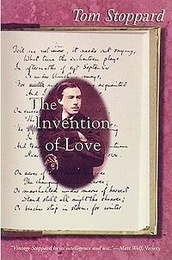
The Invention of Love [演出] 豆瓣
类型: Theater 编剧: Tom Stoppard


The play begins with A. E. Housman, dead at age 77, standing on the bank of the river Styx. Dreaming that he is boarding his boat for the afterlife – captained by a petulant Charon – Housman begins to remember moments from his life, starting with his matriculation to Oxford University, where he studied Classics. The play unfolds as a collection of short scenes that trace, primarily, Housman's relationship with Moses Jackson, the man for whom Housman harboured a lifelong, unrequited love. The scenes also explore the late-Victorian artistic ideals as well as Housman's intellectual growth into a preeminent Latin textual scholar. Throughout the play, the older Housman comments on and occasionally talks to the characters on stage, including his younger self.

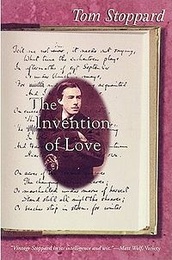
The Invention of Love 1997年版 [演出] 豆瓣
所属 演出: The Invention of Love
剧院: Cottesloe Theatre 导演: Richard Eyre
其它标题: 1997年版 编剧: Tom Stoppard 演员: John Wood / Paul Rhys


The play begins with A. E. Housman, dead at age 77, standing on the bank of the river Styx. Dreaming that he is boarding his boat for the afterlife – captained by a petulant Charon – Housman begins to remember moments from his life, starting with his matriculation to Oxford University, where he studied Classics. The play unfolds as a collection of short scenes that trace, primarily, Housman's relationship with Moses Jackson, the man for whom Housman harboured a lifelong, unrequited love. The scenes also explore the late-Victorian artistic ideals as well as Housman's intellectual growth into a preeminent Latin textual scholar. Throughout the play, the older Housman comments on and occasionally talks to the characters on stage, including his younger self.

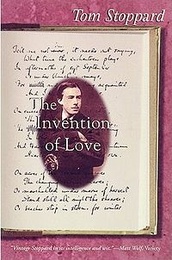
The Invention of Love 2001年版 [演出] 豆瓣
所属 演出: The Invention of Love
剧院: Lyceum Theatre 导演: 未知
其它标题: 2001年版 编剧: Tom Stoppard 演员: Richard Easton / Robert Sean Leonard


The play begins with A. E. Housman, dead at age 77, standing on the bank of the river Styx. Dreaming that he is boarding his boat for the afterlife – captained by a petulant Charon – Housman begins to remember moments from his life, starting with his matriculation to Oxford University, where he studied Classics. The play unfolds as a collection of short scenes that trace, primarily, Housman's relationship with Moses Jackson, the man for whom Housman harboured a lifelong, unrequited love. The scenes also explore the late-Victorian artistic ideals as well as Housman's intellectual growth into a preeminent Latin textual scholar. Throughout the play, the older Housman comments on and occasionally talks to the characters on stage, including his younger self.

戏谑 [演出] 豆瓣
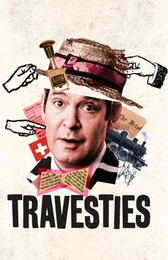
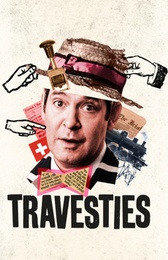
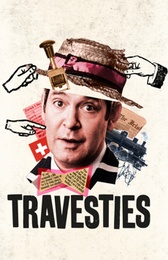
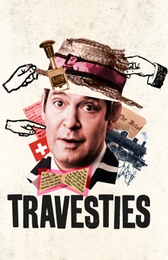
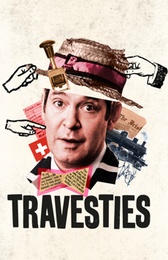
Travesties
类型: Theater 编剧: Tom Stoppard
其它标题: Travesties 导演: Peter Wood / Adrian Noble 演员: John Wood / John Hurt / Tom Bell / Frank Windsor / John Bott
The play's setting is primarily Zürich , Switzerland during the First World War. Three important personalities were living in Zürich at that time: the modernist author James Joyce , the communist revolutionary Lenin , and the founder of Dada , Tristan Tzara . In the play the less notable English consular official Henry Carr, who is likewise a real person and was similarly in Zürich, recalls his perceptions and his experiences with these influential figures. As he reminisces Carr's memory becomes prone to distraction, and instead of predictable historical biography these characters are interpreted through the maze of his mind.

Carr's memories are couched in a Zürich production of Oscar Wilde 's play The Importance of Being Earnest in which he had a starring role. Stoppard uses this production and Carr's mixed feelings surrounding it as a framework to explore art, the war and revolution. Situations from Earnest feature prominently within the action. The characters in Travesties also include versions of two from Earnest , Gwendolen and Cecily, and the comedic situations of many of the other roles are shared by other characters. Stoppard uses many theatrical devices within the play, including puns , limericks , and an extended parody of the vaudeville song " Mister Gallagher and Mister Shean ".

The real Carr did play Algernon with a group of actors called The English Players, for whom the real James Joyce was the business manager. Carr and Joyce had an angry disagreement after the play, which led to legal action and accusations of slander by Joyce. The dispute was settled with the judge deciding in favour of both disputants on different counts. Joyce later parodied Carr, and the English Consul General in Zürich at that time, A. Percy Bennett, as two minor characters in Ulysses , with Carr being portrayed as a drunken, obscene soldier in the "Circe" episode.

After the first performance of Travesties Stoppard received a letter from the real Henry Carr's widow, expressing her surprise that her late husband had found himself imagined as a character in Stoppard's play.
戏谑 百老汇首演版 [演出] 豆瓣
所属 演出: 戏谑
剧院: Aldwych Theatre 导演: Peter Wood
其它标题: 百老汇首演版 编剧: Tom Stoppard 演员: John Wood / John Hurt
The play's setting is primarily Zürich , Switzerland during the First World War. Three important personalities were living in Zürich at that time: the modernist author James Joyce , the communist revolutionary Lenin , and the founder of Dada , Tristan Tzara . In the play the less notable English consular official Henry Carr, who is likewise a real person and was similarly in Zürich, recalls his perceptions and his experiences with these influential figures. As he reminisces Carr's memory becomes prone to distraction, and instead of predictable historical biography these characters are interpreted through the maze of his mind.

Carr's memories are couched in a Zürich production of Oscar Wilde 's play The Importance of Being Earnest in which he had a starring role. Stoppard uses this production and Carr's mixed feelings surrounding it as a framework to explore art, the war and revolution. Situations from Earnest feature prominently within the action. The characters in Travesties also include versions of two from Earnest , Gwendolen and Cecily, and the comedic situations of many of the other roles are shared by other characters. Stoppard uses many theatrical devices within the play, including puns , limericks , and an extended parody of the vaudeville song " Mister Gallagher and Mister Shean ".

The real Carr did play Algernon with a group of actors called The English Players, for whom the real James Joyce was the business manager. Carr and Joyce had an angry disagreement after the play, which led to legal action and accusations of slander by Joyce. The dispute was settled with the judge deciding in favour of both disputants on different counts. Joyce later parodied Carr, and the English Consul General in Zürich at that time, A. Percy Bennett, as two minor characters in Ulysses , with Carr being portrayed as a drunken, obscene soldier in the "Circe" episode.

After the first performance of Travesties Stoppard received a letter from the real Henry Carr's widow, expressing her surprise that her late husband had found himself imagined as a character in Stoppard's play.
戏谑 1993年复排版 [演出] 豆瓣
所属 演出: 戏谑
剧院: Barbican Arts Centre 导演: Adrian Noble
其它标题: 1993年复排版 编剧: Tom Stoppard 演员: Antony Sher / David Westhead
The play's setting is primarily Zürich , Switzerland during the First World War. Three important personalities were living in Zürich at that time: the modernist author James Joyce , the communist revolutionary Lenin , and the founder of Dada , Tristan Tzara . In the play the less notable English consular official Henry Carr, who is likewise a real person and was similarly in Zürich, recalls his perceptions and his experiences with these influential figures. As he reminisces Carr's memory becomes prone to distraction, and instead of predictable historical biography these characters are interpreted through the maze of his mind.

Carr's memories are couched in a Zürich production of Oscar Wilde 's play The Importance of Being Earnest in which he had a starring role. Stoppard uses this production and Carr's mixed feelings surrounding it as a framework to explore art, the war and revolution. Situations from Earnest feature prominently within the action. The characters in Travesties also include versions of two from Earnest , Gwendolen and Cecily, and the comedic situations of many of the other roles are shared by other characters. Stoppard uses many theatrical devices within the play, including puns , limericks , and an extended parody of the vaudeville song " Mister Gallagher and Mister Shean ".

The real Carr did play Algernon with a group of actors called The English Players, for whom the real James Joyce was the business manager. Carr and Joyce had an angry disagreement after the play, which led to legal action and accusations of slander by Joyce. The dispute was settled with the judge deciding in favour of both disputants on different counts. Joyce later parodied Carr, and the English Consul General in Zürich at that time, A. Percy Bennett, as two minor characters in Ulysses , with Carr being portrayed as a drunken, obscene soldier in the "Circe" episode.

After the first performance of Travesties Stoppard received a letter from the real Henry Carr's widow, expressing her surprise that her late husband had found himself imagined as a character in Stoppard's play.
戏谑 2016版 [演出] 豆瓣
所属 演出: 戏谑
剧院: Menier Chocolate Factory 导演: Patrick Marber
其它标题: 2016版 编剧: Tom Stoppard 演员: Tom Hollander / Clare Foster
The play's setting is primarily Zürich , Switzerland during the First World War. Three important personalities were living in Zürich at that time: the modernist author James Joyce , the communist revolutionary Lenin , and the founder of Dada , Tristan Tzara . In the play the less notable English consular official Henry Carr, who is likewise a real person and was similarly in Zürich, recalls his perceptions and his experiences with these influential figures. As he reminisces Carr's memory becomes prone to distraction, and instead of predictable historical biography these characters are interpreted through the maze of his mind.

Carr's memories are couched in a Zürich production of Oscar Wilde 's play The Importance of Being Earnest in which he had a starring role. Stoppard uses this production and Carr's mixed feelings surrounding it as a framework to explore art, the war and revolution. Situations from Earnest feature prominently within the action. The characters in Travesties also include versions of two from Earnest , Gwendolen and Cecily, and the comedic situations of many of the other roles are shared by other characters. Stoppard uses many theatrical devices within the play, including puns , limericks , and an extended parody of the vaudeville song " Mister Gallagher and Mister Shean ".

The real Carr did play Algernon with a group of actors called The English Players, for whom the real James Joyce was the business manager. Carr and Joyce had an angry disagreement after the play, which led to legal action and accusations of slander by Joyce. The dispute was settled with the judge deciding in favour of both disputants on different counts. Joyce later parodied Carr, and the English Consul General in Zürich at that time, A. Percy Bennett, as two minor characters in Ulysses , with Carr being portrayed as a drunken, obscene soldier in the "Circe" episode.

After the first performance of Travesties Stoppard received a letter from the real Henry Carr's widow, expressing her surprise that her late husband had found himself imagined as a character in Stoppard's play.
戏谑 2018 百老汇 复排版 [演出] 豆瓣
所属 演出: 戏谑
剧院: American Airlines Theatre 导演: Patrick Marber
其它标题: 2018 百老汇 复排版 编剧: Tom Stoppard 演员: Tom Hollander / Seth Numrich
The play's setting is primarily Zürich , Switzerland during the First World War. Three important personalities were living in Zürich at that time: the modernist author James Joyce , the communist revolutionary Lenin , and the founder of Dada , Tristan Tzara . In the play the less notable English consular official Henry Carr, who is likewise a real person and was similarly in Zürich, recalls his perceptions and his experiences with these influential figures. As he reminisces Carr's memory becomes prone to distraction, and instead of predictable historical biography these characters are interpreted through the maze of his mind.

Carr's memories are couched in a Zürich production of Oscar Wilde 's play The Importance of Being Earnest in which he had a starring role. Stoppard uses this production and Carr's mixed feelings surrounding it as a framework to explore art, the war and revolution. Situations from Earnest feature prominently within the action. The characters in Travesties also include versions of two from Earnest , Gwendolen and Cecily, and the comedic situations of many of the other roles are shared by other characters. Stoppard uses many theatrical devices within the play, including puns , limericks , and an extended parody of the vaudeville song " Mister Gallagher and Mister Shean ".

The real Carr did play Algernon with a group of actors called The English Players, for whom the real James Joyce was the business manager. Carr and Joyce had an angry disagreement after the play, which led to legal action and accusations of slander by Joyce. The dispute was settled with the judge deciding in favour of both disputants on different counts. Joyce later parodied Carr, and the English Consul General in Zürich at that time, A. Percy Bennett, as two minor characters in Ulysses , with Carr being portrayed as a drunken, obscene soldier in the "Circe" episode.

After the first performance of Travesties Stoppard received a letter from the real Henry Carr's widow, expressing her surprise that her late husband had found himself imagined as a character in Stoppard's play.
罗森克兰茨和吉尔德斯特恩已死 [演出] 豆瓣
Розенкранц и Гильденстерн мертвы
类型: Theater 编剧: Tom Stoppard
其它标题: Розенкранц и Гильденстерн мертвы / Rosencrantz and Guildenstern Are Dead / Rozenkrancas ir Gildensternas mirę / רוזנקרנץ וגילדנשטרן מתים 导演: Yury Butusov / Yevgeny Arye
Tomo Stoppardo – vieno svarbiausių šiuolaikinio teatro dramaturgų, absurdo teatro apologeto – pjesė „Rozenkrancas ir Gildensternas mirę“ („Rosencrantz and Guildenstern are Dead“) pirmą kartą buvo suvaidinta 1967-ųjų balandį Londone, „The Old Vic“ teatre. Tuomet T. Stoppardas buvo mažai kam žinomas pradedantis dramaturgas, teatro kritikas. Dramaturgo valia pjesėje du kuklūs Williamo Shakespeareʼo pjesės „Hamletas“ personažai Rozenkrancas ir Gildensternas, arba žmonės, laiku nepasakę „ne“, tapo šiuolaikinės dramaturgijos ir mūsų laikų herojais.

Visiems žinomas klasikinis W. Shakespeareʼo siužetas pjesėje meistriškai apžaidžiamas: Danijos princo Hamleto vaikystės ir studijų Vokietijos universitete draugus Rozenkrancą ir Gildensterną Hamleto tėvo žudikas karalius Klaudijus pasikviečia palydėti princą į Angliją. Karalius įteikia jiems slaptą laišką, kuriame prašoma nukirsti galvą teisėtam karūnos įpėdiniui. Rozenkrancas ir Gildensternas Hamletą lydi į neabejotiną mirtį, tačiau princui sėkmingai apkeitus laišką patys patenka į likimo pinkles.

Šiuolaikinės dramaturgijos tyrinėtojai akcentuoja, kad pjesėje „Rozenkrancas ir Gildensternas mirę“ sąmojingai sulydyta klasikinė šekspyriškoji dramaturgija ir beketiški literatūriniai eksperimentai, absurdo estetika, o intelektualūs galvosūkiai, virtuoziškas žodžių žaismas – su angliška ironija.

Režisierius Jurijus Butusovas teigia ypač vertinantis šios jau klasikine vadinamos pjesės poetiškumą ir klasikinės absurdo stilistikos diktuojamas galimybes. „Rozenkrancas ir Gildensternas mirę“ labai taikliai pataiko į šių dienų kontekstą, skaudulius ir turėtų priminti žiūrovams prarastąjį rojų, žmogiškos pilnatvės, harmonijos, laimės neįmanomybę. Teatro teatre iliuziją J. Butusovo spektaklyje atskleis ir sustiprins lakoniška, netikėtomis medžiagomis ir tekstūromis išsiskirianti spektaklio dailininko Mariaus Nekrošiaus kuriama scenografija bei kostiumai. Ši pjesė Lietuvos teatre statoma pirmąjį kartą.
罗森克兰茨和吉尔德斯特恩已死 版本1 [演出] 豆瓣
所属 演出: 罗森克兰茨和吉尔德斯特恩已死
语言: 俄语 剧团: 维尔纽斯老剧院 剧院: 维尔纽斯老剧院 导演: Yury Butusov
其它标题: 版本1 编剧: Tom Stoppard
Tomo Stoppardo – vieno svarbiausių šiuolaikinio teatro dramaturgų, absurdo teatro apologeto – pjesė „Rozenkrancas ir Gildensternas mirę“ („Rosencrantz and Guildenstern are Dead“) pirmą kartą buvo suvaidinta 1967-ųjų balandį Londone, „The Old Vic“ teatre. Tuomet T. Stoppardas buvo mažai kam žinomas pradedantis dramaturgas, teatro kritikas. Dramaturgo valia pjesėje du kuklūs Williamo Shakespeareʼo pjesės „Hamletas“ personažai Rozenkrancas ir Gildensternas, arba žmonės, laiku nepasakę „ne“, tapo šiuolaikinės dramaturgijos ir mūsų laikų herojais.

Visiems žinomas klasikinis W. Shakespeareʼo siužetas pjesėje meistriškai apžaidžiamas: Danijos princo Hamleto vaikystės ir studijų Vokietijos universitete draugus Rozenkrancą ir Gildensterną Hamleto tėvo žudikas karalius Klaudijus pasikviečia palydėti princą į Angliją. Karalius įteikia jiems slaptą laišką, kuriame prašoma nukirsti galvą teisėtam karūnos įpėdiniui. Rozenkrancas ir Gildensternas Hamletą lydi į neabejotiną mirtį, tačiau princui sėkmingai apkeitus laišką patys patenka į likimo pinkles.

Šiuolaikinės dramaturgijos tyrinėtojai akcentuoja, kad pjesėje „Rozenkrancas ir Gildensternas mirę“ sąmojingai sulydyta klasikinė šekspyriškoji dramaturgija ir beketiški literatūriniai eksperimentai, absurdo estetika, o intelektualūs galvosūkiai, virtuoziškas žodžių žaismas – su angliška ironija.

Režisierius Jurijus Butusovas teigia ypač vertinantis šios jau klasikine vadinamos pjesės poetiškumą ir klasikinės absurdo stilistikos diktuojamas galimybes. „Rozenkrancas ir Gildensternas mirę“ labai taikliai pataiko į šių dienų kontekstą, skaudulius ir turėtų priminti žiūrovams prarastąjį rojų, žmogiškos pilnatvės, harmonijos, laimės neįmanomybę. Teatro teatre iliuziją J. Butusovo spektaklyje atskleis ir sustiprins lakoniška, netikėtomis medžiagomis ir tekstūromis išsiskirianti spektaklio dailininko Mariaus Nekrošiaus kuriama scenografija bei kostiumai. Ši pjesė Lietuvos teatre statoma pirmąjį kartą.
罗森克兰茨和吉尔德斯特恩已死 版本2 [演出] 豆瓣
所属 演出: 罗森克兰茨和吉尔德斯特恩已死
语言: 俄语 剧团: 以色列盖谢尔剧院 剧院: 以色列盖谢尔剧院 导演: Yevgeny Arye / Amit Epstein
其它标题: 版本2 编剧: Tom Stoppard
Tomo Stoppardo – vieno svarbiausių šiuolaikinio teatro dramaturgų, absurdo teatro apologeto – pjesė „Rozenkrancas ir Gildensternas mirę“ („Rosencrantz and Guildenstern are Dead“) pirmą kartą buvo suvaidinta 1967-ųjų balandį Londone, „The Old Vic“ teatre. Tuomet T. Stoppardas buvo mažai kam žinomas pradedantis dramaturgas, teatro kritikas. Dramaturgo valia pjesėje du kuklūs Williamo Shakespeareʼo pjesės „Hamletas“ personažai Rozenkrancas ir Gildensternas, arba žmonės, laiku nepasakę „ne“, tapo šiuolaikinės dramaturgijos ir mūsų laikų herojais.

Visiems žinomas klasikinis W. Shakespeareʼo siužetas pjesėje meistriškai apžaidžiamas: Danijos princo Hamleto vaikystės ir studijų Vokietijos universitete draugus Rozenkrancą ir Gildensterną Hamleto tėvo žudikas karalius Klaudijus pasikviečia palydėti princą į Angliją. Karalius įteikia jiems slaptą laišką, kuriame prašoma nukirsti galvą teisėtam karūnos įpėdiniui. Rozenkrancas ir Gildensternas Hamletą lydi į neabejotiną mirtį, tačiau princui sėkmingai apkeitus laišką patys patenka į likimo pinkles.

Šiuolaikinės dramaturgijos tyrinėtojai akcentuoja, kad pjesėje „Rozenkrancas ir Gildensternas mirę“ sąmojingai sulydyta klasikinė šekspyriškoji dramaturgija ir beketiški literatūriniai eksperimentai, absurdo estetika, o intelektualūs galvosūkiai, virtuoziškas žodžių žaismas – su angliška ironija.

Režisierius Jurijus Butusovas teigia ypač vertinantis šios jau klasikine vadinamos pjesės poetiškumą ir klasikinės absurdo stilistikos diktuojamas galimybes. „Rozenkrancas ir Gildensternas mirę“ labai taikliai pataiko į šių dienų kontekstą, skaudulius ir turėtų priminti žiūrovams prarastąjį rojų, žmogiškos pilnatvės, harmonijos, laimės neįmanomybę. Teatro teatre iliuziją J. Butusovo spektaklyje atskleis ir sustiprins lakoniška, netikėtomis medžiagomis ir tekstūromis išsiskirianti spektaklio dailininko Mariaus Nekrošiaus kuriama scenografija bei kostiumai. Ši pjesė Lietuvos teatre statoma pirmąjį kartą.
乌托邦彼岸 [演出] 豆瓣
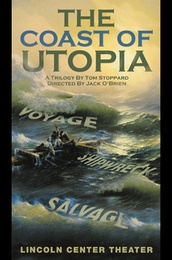
The Coast of Utopia
类型: Theater 编剧: Tom Stoppard
其它标题: The Coast of Utopia 导演: Trevor Nunn / Jack O'Brien 演员: Brían F. O'Byrne / Richard Easton / Jennifer Ehle / Billy Crudup / Ethan Hawke
The Coast of Utopia is a 2002 trilogy of plays: Voyage , Shipwreck , and Salvage , written by Tom Stoppard with focus on the philosophical debates in pre-revolution Russia between 1833 and 1866. It was the recipient of the 2007 Tony Award for Best Play . The title comes from a chapter in Avrahm Yarmolinsky 's book Road to Revolution: A Century of Russian Radicalism (1959).

The trilogy, nine hours in total, premiered with Voyage on 22 June 2002 at the National Theatre's Olivier auditorium in repertory, directed by Trevor Nunn . The openings of Shipwreck and Salvage followed on 8 July, and 19 July, completing its run on 23 November 2002. In 2006, directed by Jack O'Brien , the plays debuted on Broadway at the Vivian Beaumont Theater at Lincoln Center , New York City , where it closed on May 13, 2007 after a combined total of 124 performances.

The trilogy has also been performed in Russia; it opened at Moscow 's Russian Academic Youth Theatre in October 2007, directed by Alexey Borodin.

The trilogy received its Japanese premiere at Theater Cocoon, Bunkamura in Tokyo on 12 September 2009 and completed its run (including 10 one-day marathon performances) on 4 October 2009. The production was directed by Yukio Ninagawa .
乌托邦彼岸 London premiere版 [演出] 豆瓣
所属 演出: 乌托邦彼岸
导演: Trevor Nunn
其它标题: London premiere版 编剧: Tom Stoppard
The Coast of Utopia is a 2002 trilogy of plays: Voyage , Shipwreck , and Salvage , written by Tom Stoppard with focus on the philosophical debates in pre-revolution Russia between 1833 and 1866. It was the recipient of the 2007 Tony Award for Best Play . The title comes from a chapter in Avrahm Yarmolinsky 's book Road to Revolution: A Century of Russian Radicalism (1959).

The trilogy, nine hours in total, premiered with Voyage on 22 June 2002 at the National Theatre's Olivier auditorium in repertory, directed by Trevor Nunn . The openings of Shipwreck and Salvage followed on 8 July, and 19 July, completing its run on 23 November 2002. In 2006, directed by Jack O'Brien , the plays debuted on Broadway at the Vivian Beaumont Theater at Lincoln Center , New York City , where it closed on May 13, 2007 after a combined total of 124 performances.

The trilogy has also been performed in Russia; it opened at Moscow 's Russian Academic Youth Theatre in October 2007, directed by Alexey Borodin.

The trilogy received its Japanese premiere at Theater Cocoon, Bunkamura in Tokyo on 12 September 2009 and completed its run (including 10 one-day marathon performances) on 4 October 2009. The production was directed by Yukio Ninagawa .
乌托邦彼岸 Broadway debut版 [演出] 豆瓣
所属 演出: 乌托邦彼岸
剧院: Vivian Beaumont Theater 导演: Jack O'Brien
其它标题: Broadway debut版 编剧: Tom Stoppard 演员: Brían F. O'Byrne / Richard Easton
The Coast of Utopia is a 2002 trilogy of plays: Voyage , Shipwreck , and Salvage , written by Tom Stoppard with focus on the philosophical debates in pre-revolution Russia between 1833 and 1866. It was the recipient of the 2007 Tony Award for Best Play . The title comes from a chapter in Avrahm Yarmolinsky 's book Road to Revolution: A Century of Russian Radicalism (1959).

The trilogy, nine hours in total, premiered with Voyage on 22 June 2002 at the National Theatre's Olivier auditorium in repertory, directed by Trevor Nunn . The openings of Shipwreck and Salvage followed on 8 July, and 19 July, completing its run on 23 November 2002. In 2006, directed by Jack O'Brien , the plays debuted on Broadway at the Vivian Beaumont Theater at Lincoln Center , New York City , where it closed on May 13, 2007 after a combined total of 124 performances.

The trilogy has also been performed in Russia; it opened at Moscow 's Russian Academic Youth Theatre in October 2007, directed by Alexey Borodin.

The trilogy received its Japanese premiere at Theater Cocoon, Bunkamura in Tokyo on 12 September 2009 and completed its run (including 10 one-day marathon performances) on 4 October 2009. The production was directed by Yukio Ninagawa .
The Real Thing [演出] 豆瓣
类型: Theater 编剧: Tom Stoppard
导演: 未知 / David Leveaux 演员: Glenn Close / Jeremy Irons / Jennifer Ehle / Stephen Dillane / Maggie Gyllenhaal
Setting: London in 1982

Act I


In the first scene the coldly witty Max correctly accuses his distant and travelling wife, Charlotte, of infidelity. She leaves embarrassed and angry.


The second scene appears to follow directly after the first, but Charlotte's personality has changed completely, and she is now married to a playwright named Henry. Gradually the audience realises that Charlotte is an actress, and the first scene was her performance in a play that Henry, her husband, wrote. She is unhappy with the play, believing that Henry gives short shrift to the female character in order to show off his own wit through the mouth of Max.


Max and his wife Annie drop by for a visit to Charlotte and Henry. Without the benefit of Henry's dialogue, Max turns out to be a likeable but negligible fellow, and Annie is, according to the script, "very much like the woman Charlotte has ceased to be." Annie is a devoted activist on behalf of an imprisoned vandal, Brodie, and Henry mocks her as a sentimental do-gooder, giving offence to Max. But when Annie and Henry are left alone, it's revealed that their fight was also a performance: they are having an affair, and she agrees to meet him later on the pretext of visiting Brodie in prison.


Max discovers the affair, and Annie leaves him to be with Henry. Soon, Henry is reduced to writing television scripts in order to pay alimony to Charlotte. He struggles to write a play about his love for Annie, but finds it difficult to find the right language to express sincere emotion: he is more comfortable with comedy.

Act II


Two years later, Henry's play about Annie remains unwritten. Annie asks him to ghost-write a play by the prisoner Brodie, whom she continues to visit. Brodie's incoherent anarchist politics, anti-intellectualism , and lack of ability for writing are the antithesis of everything Henry values. Annie discounts this in favour of the intention behind the writing. Henry defends the importance of beauty in language and skill in writing using an analogy with a cricket bat: good writing is like hitting a ball with a cricket bat (ie something that has been carefully designed to hit balls in the best manner possible); bad writing is like hitting it with a plank of wood (ie, something that has the same composition as a cricket bat, and bears it some resemblance, but is ultimately random and inferior).


When Annie is cast in a production of 'Tis Pity She's a Whore in Glasgow, she must be away from Henry for some time, and Henry visits Charlotte and their daughter Debbie. The teenage Debbie declares that monogamy is a thing of the past, a form of colonisation. Henry gently cautions the girl against his own vice of making clever phrases for their own sake, but he is shaken by her cynicism nevertheless. For her part, Charlotte breezily admits to multiple affairs during their marriage, and tells him that his affair with Annie only caused trouble because he treated it romantically instead of as a source of fun.


Henry returns home in a frenzy of jealousy and ransacks his and Annie's apartment searching for evidence of infidelity. His confrontation with Annie echoes the scene from the play he wrote that was performed in the first act of The Real Thing , but Annie has more to say than his imaginary wife did. She admits that she is having an affair with her young co-star Billy, but refuses to either give Billy up or leave Henry: both romances have a moral claim on her, and Henry will just have to accept it. With pain, he does.


As if their relationship were not under enough strain, Brodie is released from prison and stops by for a visit. He turns out to be a prize oaf, with all of Henry's arrogance and elitism, but none of the genuine skill or eloquence to back it up. At last, Annie pushes a bowl of dip in his face and throws him out of the house, and peace between her and Henry is restored. The play ends with a phone call from Max, who tells Henry that he has become engaged.
The Real Thing 1982年版 [演出] 豆瓣
所属 演出: The Real Thing
导演: 未知
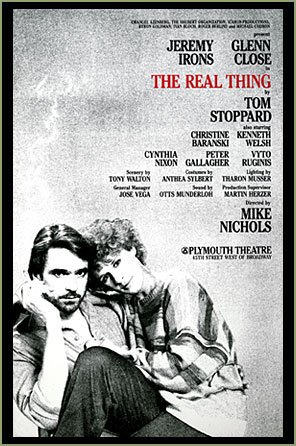
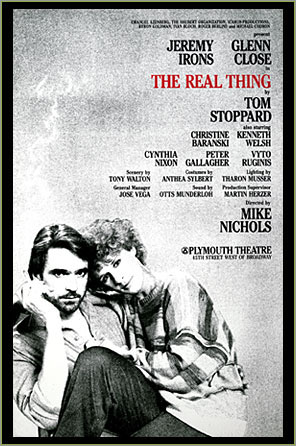
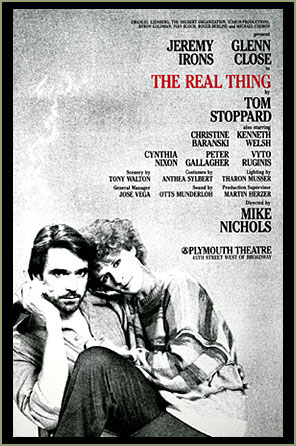
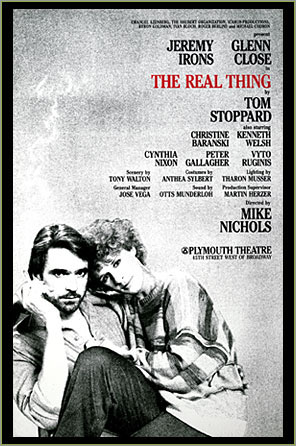
其它标题: 1982年版 编剧: Tom Stoppard 演员: Glenn Close / Jeremy Irons
Setting: London in 1982

Act I


In the first scene the coldly witty Max correctly accuses his distant and travelling wife, Charlotte, of infidelity. She leaves embarrassed and angry.


The second scene appears to follow directly after the first, but Charlotte's personality has changed completely, and she is now married to a playwright named Henry. Gradually the audience realises that Charlotte is an actress, and the first scene was her performance in a play that Henry, her husband, wrote. She is unhappy with the play, believing that Henry gives short shrift to the female character in order to show off his own wit through the mouth of Max.


Max and his wife Annie drop by for a visit to Charlotte and Henry. Without the benefit of Henry's dialogue, Max turns out to be a likeable but negligible fellow, and Annie is, according to the script, "very much like the woman Charlotte has ceased to be." Annie is a devoted activist on behalf of an imprisoned vandal, Brodie, and Henry mocks her as a sentimental do-gooder, giving offence to Max. But when Annie and Henry are left alone, it's revealed that their fight was also a performance: they are having an affair, and she agrees to meet him later on the pretext of visiting Brodie in prison.


Max discovers the affair, and Annie leaves him to be with Henry. Soon, Henry is reduced to writing television scripts in order to pay alimony to Charlotte. He struggles to write a play about his love for Annie, but finds it difficult to find the right language to express sincere emotion: he is more comfortable with comedy.

Act II


Two years later, Henry's play about Annie remains unwritten. Annie asks him to ghost-write a play by the prisoner Brodie, whom she continues to visit. Brodie's incoherent anarchist politics, anti-intellectualism , and lack of ability for writing are the antithesis of everything Henry values. Annie discounts this in favour of the intention behind the writing. Henry defends the importance of beauty in language and skill in writing using an analogy with a cricket bat: good writing is like hitting a ball with a cricket bat (ie something that has been carefully designed to hit balls in the best manner possible); bad writing is like hitting it with a plank of wood (ie, something that has the same composition as a cricket bat, and bears it some resemblance, but is ultimately random and inferior).


When Annie is cast in a production of 'Tis Pity She's a Whore in Glasgow, she must be away from Henry for some time, and Henry visits Charlotte and their daughter Debbie. The teenage Debbie declares that monogamy is a thing of the past, a form of colonisation. Henry gently cautions the girl against his own vice of making clever phrases for their own sake, but he is shaken by her cynicism nevertheless. For her part, Charlotte breezily admits to multiple affairs during their marriage, and tells him that his affair with Annie only caused trouble because he treated it romantically instead of as a source of fun.


Henry returns home in a frenzy of jealousy and ransacks his and Annie's apartment searching for evidence of infidelity. His confrontation with Annie echoes the scene from the play he wrote that was performed in the first act of The Real Thing , but Annie has more to say than his imaginary wife did. She admits that she is having an affair with her young co-star Billy, but refuses to either give Billy up or leave Henry: both romances have a moral claim on her, and Henry will just have to accept it. With pain, he does.


As if their relationship were not under enough strain, Brodie is released from prison and stops by for a visit. He turns out to be a prize oaf, with all of Henry's arrogance and elitism, but none of the genuine skill or eloquence to back it up. At last, Annie pushes a bowl of dip in his face and throws him out of the house, and peace between her and Henry is restored. The play ends with a phone call from Max, who tells Henry that he has become engaged.
The Real Thing 2000年版 [演出] 豆瓣
所属 演出: The Real Thing
导演: David Leveaux
其它标题: 2000年版 编剧: Tom Stoppard 演员: Jennifer Ehle / Stephen Dillane
Setting: London in 1982

Act I


In the first scene the coldly witty Max correctly accuses his distant and travelling wife, Charlotte, of infidelity. She leaves embarrassed and angry.


The second scene appears to follow directly after the first, but Charlotte's personality has changed completely, and she is now married to a playwright named Henry. Gradually the audience realises that Charlotte is an actress, and the first scene was her performance in a play that Henry, her husband, wrote. She is unhappy with the play, believing that Henry gives short shrift to the female character in order to show off his own wit through the mouth of Max.


Max and his wife Annie drop by for a visit to Charlotte and Henry. Without the benefit of Henry's dialogue, Max turns out to be a likeable but negligible fellow, and Annie is, according to the script, "very much like the woman Charlotte has ceased to be." Annie is a devoted activist on behalf of an imprisoned vandal, Brodie, and Henry mocks her as a sentimental do-gooder, giving offence to Max. But when Annie and Henry are left alone, it's revealed that their fight was also a performance: they are having an affair, and she agrees to meet him later on the pretext of visiting Brodie in prison.


Max discovers the affair, and Annie leaves him to be with Henry. Soon, Henry is reduced to writing television scripts in order to pay alimony to Charlotte. He struggles to write a play about his love for Annie, but finds it difficult to find the right language to express sincere emotion: he is more comfortable with comedy.

Act II


Two years later, Henry's play about Annie remains unwritten. Annie asks him to ghost-write a play by the prisoner Brodie, whom she continues to visit. Brodie's incoherent anarchist politics, anti-intellectualism , and lack of ability for writing are the antithesis of everything Henry values. Annie discounts this in favour of the intention behind the writing. Henry defends the importance of beauty in language and skill in writing using an analogy with a cricket bat: good writing is like hitting a ball with a cricket bat (ie something that has been carefully designed to hit balls in the best manner possible); bad writing is like hitting it with a plank of wood (ie, something that has the same composition as a cricket bat, and bears it some resemblance, but is ultimately random and inferior).


When Annie is cast in a production of 'Tis Pity She's a Whore in Glasgow, she must be away from Henry for some time, and Henry visits Charlotte and their daughter Debbie. The teenage Debbie declares that monogamy is a thing of the past, a form of colonisation. Henry gently cautions the girl against his own vice of making clever phrases for their own sake, but he is shaken by her cynicism nevertheless. For her part, Charlotte breezily admits to multiple affairs during their marriage, and tells him that his affair with Annie only caused trouble because he treated it romantically instead of as a source of fun.


Henry returns home in a frenzy of jealousy and ransacks his and Annie's apartment searching for evidence of infidelity. His confrontation with Annie echoes the scene from the play he wrote that was performed in the first act of The Real Thing , but Annie has more to say than his imaginary wife did. She admits that she is having an affair with her young co-star Billy, but refuses to either give Billy up or leave Henry: both romances have a moral claim on her, and Henry will just have to accept it. With pain, he does.


As if their relationship were not under enough strain, Brodie is released from prison and stops by for a visit. He turns out to be a prize oaf, with all of Henry's arrogance and elitism, but none of the genuine skill or eloquence to back it up. At last, Annie pushes a bowl of dip in his face and throws him out of the house, and peace between her and Henry is restored. The play ends with a phone call from Max, who tells Henry that he has become engaged.
The Real Thing 2014 Roundabout Revival版 [演出] 豆瓣
所属 演出: The Real Thing
导演: Sam Gold
其它标题: 2014 Roundabout Revival版 编剧: Tom Stoppard 演员: Maggie Gyllenhaal / Ewan Mcgregor
Setting: London in 1982

Act I


In the first scene the coldly witty Max correctly accuses his distant and travelling wife, Charlotte, of infidelity. She leaves embarrassed and angry.


The second scene appears to follow directly after the first, but Charlotte's personality has changed completely, and she is now married to a playwright named Henry. Gradually the audience realises that Charlotte is an actress, and the first scene was her performance in a play that Henry, her husband, wrote. She is unhappy with the play, believing that Henry gives short shrift to the female character in order to show off his own wit through the mouth of Max.


Max and his wife Annie drop by for a visit to Charlotte and Henry. Without the benefit of Henry's dialogue, Max turns out to be a likeable but negligible fellow, and Annie is, according to the script, "very much like the woman Charlotte has ceased to be." Annie is a devoted activist on behalf of an imprisoned vandal, Brodie, and Henry mocks her as a sentimental do-gooder, giving offence to Max. But when Annie and Henry are left alone, it's revealed that their fight was also a performance: they are having an affair, and she agrees to meet him later on the pretext of visiting Brodie in prison.


Max discovers the affair, and Annie leaves him to be with Henry. Soon, Henry is reduced to writing television scripts in order to pay alimony to Charlotte. He struggles to write a play about his love for Annie, but finds it difficult to find the right language to express sincere emotion: he is more comfortable with comedy.

Act II


Two years later, Henry's play about Annie remains unwritten. Annie asks him to ghost-write a play by the prisoner Brodie, whom she continues to visit. Brodie's incoherent anarchist politics, anti-intellectualism , and lack of ability for writing are the antithesis of everything Henry values. Annie discounts this in favour of the intention behind the writing. Henry defends the importance of beauty in language and skill in writing using an analogy with a cricket bat: good writing is like hitting a ball with a cricket bat (ie something that has been carefully designed to hit balls in the best manner possible); bad writing is like hitting it with a plank of wood (ie, something that has the same composition as a cricket bat, and bears it some resemblance, but is ultimately random and inferior).


When Annie is cast in a production of 'Tis Pity She's a Whore in Glasgow, she must be away from Henry for some time, and Henry visits Charlotte and their daughter Debbie. The teenage Debbie declares that monogamy is a thing of the past, a form of colonisation. Henry gently cautions the girl against his own vice of making clever phrases for their own sake, but he is shaken by her cynicism nevertheless. For her part, Charlotte breezily admits to multiple affairs during their marriage, and tells him that his affair with Annie only caused trouble because he treated it romantically instead of as a source of fun.


Henry returns home in a frenzy of jealousy and ransacks his and Annie's apartment searching for evidence of infidelity. His confrontation with Annie echoes the scene from the play he wrote that was performed in the first act of The Real Thing , but Annie has more to say than his imaginary wife did. She admits that she is having an affair with her young co-star Billy, but refuses to either give Billy up or leave Henry: both romances have a moral claim on her, and Henry will just have to accept it. With pain, he does.


As if their relationship were not under enough strain, Brodie is released from prison and stops by for a visit. He turns out to be a prize oaf, with all of Henry's arrogance and elitism, but none of the genuine skill or eloquence to back it up. At last, Annie pushes a bowl of dip in his face and throws him out of the house, and peace between her and Henry is restored. The play ends with a phone call from Max, who tells Henry that he has become engaged.