Edward S. Herman — 作者 (6)
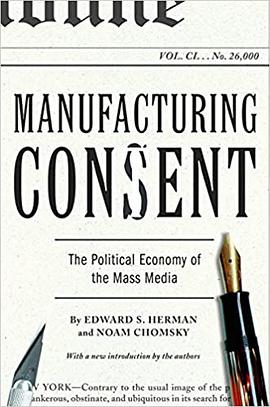
Manufacturing Consent [图书] 豆瓣 Eggplant.place Goodreads
作者: Edward S. Herman / Noam Chomsky publishing house: Pantheon 2002 - 1 其它标题: Manufacturing Consent: The Political Economy of the Mass Media
In this pathbreaking work, now with a new introduction, Edward S. Herman and Noam Chomsky show that, contrary to the usual image of the news media as cantankerous, obstinate, and ubiquitous in their search for truth and defense of justice, in their actual practice they defend the economic, social, and political agendas of the privileged groups that dominate domestic society, the state, and the global order.

Based on a series of case studies—including the media’s dichotomous treatment of “worthy” versus “unworthy” victims, “legitimizing” and “meaningless” Third World elections, and devastating critiques of media coverage of the U.S. wars against Indochina—Herman and Chomsky draw on decades of criticism and research to propose a Propaganda Model to explain the media’s behavior and performance. Their new introduction updates the Propaganda Model and the earlier case studies, and it discusses several other applications. These include the manner in which the media covered the passage of the North American Free Trade Agreement and subsequent Mexican financial meltdown of 1994-1995, the media’s handling of the protests against the World Trade Organization, World Bank, and International Monetary Fund in 1999 and 2000, and the media’s treatment of the chemical industry and its regulation. What emerges from this work is a powerful assessment of how propagandistic the U.S. mass media are, how they systematically fail to live up to their self-image as providers of the kind of information that people need to make sense of the world, and how we can understand their function in a radically new way.
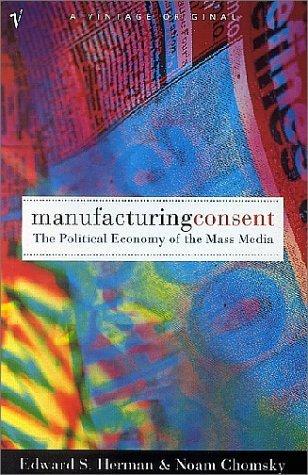
Manufacturing Consent [图书] 豆瓣 豆瓣
作者: Edward S. Herman / Noam Chomsky publishing house: Vintage Uk 1995 - 3
Contrary to the usual image of the press as cantankerous, obstinate, and ubiquitous in its search for truth, Edward Herman and Noam Chomsky depict how an underlying elite consensus largely structures all facets of the news. They skilfully dissect the way in which the marketplace and the economics of publishing significantly shape the news. They reveal how issues are framed and topics chosen, and contrast the double standards underlying accounts of free elections, a free press, and governmental repression between Nicaragua and El Salvador; between the Russian invasion of Afghanistan and the American invasion of Vietnam; between the genocide in Cambodia under a pro-American government and genocide under Pol Pot. What emerges from this groundbreaking work is an account of just how propagandistic our mass media are, and how we can learn to read them and see their function in a radically new way.
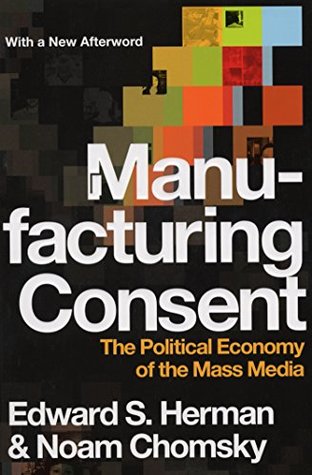
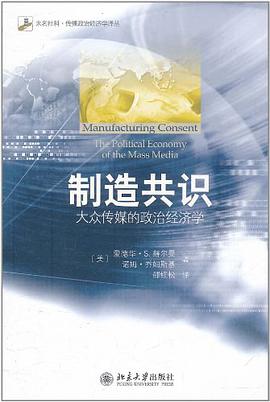
制造共识 [图书] 豆瓣
Manufacturing Consent: Political Economy of the Mass Media
作者: Edward S. Herman / Noam Chomsky 译者: 邵红松 译 publishing house: 北京大学出版社 2011 - 9
爱德华·S.赫尔曼和诺姆·乔姆斯基以这部再版新增了导论、极具开创性的著作向读者揭示出,新闻媒体与其以往好战、执著、无所不在地探求真相和捍卫正义的形象截然不同,它们在实践中维护的是对国内社会、国家以及全球秩序起主导作用的精英阶层的经济、社会和政治议程。
赫尔曼与乔姆斯基研究了数十年间的评论与研究资料,对一系列案例,包括媒体对“有价值”和“无价值”的受害者、“合法的”与“毫无意义的”第三世界选举等事件的两分法报道进行了研究,对媒体就美国对印度支那的侵略战争所作的报道进行无可辩驳的批判,并基于上述研究与批判提出了一个用于分析媒体行为与表现的宣传模型。新增的导论对宣传模型及以往案例进行了更新阐述并讨论了该模型适用的其他案例范畴,如媒体对《北美自由贸易协定》及此后的1994--1995年墨西哥的金融大崩溃的报道,媒体对1999年和2000年针对世贸组织、世界银行和国际货币基金组织的抗议活动的报道手段,以及媒体对化工产业及针对该产业的规范所作报道的处理等等。通过上述强有力的分析,本书得出结论认为美国大众媒体极具宣传特性,它们没能为人们真实地了解世界提供它们作为媒体本应提供的信息。本书为我们了解大众媒体的功能提供了一个全新的视角。
Manufacturing Consent: The Political Economy of the Mass Media [图书] Goodreads
Manufacturing Consent: The Political Economy of the Mass Media
作者: Edward S. Herman / Noam Chomsky publishing house: Vintage Digital 2010 - 3
We normally think that the press are cantankerous, obstinate, and ubiquitous in its search for truth. In
Edward Herman and Noam Chomsky show how an underlying elite consensus largely structures all facets of the news. Far from challenging established power, the media work hard to discover and mirror its assumptions. The authors skilfully dissect the way in which the marketplace and the economics of publishing significantly shape the news. They reveal how issues are framed and topics chosen, and contrast the double standards underlying accounts of free elections, a free press, and governmental repression. The authors conclude that the modern mass media can best be understood in terms of a 'propaganda model'. News and entertainment companies dedicate themselves to profit within the established system. Their interests require that they support the governing assumptions of state and private power. The propaganda model provokes outrage from journalists, editors and broadcasters, but twenty years after first publication,
remains the most important critique of the mass media.