Composer Note:
Shaker Loops began as a string quartet with the title Wavemaker. At the time, like many a young composer, I was essentially unaware of the nature of those musical materials I had chosen for my tools. Having experienced a few of the seminal pieces of American Minimalism during the early 1970's, I thought their combination of stripped-down harmonic and rhythmic discourse might be just the ticket for my own unformed yearnings. I gradually developed a scheme for composing that was partly indebted to the repetitive procedures of Minimalism and partly an outgrowth of my interest in waveforms. The "waves" of Wavemaker were to be long sequences of oscillating melodic cells that created a rippling, shimmering complex of patterns like the surface of a slightly agitated pond or lake. But my technique lagged behind my inspiration, and this rippling pond very quickly went dry. Wavemaker crashed and burned at its first performance. The need for a larger, thicker ensemble and for a more flexible, less theory-bound means of composing became very apparent.
Fortunately I had in my students at the San Francisco Conservatory of Music an ensemble willing to tryout new ideas, and with the original Wavemaker scrapped I worked over the next four months to pick up the pieces and start over. I held on to the idea of the oscillating patterns and made an overall structure that could embrace much more variety and emotional range. Most importantly the quartet became a septet, thereby adding a sonic mass and the potential for more acoustical power. The "loops" idea was a technique from the era of tape music where small lengths of prerecorded tape attached end to end could repeat melodic or rhythmic figures ad infinitum. (Steve Reich's It's Gonna Rain is the paradigm of this technique.) The Shakers got into the act partly as a pun on the musical term "to shake", meaning either to make a tremolo with the bow across the string or else to trill rapidly from one note to another. The flip side of the pun was suggested by my own childhood memories of growing up not far from a defunct Shaker colony near Canterbury, New Hampshire. Although, as has since been pointed out to me, the term "Shaker" itself is derogatory, it nevertheless summons up the vision of these otherwise pious and industrious souls caught up in the ecstatic frenzy of a dance that culminated in an epiphany of physical and spiritual transcendence. This dynamic, almost electrically charged element, so out of place in the orderly mechanistic universe of Minimalism, gave the music its raison d'etre and ultimately led to the full realization of the piece. Shaker Loops continues to be one of my most performed pieces. There are partisans who favor the clarity and individualism of the solo septet version, and there are those who prefer the orchestral version for its added density and power. The piece has several times been choreographed and even enjoyed a moment of cult status in the movie Barfly, an autobiographical account of the poet Charles Bukowsky's down and out days on LA's Skid Row. In a famous scene Bukowsky (Mickey Rourke), having been battered and bloodied by his drunken girlfriend (Faye Dunaway) holes up in a flophouse room, writing poems in a fit of inspiration to the accompaniment of the insistent buzz of "Shaking and Trembling".
-- John Adams
John Adams on the Violin Concerto
The proposal to write a violin concerto came from the violinist Jorja Fleezanis, a close friend and enthusiastic champion of new music. Composers who are not string players are seriously challenged when it comes to writing a concerto, and close collaborations are the rule, as it was in this case. For those who have not played a violin or a cello, the physical relation of the turned-over left wrist and grasping fingers defies logic. Intervals that ought to be simple are awkward, while gestures that seem humanly impossible turn out to be rudimentary.
A concerto without a strong melodic statement is hard to imagine. I knew that if I were to compose a violin concerto I would have to solve the issue of melody. I could not possibly have produced such a thing in the 1980’s because my compositional language was principally one of massed sonorities riding on great rippling waves of energy. Harmony and rhythm were the driving forces in my music of that decade; melody was almost non-existent. The “News” aria in Nixon in China, for example, is less melody than it is declamation riding over what feels like the chords of a giant ukelele.
But in the early 1990’s, during the composition of The Death of Klinghoffer, I began to think more about melody. This was perhaps a result of being partially liberated by a new chromatic richness that was creeping into my sound, but it was more likely due to the need to find a melodic means to set Alice Goodman’s psychologically complex libretto.
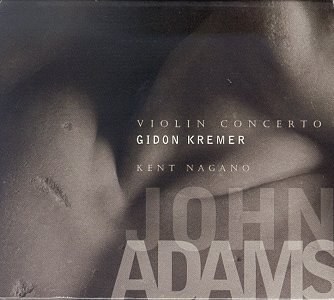
As if to compensate for years of neglecting the “singing line,” the Violin Concerto (1993) emerged as an almost implacably melodic piece—a example of “hypermelody.” The violin spins one long phrase after another wihout stop for nearly the full thirty-five minutes of the piece. I adopted the classic form of the concerto as a kind of Platonic model, even to the point of placing a brief cadenza for the soloist at the traditional locus near the end of the first movement. The concerto opens with a long extended rhapsody for the violin, a free, fantastical “endless melody” over the regularly pulsing staircase of upwardly rising figures in the orchestra. The second movement takes a received form, the chaconne, and gently stretches, compresses, and transfigures its contours and modalities while the violin floats like a disembodied spirit around and about the orchestral tissue. The chaconne’s title, “Body through which the dream flows,” is a phrase from a poem by Robert Haas, words that suggested to me the duality of flesh and spirit that permeates the movement. It is as if the violin is the “dream” that flows through the slow, regular heartbeat of the the orchestral “body.”
The “Toccare” utilizes the surging, motoric power of Shaker Loops to create a virtuoso vehicle for the solo violin. After Jorja Fleezanis’s memorable premiere, many violinists have taken on the piece, and each has played it with his or her unique flair and understanding. Among them are Gidon Kremer (who made the first recording with the London Symphony), Vadim Repin, Robert McDuffie, Midori and, perhaps most astonishingly of all, Leila Josefowicz, who made the piece a personal calling card for years.
The Violin Concerto is dedicated to the memory of David Huntley, longtime enthusiast and great champion of my and much other contemporary music.