Ken Burns — 作者 (3)
The Vietnam War [图书] 豆瓣
作者: Geoffrey C. Ward / Ken Burns 出版社: Knopf 2017 - 9
From the award-winning historian and filmmakers of The Civil War, Baseball, The War, The Roosevelts, and others: a vivid, uniquely powerful history of the conflict that tore America apart--the companion volume to the major, multipart PBS film to be aired in September 2017.
More than forty years after it ended, the Vietnam War continues to haunt our country. We still argue over why we were there, whether we could have won, and who was right and wrong in their response to the conflict. When the war divided the country, it created deep political fault lines that continue to divide us today. Now, continuing in the tradition of their critically acclaimed collaborations, the authors draw on dozens and dozens of interviews in America and Vietnam to give us the perspectives of people involved at all levels of the war: U.S. and Vietnamese soldiers and their families, high-level officials in America and Vietnam, antiwar protestors, POWs, and many more. The book plunges us into the chaos and intensity of combat, even as it explains the rationale that got us into Vietnam and kept us there for so many years. Rather than taking sides, the book seeks to understand why the war happened the way it did, and to clarify its complicated legacy. Beautifully written and richly illustrated, this is a tour de force that is certain to launch a new national conversation.
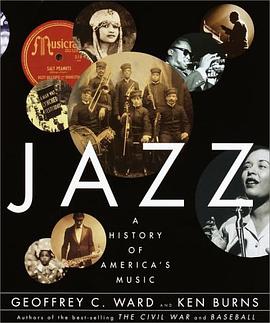
Jazz [图书] 豆瓣
作者: Geoffrey C. Ward / Ken Burns 出版社: Knopf 2000 - 11
The companion volume to the ten-part PBS TV series by the team responsible for
The Civil War and Baseball .
Continuing in the tradition of their critically acclaimed works, Geoffrey C. Ward and Ken Burns vividly bring to life the story of the quintessential American music—jazz. Born in the black community of turn-of-the-century New Orleans but played from the beginning by musicians of every color, jazz celebrates all Americans at their best.
Here are the stories of the extraordinary men and women who made the music: Louis Armstrong, the fatherless waif whose unrivaled genius helped turn jazz into a soloist's art and influenced every singer, every instrumentalist who came after him; Duke Ellington, the pampered son of middle-class parents who turned a whole orchestra into his personal instrument, wrote nearly two thousand pieces for it, and captured more of American life than any other composer. Bix Beiderbecke, the doomed cornet prodigy who showed white musicians that they too could make an important contribution to the music; Benny Goodman, the immigrants' son who learned the clarinet to help feed his family, but who grew up to teach a whole country how to dance; Billie Holiday, whose distinctive style routinely transformed mediocre music into great art; Charlie Parker, who helped lead a musical revolution, only to destroy himself at thirty-four; and Miles Davis, whose search for fresh ways to sound made him the most influential jazz musician of his generation, and then led him to abandon jazz altogether. Buddy Bolden, Jelly Roll Morton, Dizzy Gillespie, Art Tatum, Count Basie, Dave Brubeck, Artie Shaw, and Ella Fitzgerald are all here; so are Sidney Bechet, Coleman Hawkins, Lester Young, John Coltrane, Ornette Coleman, and a host of others.
But Jazz is more than mere biography. The history of the music echoes the history of twentieth-century America. Jazz provided the background for the giddy era that F. Scott Fitzgerald called the Jazz Age. The irresistible pulse of big-band swing lifted the spirits and boosted American morale during the Great Depression and World War II. The virtuosic, demanding style called bebop mirrored the stepped-up pace and dislocation that came with peace. During the Cold War era, jazz served as a propaganda weapon—and forged links with the burgeoning counterculture. The story of jazz encompasses the story of American courtship and show business; the epic growth of great cities—New Orleans and Chicago, Kansas City and New York—and the struggle for civil rights and simple justice that continues into the new millennium.
Visually stunning, with more than five hundred photographs, some never before published, this book, like the music it chronicles, is an exploration—and a celebration—of the American experiment.
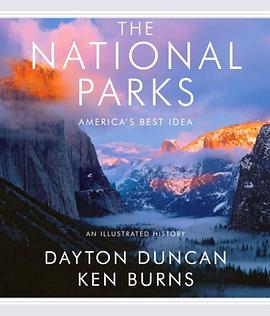
The National Parks [图书] 豆瓣
作者: Dayton Duncan / Ken Burns 出版社: Knopf 2009 - 9
The companion volume to the twelve-hour PBS series from the acclaimed filmmaker behind The Civil War, Baseball, and The War

America’s national parks spring from an idea as radical as the Declaration of Independence: that the nation’s most magnificent and sacred places should be preserved, not for royalty or the rich, but for everyone. In this evocative and lavishly illustrated narrative, Ken Burns and Dayton Duncan delve into the history of the park idea, from the first sighting by white men in 1851 of the valley that would become Yosemite and the creation of the world’s first national park at Yellowstone in 1872, through the most recent additions to a system that now encompasses nearly four hundred sites and 84 million acres.
The authors recount the adventures, mythmaking, and intense political battles behind the evolution of the park system, and the enduring ideals that fostered its growth. They capture the importance and splendors of the individual parks: from Haleakala in Hawaii to Acadia in Maine, from Denali in Alaska to the Everglades in Florida, from Glacier in Montana to Big Bend in Texas. And they introduce us to a diverse cast of compelling characters—both unsung heroes and famous figures such as John Muir, Theodore Roosevelt, and Ansel Adams—who have been transformed by these special places and committed themselves to saving them from destruction so that the rest of us could be transformed as well.
The National Parks is a glorious celebration of an essential expression of American democracy.