Raúl Ruiz — Playwright (37)
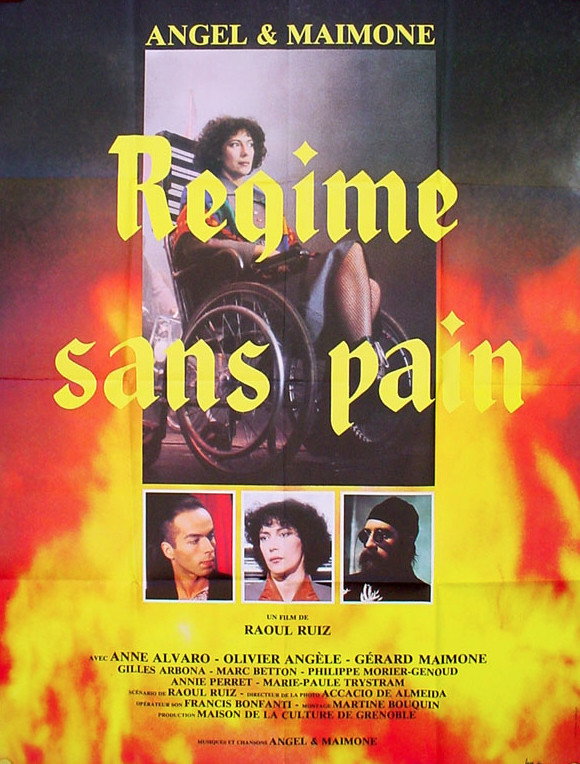
Régime sans pain (1985) [Movie] TMDB IMDb WikiData
Régime sans pain
director: Raúl Ruiz actor: Anne Alvaro / Olivier Angèle
Régime sans pain, influenced by (Ruiz's) friend Jean Baudrillard (and calling) to mind grade-Z SF, grew out of a commission to direct a music video (featuring French cult rock duo of Angèle/Maimone). Ruiz offered a counterproposal that he direct several music videos rather than one; once this deal was made, he shot enough material to interconnect the various videos until he arrived at a feature.
The Expropriation (1974) [Movie] TMDB IMDb WikiData
La expropiación
other title: La expropiación / Die Enteignung
The film captures the activities of the inhabitants in the countryside, in southern Chile, and the CORA (Corporation for Agrarian Reform). Although the action was filmed in four days and four nights in 1971, the movie was only finished in France in 1973, after the military coup.
Secrets (2008) [Movie] IMDb WikiData TMDB
Secretos
other title: Secretos
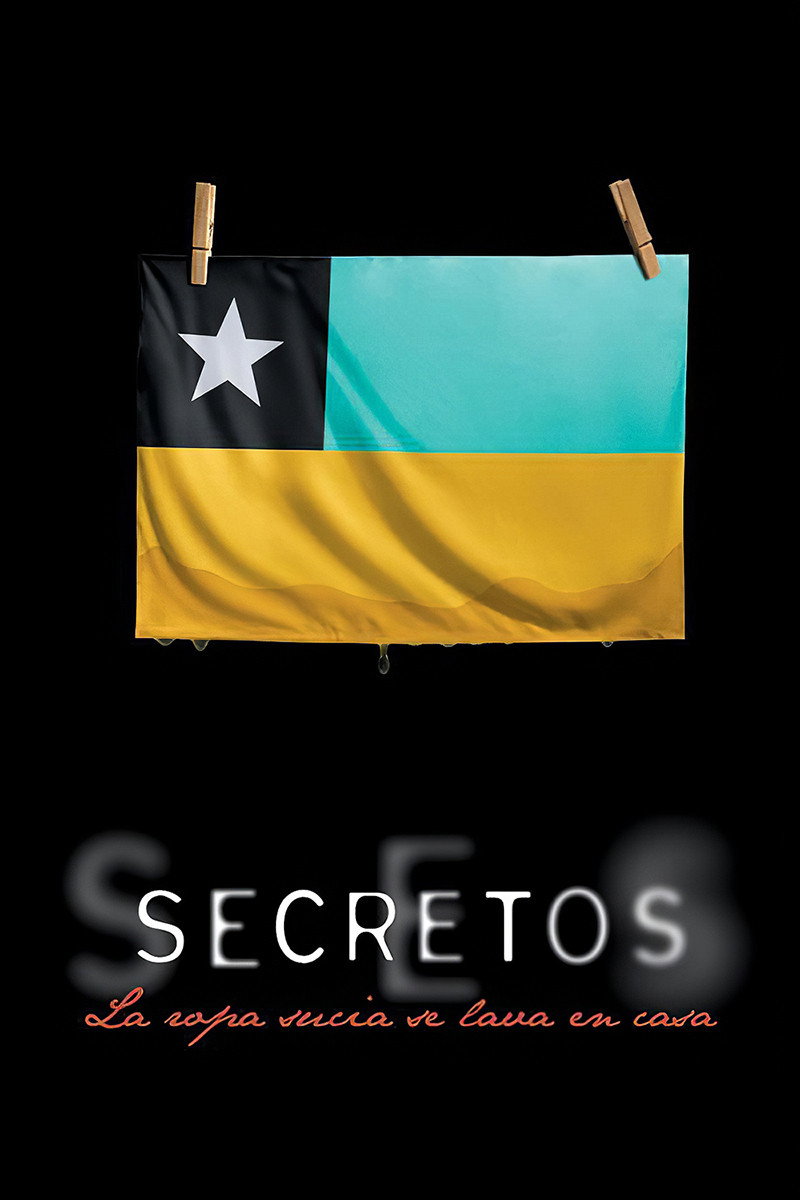
After long decades of exile, a leftist former activist returns to Chile to settle accounts with his conscience, related to the death of a colleague and political hero . The task of Atalibar is to reveal his secret. But his view clashes with the current country, godless, far from the old ideologies and where all his old colleagues have changed.
Dialogues of the Exiles (1975) [Movie] Douban TMDB IMDb WikiData
Diálogos de exiliados
director: Raúl Ruiz actor: 弗朗索瓦·阿努尔 / Carla Cristi
other title: Diálogos de exiliados / Dialogue Of Exiles
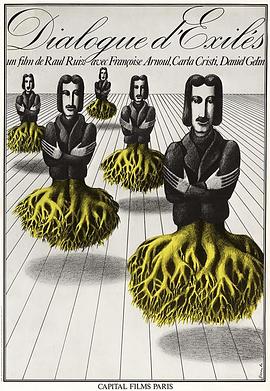
Chilean exiles in Paris discuss the problems facing them. They kidnap and attempt to re-educate a touring singer from their fatherland.
La recta provincia (2007) [Movie] Douban TMDB IMDb
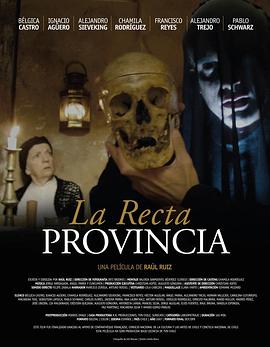
La Recta Provincia
director: Raoul Ruiz actor: Bélgica Castro / Ignacio Agüero
other title: La Recta Provincia. Terre de sorciers / La Recta Provincia
Este era un hombre. Vivía con su madre. Le importaba una casa señorial en el campo de Chile. Un día, el hombre encontró un hueso en el jardín. El hueso estaba aburrido. Esa fue una flauta de hueso. El hombre con la reproducción de la música flauta. Y la canción de la música se convirtió en. La voz de la canción pidió buscar los otros huesos de su cuerpo disperso. El hombre y su madre estaban en esas formas de Dios y el infierno, buscando los huesos que conforman el esqueleto de ese cristiano. Y dale un entierro cristiano. Y vieron lo que vieron, vivieron lo que vivían. Muchas historias vivieron. Y aunque no le dijeron a nadie, otros les dijeron.
Manuel on the Island of Wonders (1984) [Movie] Douban WikiData IMDb TMDB
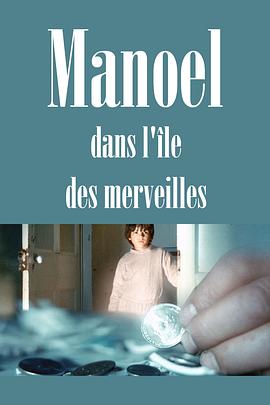
Manoel dans l'île des merveilles
director: Raoul Ruiz actor: Ruben de Freitas / 特丽莎·马德鲁加
other title: 曼努尔的欲望 / Manoel dans l'île des merveilles
This three part French TV serial for children (alternate versions exist as a feature, Manoel's Destinies, and a 4 part Portuguese TV serial, Adventure in Madeira) is the favourite of many devotees of Raúl Ruiz. This is because it ties the enchantment and mystery of Lewis Carroll, Carlo Collodi and the Brothers Grimm to the filmmaker's experiments with narrative strategies and what he calls the pentaludic model of storytelling (where characters are thrown dice-like into combinations and situations governed by the play of Chance and Destiny).
But this film for children is among his most complex works, hard to grasp in its totality. Often it can seem an arbitrary collection of free-associational images and words, bordering on nonsense. But attentive viewers will have the strong sense that there is method behind this near-madness. Otherwise, it could never produce the intense emotions it so clearly offers. Ruiz's obsessions from film to film bind the fragments together – within a single work and across projects – and the emotion comes from the totally unexpected forking taken within a well-worn territorial map.
Part One presents us with three possible worlds. In each world, seven year-old Manoel has a different response to an entreaty from the outside world. Fittingly, in this film in which nothing coincides, the three parts of the story do not coincide with the three-episode structure (the trinity-form recurs frequently in Ruiz). In this case, past, present and future – the unholy trinity or Time en soi – is the film's very protagonist, variously called 'long ago' (Part One), 'now' (Part Two), and 'future' (Part Three). At the outset, this gives the story an apparent order before digressions take it over.
Part Two (the status of which is at first confusing since it begins after the three mini-narratives of the first Part and before the end of Episode One) is entitled 'The Picnic of Dreams'. Whilst vaguely 'keeping to the storyline', it veers off in many different directions, where the thematic coupling ordinary/special replaces the familiar/unknown dualism of Part One. (Each Part is guided by a thematic 'dominant', a pair of notions that tend to exchange their meanings as it progresses.)
Part Three (beginning in Episode Two), entitled 'The Little Chess-Champion', hands the (until now) off-screen voice-over narration to Manoel himself. He promises to tell his own story, but adds that it's 'a story that I made up in my distant childhood and that happens in the future'. The tone is less Baroque, more Gothic, as Ruiz explores the 'wonders of the night'. The filmmaker's obsession in this section concerns perception and the deciphering of secret signs and codes.
Love Torn in Dream (2000) [Movie] WikiData IMDb Douban TMDB
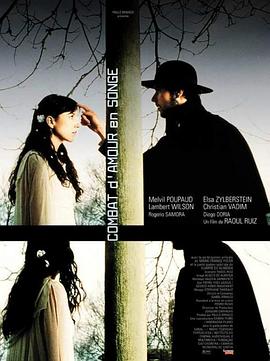
Combat d'amour en songe
director: 劳尔·鲁伊斯 actor: 梅尔维尔·珀波 / 艾尔莎·泽贝斯坦
other title: 梦中爱痴缠 / Combat d'amour en songe
A serious young man of free spirit is forced by his surroundings to become rich at all costs. A group of blind children tries to open the eyes of the unbelievers to the Christian faith. Retired nuns who open a brothel, to pay the running costs of the convent. These rather ironic paradoxes turn this fairytale into a philosophical fable.
That Day (2003) [Movie] Douban WikiData IMDb TMDB
Ce jour-là
director: 劳尔·鲁伊斯 actor: 贝纳·纪欧多 / 艾尔莎·泽贝斯坦
other title: 大宅心慌慌 / Ce jour-là
A father is scheming to have his slightly mental daughter from an earlier marriage killed by allowing a murderous psychopath to be released from the asylum and led to his house. However, the psychopath and the daughter fall for each other.
The Suspended Vocation (1978) [Movie] Douban
La vocation suspendue
director: 劳尔·鲁伊斯 actor: 狄迪尔·弗拉蒙 / 加布里埃尔·加斯康
other title: 延宕的假期 / La vocation suspendue
改编自法国著名评论家克罗索夫斯基的同名小说.
Three Sad Tigers (1968) [Movie] Douban TMDB IMDb WikiData
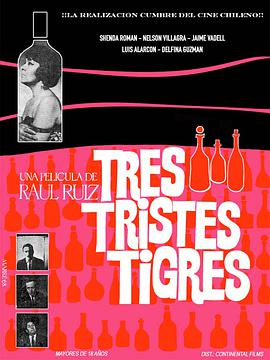
Tres tristes tigres
director: 劳尔·鲁伊斯 actor: Shenda Román / 尼尔森·维拉格拉
other title: 三只惨老虎 / Tres tristes tigres
This movie is the best portrait of Chilean society. Ruiz show us like a group of little people with little problems, with a very special way of life. The strangest Spanish in all South American with the funniest accent too. This movie is like Martin Scorsese's Mean Street but without the crime ingredient. You must see it if you wanna know what's to be a Chilean, how you can feel believing that you're in the center of the world but actually living in the end, almost hanging from the continent. Raul Ruiz right now is living in Paris and making the most bizarre but fascinating films of the french production. "Tres tristes tigres" is very difficult to find but if you can, i tell you that you'll have a real gem.
Brise-glace (1987) [Movie] Douban TMDB IMDb
Brise-glace
director: Jean Rouch / Titte Törnroth actor: Jean Rouch / Raúl Ruiz
other title: 破冰船
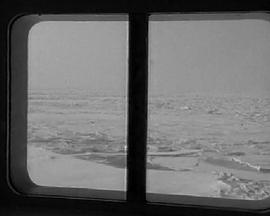
在一艘行驶在北欧Botnie冰川峡湾的破冰船上,三位导演将三部电影合而为一。Givre号船(35分钟) :影片片头,导演Jean Rouch就用摄像机无声地记录着破冰船及其水手日日夜夜的工作,让我们隐约感受到船舶在海洋中无止尽的飘荡。影片在广阔的冰川和薄雾中拍摄完成,显现出一种现实主义诗歌氛围。
Cofralandes, rapsodia chilena (2002) [Movie] Douban
Cofralandes, rapsodia chilena
director: 劳尔·鲁伊斯 actor: 伊拿士·奥阿基卢 / Marcial Edwards
other title: 智利狂想曲 / Chilean Rhapsody
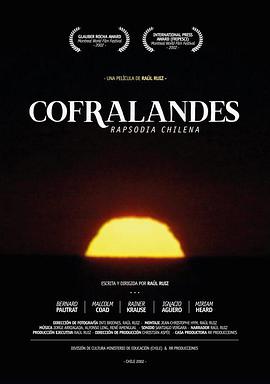
This is the first in a series of seven projected video essays (four of which were completed) that Ruiz was commissioned to make in 2002 -2003 for use among Chilean community organizations and broadcast on public television. Thanks go to yogiyamada for providing a rip from a superior source to the MPEG available on-line (see below). Cofralandes, the head-title for each of the segments of Ruiz's series, is taken from a song by Violeta Parra where it evokes the "land of milk and honey," the "land of Cockayne," the "green world" imagined by Gonzalo in The Tempest.
See also the excellent article, "Cofralandes: A Formative Space for Chilean Identity," by Alejandra Rodríguez-Remedi in Visual Synergies in Fiction and Documentary Film from Latin America, Miriam Haddu, Joanna Page, eds. (MacMillan, 2009), pp.87-103. The article can be read in its entirety on googlebooks HERE
(转自auess)智利狂想曲(Chilean Rhapsody)是智利/法国籍电影大师Raoul Ruiz拍摄于2001至2002年的纪录片作品,拉乌尔.鲁伊兹1941年生于智利小镇波多蒙第,19岁时开始独立拍摄电影短片和纪录片,从60年到73年间他拍摄了十几部反映智利贫苦人民生活的短片,纪录片以及长片,1973年,由于在影片《白鸽》中对智利政府和军队对百姓的欺压进行了尖锐的讽刺和批判,他因此被禁止再在本国拍摄影片并受到政府的通缉而流亡法国。
此后20多年间,鲁伊兹一直流亡在法国,荷兰,瑞士,德国等地拍摄了大量优秀的艺术电影和先锋电影,1979年,一部希区科克式复杂深奥的先锋电影《被窃油画的假设》为其第一次获得了国际影坛的关注,被评为当年的法国最佳电影之一,其后他在82年和83年接连导演的《鲸鱼之上》和《海员的三个王冠》,以其中悔涩难懂的哲学意义和对电影叙事结构方面的大胆突破和探索而大获成功,之后的《海盗城》被公认为80年代最优秀的先锋电影之一,成为最能体现鲁伊兹电影构图的实验风格的代表作,而鲁伊兹也在当年被众多评论家誉为是继戈达尔之后最具革新意识和创造力的电影大师。
自83年之后,鲁伊兹几乎每年都有一部甚至好几部作品问世,而且更难能可贵的是,其电影在艺术水平上丝毫没有下降,这使得他成为当时法国最活跃的电影人之一,但却始终漂泊在国外而无法回到祖国。
2001年,在其离开28年之后,60岁的鲁伊兹终于回到了故乡,虽然由于种种原因他依然无法在国内拍片,但他选择了一种最节省最独立也是最地下的拍摄方法,用一部手提DV拍摄出这部长达320分钟,分成四章节的纪录电影杰作,采用仿日记式叙述方法,纪录下导演个人回到本国后的一些感受和生活,反映出当代智利人民生活方方面面的真实现状,同时鲁伊兹又用其独特的电影创作手法,打破了时空的限制,将一些历史,现在和未来的画面交织融合在一起。这是一部眼光独特同时又在电影形式上极具创意的影片,这部作品同时是纪录片也是一部奇异的幻想电影,成功地把纪录和故事两种载体揉合在一起,创造出一个奇怪而又真实的世界,个人认为它绝对不比那些影史上最最经典的纪录片巨作比如《中国》或《愚公移山》的艺术水平差。
全片分成4个章节分别是《狂想篇:今天的智利》(82分钟); 《人民篇:面孔与角落》(81分钟);《历史篇:博物馆与俱乐部》(65分钟);《文化篇:唤醒与华尔兹》(88分钟),全部以DV拍摄,耗时两年的时间所有拍摄剪辑均由导演一人完成。在第一章狂想篇中,鲁伊兹用一些具有象征意义的场景和超现实的画面结合现实中的人物对当代智利的各方面做了概述和纪录,第二章人民篇是对当代智利人以及传统的印第安人民的生活现状进行深入的探讨,纪录下他们的生活方式,并采访了很多市民对目前生活及执政政府的态度,第三章则是讲悠久的安第斯山文化和印地安人的历史,同时也纪录了当代流行的俱乐部文化等,第四章纪录智利本国的民间风俗和教育水平。
在影片中,你既可以欣赏到南美洲美丽的风光景色和智利最纯正的印第安民歌以及民间游戏等,也惊叹于导演天才的想象力用蒙太奇和变焦摄影所创造出来的奇妙世界,鲁伊兹用一种全新的纪录语言以及独特的拍摄角度带给观众一个时而真实时而幻想的世界,它既不同于惯用DV拍摄的“真实电影”或“直接电影”流派那样过于注重事件的真实性和纪录性,也不同于“伪纪录片”流派的刻意营造于一些事件来表述创作者对现实的看法和观点。
可以说,《智利狂想曲》完美地结合了两者的特点,既纪录了真实同时又结合虚幻的场景在电影表现语言上有新的探索,你常常可以看到历史或绘画中的人物和当代的人走在一起,比如狂想篇中的一段孩童嬉戏的场景,镜头一直跟随女孩的背影缓缓拍摄了7分钟的长镜头而没有剪辑,用手提DV拍摄长镜头是很难的,因为你很难控制镜头到非常精准也很难拍出长镜头那种感觉,而鲁伊兹用其深厚的功底做到了,他的镜头平缓流畅丝毫没有抖动,能够让你惊叹于长镜头所营造出来的优美而忘记这是完全用手提DV机做到的。
另一个虚构场景描写一次政府的财政会议,鲁伊兹把DV摆到圆桌上,让扮演官员的演员围坐在桌边,让DV机在桌面上从慢到快地旋转移动,用从桌面往上仰视的角度拍摄每个人面孔的特写。。。诸如此类在正式影片中都很难看到的拍摄方式在一部全DV电影中居然能运用自如,不得不让人佩服导演的创意和功力,另外值得一提的还有片中的音乐极具创意,优美的吉它民谣往往被随后而来剧烈而紧张不安的小提琴奏乐所打破,加之穿插其间突然闪现的玻璃破碎声,流水声,风声以及狗的叫声,整个就是一场古怪精灵的实验音乐会,但却能恰如其份的搭配上整部电影。
2002年,鲁伊兹携带影片参加了第26届加拿大蒙特利尔世界电影节,在这个世界著名的A级国际电影节上获得了评审团FIPRESCI特别大奖以及格劳贝尔罗查奖(最具探索精神电影奖)。虽然影片在国际上获得了声誉,但依然无法在智利本国上映发行,2003年鲁伊兹带影片考贝重新回到法国继续书写其辉煌的电影生涯。
Nobody Said Anything (1971) [Movie] Douban IMDb WikiData TMDB
Nadie dijo nada
director: Raúl Ruiz actor: Carlos Solanos / Jaime Vadell
other title: 无言的人 / Nadie dijo nada
"With this film I returned to the world of Tres tristes tigres, to some people, in this case writers, who live in their own reality and believe that it is, in fact, Chile." - Raul Ruiz
A group of young writers sell their soul to the devil. It is a film about the meaning of isolation and a certain megalomania that developed in Chile during the government of Eduardo Frei. The version RAI originally broadcast [black and white, 45 minutes shorter and until now the only one in circulation] was made by cutting everything out that makes allusion to the political context and makes the characters real. The story was not the most important thing: the most important thing was the speeches that were around the story, which is one of the themes of modern cinema.