Kristine Nielsen — 演员 (5)
名声大噪 [演出] 豆瓣
Smash
类型: 音乐剧 编剧: Rick Elice / Bob Martin 作曲: Marc Shaiman
其它标题: Smash 剧院: Imperial Theatre 导演: Susan Stroman 演员: Robyn Hurder / Brooks Ashmanskas / Krysta Rodriguez / John Behlmann / Kristine Nielsen
The ultimate love letter to Broadway is actually now ON BROADWAY!

Inspired by the hit TV series, SMASH is the perfect musical-lover’s musical. Get ready for all the backstage pandemonium as opening night approaches for Bombshell, the splashy new show about Marilyn Monroe. Nearly breaking under the pressure, legendary Broadway star Ivy Lynn causes a series of hilarious set-backs and surprises that brings a diva director, a bewildered producer, two exasperated authors, one eager understudy, and an entire company to its knees. But the curtain’s going up, no matter what!

SMASH is filled with kick-ass production numbers and iconic songs like “Let Me Be Your Star,” “Don’t Forget Me”, “They Just Keep Moving the Line,” and more. And who better to play Broadway A-listers than actual Broadway A-listers? Our cast is stacked with veterans and Tony Award® nominees including Robyn Hurder, Brooks Ashmanskas, Krysta Rodriguez, John Behlmann, Kristine Nielsen, and Jacqueline B. Arnold, to name just a few.

Produced by Robert Greenblatt, Neil Meron and Steven Spielberg, SMASH is helmed by five-time Tony winner Susan Stroman (The Producers), with a score by Emmy®-, Grammy®-, and Tony-winners Marc Shaiman and Scott Wittman (Hairspray, Some Like It Hot), a book by Bob Martin (Tony winner, The Drowsy Chaperone) and Rick Elice (Tony nominee, Jersey Boys), and choreography by Joshua Bergasse (Emmy winner for Smash, the series).

Infinite Life [演出]
类型: theater 编剧: Annie Baker
语言: 英语 剧团: Atlantic Theater Company 剧院: Linda Gross Theater 导演: James Macdonald 演员: Christina Kirk / Marylouise Burke / Brenda Pressley / Kristine Nielsen / Mia Katigbak
Five women in Northern California sit outside on chaise lounges and philosophize. A surprisingly funny inquiry into the complexity of suffering, and what it means to desire in a body that’s failing you.
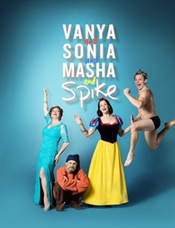
万尼亚和索尼亚和马莎和斯派克 [演出] 豆瓣
Vanya and Sonia and Masha and Spike
类型: theater 编剧: Christopher Durang
其它标题: Vanya and Sonia and Masha and Spike 剧院: John Golden Theatre 导演: Nicholas Martin 演员: Sigourney Weaver / David Hyde Pierce / Kristine Nielsen / Billy Magnussen


Vanya and Sonia have never left the confines of their childhood home in Bucks County, PA, while their sister Masha has been gallivanting around the world as a successful actress. A surprise visit from Masha and her 20-something boy toy, Spike, throws the normally quiet household into utter upheaval as its residents and visitors get swept up in an intoxicating mixture of lust, rivalry, regret, and the sudden possibility of escape.

彭特西勒亚 (1974) [电影] 豆瓣 TMDB IMDb
Penthesilea
其它标题: Penthesilea / Penthesilea: Queen of the Amazons
The film is composed of five sequences, each preceded by a quotation. 1: “Ghost white like a not yet written page” (Mallarmé, “Mimique” ): A mime of Kleist’s Penthesilea, filmed in long shot from a fixed camera position. 2: “The shadows sprinkled in black characters” (Mallarmé, “Quant au livre”): A lecture on Kleist’s play, the myth of Penthesilea and the theoretical basis of the film, delivered by Peter Wollen while moving about a terrace and adjoining living room, the camera tracing an independent trajectory within the same confined space and occasionally approaching the index cards of notes left behind by Wollen at various stages in his route. 3: “Blazons of phobia, seals of self-punishment” (Lacan, after Vico): A succession of images relating to Penthesilea and the Amazons — paintings, sculptures, artifacts, tapestries, etc., including frames from a Wonder Woman comic book — separated by animated wipes and maskings, and accompanied on the soundtrack by Berio’s “Visage”. 4: “Net of light on overlight” (H.D., “Projector”): A silent film, What 80 Million Women Want (1913), on which a woman’s face in color is superimposed, speaking the words of feminist Jesse Ashley. 5: “Notes on the magic writing pad” (Freud): Four black-and-white television screens simultaneously present The preceding sections of the film; the camera occasionally isolates an individual screen, and similarly the soundtrack occasionally highIights one of the preceding soundtracks; gradually the material on the screens is replaced by new footage of the mime actress portraying Penthesilea returning to her dressing room, taking off her make-up, and addressing the camera.

Fascinating overall for its investigation into alternative didactic methods and the relationship between independently expressive surfaces and texts, Penthesilea is far from simple going when one confronts the opening sequence: too remote from both the mime itself and one’s subsequent perception of the film’s general design, it simply demands more (or less) than one can comfortably bring to it. Once past this obstacle — an interesting and legitimate sequence that acquires interest only after the fact — one is swiftly rewarded by the words and camera movements of sequence #2, which beautifully juggle sound and image, theory and practice, Wollen’s trajectory and the camera’s in something resembling a two-part invention. Wittiest of all are the cue cards strewn in Wollen’s path, which the camera ‘picks up’ after him like a dutiful servant: sometimes the words on the card duplicate an earlier part of the lecture, sometimes the reflection of light on the cards makes the words paradoxically illegible, and at one strange juncture — properly speaking, the only ‘fictional’ moment in the entire film — the words appear just as they are being spoken in another room. Sequence #3 registers as a systematic exploration into how one can arrive at an order of things (the succession of Wonder Woman frames providing an inventory of ways one image can follow another), while the Berio piece offsets this with what is described.in the Autumn 1974 Screen (an interview with Mulvey and Wollen that usefully supplements the film) as “the ‘birth’ of a new form of language”. #4 juxtaposes two ‘texts’ in the form of superimposed images, with a historical artifact set against a contemporary recitation of a historical document; and #5 exploits some of the Wavelength-like paradoxes of relative illusionist surfaces (as when the camera moves into a TV screen showing sequence #2,where the camera is also moving) while drawing all of the previous juxtapositions and new material into fresh mixtures and relationships. Each sequence, it must be noted, consists of two reels ‘invisibly’ joined (in the manner of Rope), and the justifications for this non-editing are stated succinctly in Wollen’s lecture, which also alludes to “The space between a story that is never told and a history that has never yet been made” — that array of lecture material around an unarticulated story that the film occupies, with speculative past myth and speculative utopian myth developing concurrently from the empty spaces. Curiously but perhaps inevitably, the film’s conceptual framework somewhat overrides the feminist theme it pursues, and the question of how one perceives Penthesilea becomes somewhat more of a subject than the figure herself. One recalls the structure of Godard’s One Plus One, with its similar notion of grappling with diverse phenomena by placing them side by side (albeit in an edited context), with the Anne Wiazemsky question-and-answer sequence performing an expositional function somewhat analogous to Wollen’s lecture. But One Plus One arguably represented the end of something, while Penthesilea suggests a beginning — a step forward in the European avant-garde that cross-fertilizes more active currents (from the American structural film to Tel Quel) than this review could hope to enumerate. An object for reflection and inquiry more than a ‘finished’ statement, it is a theoretical do-it-yourself kit –- or stated differently, an exploratory tool –- of the first importance. JONATHAN ROSENBAUM
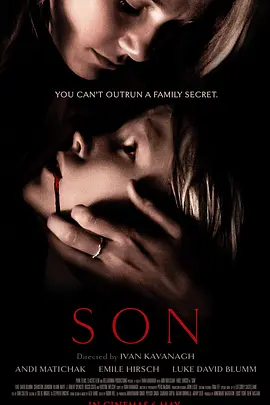
骨肉 (2021) [电影] 豆瓣 TMDB IMDb 维基数据
Son
4.7 (6 个评分) 导演: 伊万·卡瓦纳 演员: 埃米尔·赫斯基 / 安迪·马蒂切克
其它标题: Son / 爱子
安迪·马蒂切克([月光光心慌慌])、埃米尔·赫斯基([荒野生存])将主演恐怖片[儿子](Son,暂译),伊万·卡瓦纳([永生之地])自编自导。影片讲述一位母亲在她儿时曾逃脱邪教组织。而她成为母亲之后,邪教组织的成员让她的孩子感染上了一种可怕的疾病,这种疾病的治愈方法比她想象中的更可怕。该片将于2020年1月在美国开拍。