John Cage — 艺术家 (54)
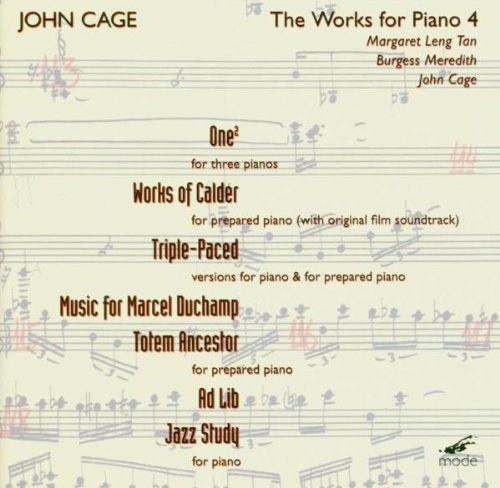
The Works For Piano 4 / The Complete John Cage Edition - Volume 25 [音乐] 豆瓣
John Cage / Margaret Leng Tan
发布日期 2002年1月1日 出版发行: Mode Records
Until recently at C.F. Peters, Cage's publisher in New York, there was a box of works which Cage had held off publishing or had simply forgotten about. Among them were the dance pieces, Triple-Paced and Ad Lib, Jazz Study, and the film score Works of Calder - all composed between 1942 and 1950. At Peters' request, Margaret Leng Tan was enlisted to edit these works as part of a new volume of Cage's piano pieces; they have been recorded here in conjunction with that publication.
Of great interest among these is Cage's score for the film Works of Calder. Actor Burgess Meredith produced and narrated this documentary by Swiss filmmaker Herbert Matter on the artist Alexander Calder. Cage's fluid prepared piano score is a major discovery, requiring an extensive preparation comparable in complexity to that of the Sonatas and Interludes. Composed in three-parts, Works of Calder's two outer movements are newly recorded by Ms. Tan. The middle section is taken directly from the original soundtrack as Cage composed and performed it - a percussion interlude enhanced by discreet electronic effects; and is presented here in its entirety.
Cage wrote One2 for Ms. Tan, who worked directly with him on the conception of the piece. It is to be performed by one player on one to four pianos; three are used here. The damper pedals of all the pianos are wedged so that the strings vibrate freely throughout the piece. The pianos become, in effect, sound sculptures where sustained resonances coalesce and gradually disappear. The result is an extraordinary sonic landscape, and a unique work in Cage's oeuvre. Cage and Tan
Ten / Ryoanji / Fourteen [音乐] 豆瓣
John Cage 类型: 古典
发布日期 1994年1月1日 出版发行: hat ART
Ten (1991) for flute, oboe, clarinet in Bb, tenor trombone, percussion, piano, two violins, viola and violoncello - first recording
Ryoanji (1985) version for flute, trombone and percussion
Fourteen (1990) for piano solo with flute/piccolo, bass flute, clarinet, bass clarinet, horn, trumpet, two percussion, two violins, viola, cello and contrabass
Digital recording: February 20-22, 1994 at Theater Romein, Leeuwarden, the Netherlands
12-page booklet includes texts in English, French and German.
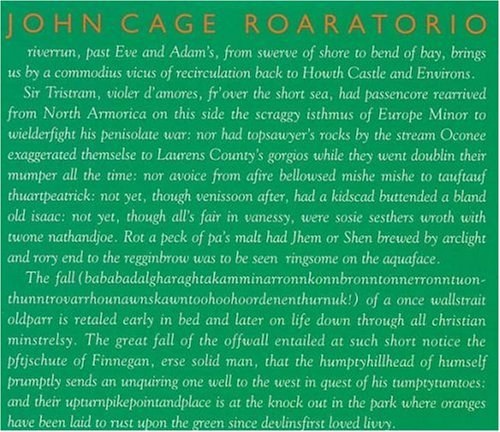
Roaratorio [音乐] 豆瓣
发布日期 1992年1月1日 出版发行: Mode
Voice —— john cage
Song —— joe heaney
Violin —— paddy glackin
Bodhran—— peadar and mel mercier
Flute —— matt malloy
Uillean pipe—— seamus ennis
Realizaton—— john cage and john david fullemann
Editing—— klaus schoning
60’13”
1979
With “roaratorio.an irish circus on finnegans wake”, a commissioned work for WDR, john cage realized a composition that would become an international sensationn and a key work in the acoustic art of this century.
In “roaratorio”, john cage bring his experiences with music and poetry, sound poetry and tape montage, and his involvement with zen buddhism, to an all-encompassing cosmogony of the human voice, sound of nature and the environment, noise, song and music. The basis for cage’s work on “roaratorio” was his intensive study over the years of james joyce’s epochal novel “finnegans wake”, cage’s sound poetry text consists of citations from the novel. The letters of the name of irish poet “james joyce”, continually recurring, from the centeal axis of this mesostic text. John cage recited this meditative sound poem himself. Joyce ‘s text was aslo used as the basis for the musical composition, a complex ambience of noise and sound. With the help of the ancient chinese book of oracles, the “I ching” ,john cage used chance operations to determine the sounds of 2293 place and noise mentioned in “finnegans wake”. These he composed into a polyphonic collage. The montage was supplemented by irish ballads, jigs and instrumental music that he had recorded in ireland. John cage saw this piece as an opportunity to transpose works of world literature into acoustic form, and so into a language accessible to everyone. “more and more, I think that we need a language that gets along without translation.”
Numerous european, american and australian radio stations have broadcast this work of acoustic art that has become a classic. It has been presented by WDR at international festivals as a live performance with john cage and irish musicians. Using the composition, merce cunningham choreographed a ballet for his new york company that was performed with great success at international festivals.
Heinrich vormweg in his laudation:”’roaratorio’ is a huge tablet of contemporary cuneiform. Full of hints and information and indeecipherable, it will lure interpreters. And as a medium of immersion or of flights of fancy, as an understanding with the world, and as a comprehensive utopia, it is at the same time a radical challenge to live differently in the world. A utopia of equality and the peace it achieves.”
`````````Just a whisk
`````````of
``````pity
```````a cloud
``in peace and silence
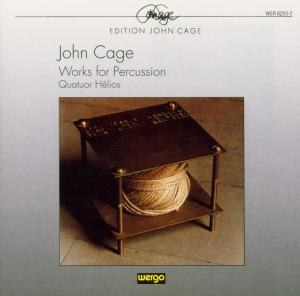
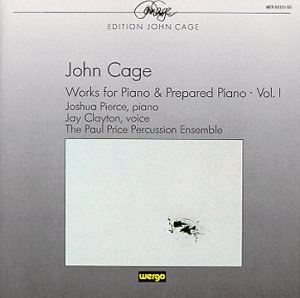
凯奇《钢琴与预置钢琴作品集》卷一 [音乐] 豆瓣
John Cage / Joshua Pierce 类型: 古典
发布日期 1993年12月8日 出版发行: Wergo
Joshua Pierce brings to John Cage's music an almost uninhibited classicism, but that only bolsters the compositions. He opens A Room and emphasizes its shifts with the attention of a concert pianist, rather than someone who follows Cage's directions to play the piece very quietly. Pierce, in fact, takes each of these dozen works, all of them dating to the 1940s and '50s, and draws from them the resonant Cagean oddness--phrases of weird shapes and all. But he adds a ton, too. In a Landscape sounds almost wholeheartedly minimalist in its tone colors, and She Is Asleep sounds both drummerly (on the artfully flat prepared piano) and jazzy, with Jay Clayton dropping some scat vocals in ever so subtly. This is, after all, the period when Cage was discovering the closeness between percussion and motion, on the one hand, and percussion and the modified piano, on the other hand. So these pieces blurt out chunky phrases, build with shaded drama, and rumble delicately along. It's a difficult assessment making suggestions when it comes music so notoriously open to interpretation. But Pierce has played all the Cage piano and prepared-piano stuff, creating a Wergo series that any lover of the piano repertoire should own in full. Here, anyway, is an excellent introduction, perfect for the Cagean neophyte and still inventive enough to energize owners of Roaratorio or Frances Marie Uitti's Works for Cello. --Andrew Bartlett
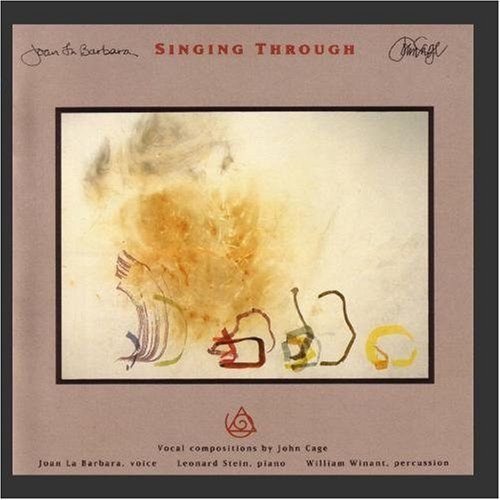
singing through [音乐] 豆瓣
John Cage 类型: 古典
发布日期 1991年1月1日 出版发行: New Albion Records
Artwork [Cover Image] – John Cage
Composed By – John Cage
Design – Todd Reamon
Engineer – Tom Lazarus
Executive-Producer – Tom Lazarus
Photography By – Jim Wood
Producer – Foster Reed, Joan La Barbara, Tom Lazarus
Voice – Joan La Barbara
A Flower (1950) for Louise Lippold
Mirakus² (1984)
Eight Whiskus (1984) for Joan La Barbara
The Wonderful Widow of Eighteen Springs (1942) for Janet Fairbank
Nowth Upon Nacht (1984) in memoriam Cathy Berberian
Sonnekus² (1985) including sections of "Je te veux", "La Diva de l'Empire" and "Tendrement" by Erik Satie
Forever and Sunsmell (1942)
Solo for Voice 49 (1970) song with electronics
Solo for Voice 52 (Aria No. 2) (1970) song
Solo for Voice 67 (1970) song with electronics
Music For Two (By One) (1984)
All works published by Henmar Press Inc., ASCAP, (C. F. Peter Corporation, NYC), except "Je te veux", "La Diva de l'Empire" and "Tendrement" composed by Erik Satie and published by Editions Salabert, Paris.
Partial funding for this recording has been provided by the Mary Flagler Cary Charitable Trust.
Recorded at Skywalker Music, Lucas Valley, California, July 1990.
Recording of "Eight Whiskus", "Solo for Voice 67" from "Songbooks", "The Wonderful Widow of Eighteen Springs" and "Nowth Upon Nacht" was funded in part by a grant from the National Endowment for the Arts Music Recording Program (1988-89).
32-page booklet include score excepts.
凯奇《打击乐作品集》 [音乐] 豆瓣
发布日期 1992年1月1日 出版发行: Wergo Germany
The significance of the seven pieces brought together here is that they both generate a striking panorama of the intelligence of the material presented, over a period of four years, from 1939 to 1943, by the composer whom the critic Fred Goldbeck described as “the greatest Giraudouxian of our age”, and clarify in an extraordinarily oblique manner the prehistory of this “automation” of the creative act, towards which one can detect the perpetual temptation in the young Cage.
Sounds of New Music [音乐] 豆瓣
Henry Cowell / John Cage 类型: 古典
发布日期 2012年5月30日 出版发行: Folkways Records
Sounds of New Music is a collection of 18 compositions from the 1920s to the mid-1950s representing attempts at a "new means of musical expression." Some use familiar instruments in new ways, while others experiment with new instruments; the formats of the compositions range from structured musical scores written for orchestra to electronically altered music using tape-recording devices. Composers include Edgard Varèse, Henry Cowell, and John Cage, whose "Dance" is played on a transformed Steinway piano that gives the music an almost primitive quality. Liner notes describing the new music feature a substantial article on Concrete Music.
Roaratorio [音乐] 豆瓣
John Cage / Joe Heaney
发布日期 2002年7月9日 出版发行: Mode
"Roaratorio is one of Cage's most attractive larger assemblages...the piece is a landmark in the composer's later output, and a credit to all involved in its elaborate realization." - Peter Dickinson, Gramophone, 1994
Roaratorio was a commission from the West German Radio and IRCAM for Cage to realize a work based on his favorite book, Finnegans Wake by James Joyce. Cage began by making a text from the original (which became Writing for the Second Time Through Finnegans Wake, also issued here in its entirety), and cataloging the many sounds and locations mentioned in the book. A recording of each sound was made at the noted locations - virtually every sound/location was recorded. These were then laid out in the sequence in which they are mentioned in the Wake and mixed, along with Cage's rendering of the text, into a massive collage of 62 tracks of tape lasting about an hour. Added to this is live accompaniment from leading Irish musicians on traditional instruments, performing traditional Irish music. The result is an enthralling stew of words, sound and music unlike anything you've encountered before.
Because Cage's beautiful reading of the text often gets submerged in the density of Roaratorio, the unadorned recording of Writing for the Second Time... is also included. Special insight on the works can be had from Laughtears, with Cage interviewed by Klaus Schöning of the WDR regarding the project.