Plácido Domingo — 演员 (39)
世界三大男高音:1990年罗马世纪音乐会 [电影] 豆瓣
Carreras Domingo Pavarotti in Concert 1990 (TV)
导演: Brian Large 演员: Josep Carreras / Plácido Domingo
其它标题: Carreras Domingo Pavarotti in Concert 1990 (TV) / The Original Three Tenors Concert
The triumvirate of tenors blend classical arias with an encore round of popular Italian ballads in this concert special from the Musicale Fiorentino Teatro Opera in Rome. Experience the emotion, the excitement and the triumph of the greatest classical event of our time, captured as never before in studio-quality vision and spectacular 5-channel surround sound!
Recorded in Rome 7 July 1990. Contents: Titles, "Il Lamento di Federico", "O paradis", "Recondita armonia", "Dein ist mein ganzes Herz", "Rondine al nido", "Core 'ngrato", "I vespri siciliani (Sinfonia)", "Torna a Surriento", "Granada", "No puerde ser", "L'improvviso", "E lucevan le stelle", "Nessun dorma", Finale Medley, Encore "'O sole mio", Encore "Nessun dorma".
路易莎·费尔南达 (2006) [电影] 豆瓣
Luisa Fernanda
导演: 埃米利奥·萨希 / 安赫尔·路易斯·拉米雷斯 演员: Plácido Domingo / Nancy Herrera
其它标题: Luisa Fernanda / 2019国际歌剧电影展西班牙马德里皇家歌剧院出品歌剧电影《路易莎·费尔南达》
路易莎·费尔南达》是西班牙特有的歌剧类型查瑞拉歌剧中非常重要的一部作品。于1932年3月26日在马德里卡尔德龙剧院首演后大获成功。该剧以1868年波旁王朝时期为背景,讲述了西班牙历史动荡时期的爱情故事。通过极简的舞台、普拉西多·多明戈和南希·埃雷拉的歌声将观众带回十九世纪的西班牙。
西部女郎 (1982) [电影] 豆瓣
La Fanciulla del West
导演: 约翰·沃侬 演员: Plácido Domingo / Carol Neblett
其它标题: La Fanciulla del West / 歌剧《西部女郎》
托斯卡 (1976) [电影] 豆瓣
Tosca
导演: Gianfranco De Bosio 演员: Raina Kabaivanska / Plácido Domingo
其它标题: Tosca / 普契尼 歌剧电影《托斯卡》
故事发生在1800年的罗马,画家卡瓦拉多西(普拉西多·多明戈 Plácido Domingo 饰)因为被卷入了革命运动之中而锒铛入狱,被判处了死刑,卡瓦拉多西的恋人托斯卡(Raina Kabaivanska 饰)心急如焚的找到了警察局局长斯卡皮亚(塞尔瓦托雷·比拉 Salvatore Billa 饰),希望他能够帮忙救卡瓦拉多西一命。
斯卡皮亚觊觎托斯卡的美貌已久,于是提出要托斯卡用自己的身体来换取卡瓦拉多西的生命,托斯卡忍辱负重答应了局长无理的要求。然而,在即将被玷污的那一刻,托斯卡在桌上找到一把刀刺入了局长的胸膛,将他杀死。托斯卡告诉即将被押往刑场的卡瓦拉多西,这将会是一次假死刑,很快他们就能逃往国外,过上平静的生活。
丑角 (1982) [电影] 豆瓣
Pagliacci
导演: Franco Zeffirelli 演员: Teresa Stratas / Plácido Domingo
其它标题: Pagliacci
The story is set in southern Italy and recounts the tragedy of Canio, the lead clown in a commedia dell'arte troupe, his wife Nedda, and her lover, Silvio.
阿依达 (1989) [电影] 豆瓣
Aida
8.0 (7 个评分) 导演: 布赖恩 拉奇 (Brian Large) 演员: Aprile Millo / Plácido Domingo
其它标题: Aida / 1989年美国纽约大都会歌剧院现场演出
故事发生在古埃及的法老王时代,彼时埃及和埃塞尔比亚之间正在进行一场非常激烈的战争,埃及王派出了手下大将拉达梅斯(Aprile Millo 饰)迎战埃塞俄比亚国王阿姆纳斯洛。埃及公主阿姆涅丽斯默默爱慕着拉达梅斯,可是拉达梅斯的心上人是一位名叫阿依达(朵萝拉·扎吉克 Dolora Zajick 饰)的女奴。
实际上,阿依达的真实身份是埃塞俄比亚国王的私生女,阿姆纳斯洛战败后,乔装打扮成为了普通士兵,阿依达在俘虏的队伍中认出了父亲的脸。阿依达向拉达梅斯求助,此时的拉达梅斯被国王指婚,即将和埃及公主成亲,面对心上人楚楚可怜的求助,拉达梅斯决定将自己的生死置之度外。
普契尼歌剧《托斯卡》 [电影] 豆瓣
Puccini: Tosca
导演: Kirk Browning 演员: Hildegard Behrens / Plácido Domingo
其它标题: Puccini: Tosca / 普契尼 歌剧《托斯卡》
● 1985年美国旧金山歌剧院现场演出
● 剧情
1800年,罗马
第一幕
越狱逃脱的政治犯安吉罗提(Cesare Angelotti,男低音)冲进圣安德烈第拉瓦雷教堂(Church of Sant' Andrea della Valle)内的阿塔凡蒂侯爵家的礼拜堂,他刚刚躲好,一个老教堂执事蹒跚的走进来,祈祷的钟声响起。不久,在教堂内画壁画的画家卡瓦拉多希(Mario Cavaradossi,男高音)进来,他掀开画布,继续画以安吉罗提的姐姐、侯爵夫人玛格达莱娜为形象的玛利亚(Mary Magdalene)。卡瓦拉多希从怀中拿出自己的情人女歌手托斯卡(Floria Tosca,女高音)的小肖像来跟画像比较,一个是黑色的眼珠,一个则金发碧眼,却同样的美丽(Recondita Armonia,奇妙的调和,此旋律后来变成了侯爵夫人玛格达莱娜的动机)。一旁的教堂执事抱怨着离开。安吉罗提从礼拜堂中露出了脸,他很高兴能够和以前的同志卡瓦拉多希再次见面,卡瓦拉多希激动的拿食物给他,当听到托斯卡的声音,安吉罗提赶紧又藏起来。托斯卡是一个忌妒心很强的女人,她总是疑心卡瓦拉多希背着她跟别的女人来往,看到画中蓝色眼睛的侯爵夫人她更有了怀疑的理由(Mario!Mario!Mario!),卡瓦拉多希微笑着向她解释让她平静下来(Qual`occhio al Mondo),并说定晚上音乐会后在他郊外的小屋再见。托斯卡走后卡瓦拉多希招呼安吉罗提出来,告诉他自己小屋的去路,并说如遇危险可以躲在花园的古井中。外面响起了通知有人越狱的炮声,两个人立刻离开教堂。同时,教堂执事带着唱诗班的孩子们进来,他们喧闹着,因为有人说罗马军队已把拿破仑(Napoleon)赶出了意大利。当前来搜寻安吉罗提的秘密警察局长斯卡皮亚男爵(Baron Scarpia,男中音)出现时,大家都安静下来,他在侯爵家的礼拜堂里发现了侯爵夫人的扇子以及吃完食物的空盒子(此时奇妙的和谐之旋律再度出现),而墙壁上的玛利亚画像则告诉了他画这幅像的人就是卡瓦拉多希。托斯卡由于不放心又回来找卡瓦拉多希,但却遇到曾经垂涎于她的斯卡皮亚,她的脸上露出厌恶的表情,但心怀诡计的警察局长热情迎上前向她问好。斯卡皮亚把自己刚刚找到的侯爵夫人的扇子拿给托斯卡看,并极力的添油加醋,认为卡瓦拉多希背叛自己的托斯卡流着眼泪发誓要报复。托斯卡离开,教堂里渐渐人多起来,人们来做祷告。斯卡皮亚派人跟踪托斯卡,看着落入他圈套的女人,斯卡皮亚笑起来,那声音令人毛骨悚然(Va,Tosca!)。
第二幕
在法内斯宫殿(Farnese Palace)楼上的秘密警察局长的房间里,斯卡皮亚一边吃饭一边幻想着能够按照自己意愿征服托斯卡时的那种病态的快感(Ha pi Forte Sapore)。这时跟踪托斯卡的人回来,他报告说没有发现安吉罗提,但抓来了卡瓦拉多希。楼下正在举行皇家庆祝活动,传来了托斯卡的歌声,音乐会结束后,托斯卡上来,斯卡皮亚吩咐将卡瓦拉多希带到隔壁的房间。听到骄傲的卡瓦拉多希受到酷刑所发出的呻吟声,托斯卡再也受不了了,她说出了安吉罗提的藏身之处。卡瓦拉多希被带出来,意识到发生了什么后他严厉的指责托斯卡。这是一个官员冲进来说拿破仑打赢了战争(Battle of Marengo),卡瓦拉多希情不自禁的欢呼胜利(Vittoria!)。斯卡皮亚命令将他押入大牢。看看托斯卡,斯卡皮亚邪恶的微笑着走向她,表示她可以用自己来换得卡瓦拉多希的生命,托斯卡推开他。可怜的女人在心中向上帝诉求,为何她的命运如此悲惨(Vissi d`arte,为了艺术为了爱)。一个秘密警察进来报告说在围捕过程中安吉罗提自杀了。托斯卡低着头脸色苍白,她对斯卡皮亚表示愿意屈服,斯卡皮亚答应只是形式上的处决卡瓦拉多希,暗地里再将他放走,托斯卡要求他再写一张通行证给他们。当斯卡皮亚签字的时候,托斯卡拿起桌上的一把餐刀刺进斯卡皮亚的身体,并从他渐渐坚硬的手指中拿出通行证,在他的头便点了一根蜡烛,放一个小十字架在他的胸口,托斯卡逃离房间。
第三幕
处决日的清晨,教堂的钟声响起,卡瓦拉多希绝望的思念着托斯卡(E lucevan le stelle,今夜星光灿烂),便以他身上唯一值钱的戒指来贿赂了一个狱卒要他送张告别的纸条给托斯卡,不久托斯卡跑进来,她告诉卡瓦拉多希自己杀死斯卡皮亚的经过,两个人描画这美好的未来。执行枪决的士兵来把卡瓦拉多希带走,托斯卡要他假装自己中弹了倒地,然后一起逃走。以为士兵们所开的是空炮弹,托斯卡在执行官离开后跑到卡瓦拉多希的身边催他快起来,却发现情人一动不动,胸口不断流出鲜红的血,这时她才明白自己受了骗,抱着爱人的尸体悲痛欲绝。发现斯卡皮亚被谋杀的卫兵赶来逮捕托斯卡,托斯卡对卡瓦拉多希告别后跳下行刑台自杀,普契尼在此以(今夜星光灿烂)来当终曲。
威尔第《纳布科》 (2017) [电影] 豆瓣
"The Metropolitan Opera HD Live" Verdi: Nabucco
导演: Barbara Willis Sweete 演员: Jamie Barton / Dmitri Belosselsky
其它标题: "The Metropolitan Opera HD Live" Verdi: Nabucco
威尔第《路易莎·米勒》 (2018) [电影] 豆瓣
"The Metropolitan Opera HD Live" Verdi: Luisa Miller
演员: Piotr Beczala / Dmitri Belosselsky
其它标题: "The Metropolitan Opera HD Live" Verdi: Luisa Miller
安德鲁·洛伊·韦伯:安魂曲 (1991) [电影] 豆瓣
Andrew Lloyd Webber: Requiem
演员: Plácido Domingo / Sarah Brightman
其它标题: Andrew Lloyd Webber: Requiem
Andrew Lloyd Webber's first and only large-scale classical work was his 1985 Requiem, composed shortly before he dabbled in opera miniatures for The Phantom of the Opera, both of which were written for the stratospheric vocal range of his then-wife, soprano Sarah Brightman. Inspired by the death of his father (himself a composer of church music) as well as strife in Northern Ireland and Cambodia, Lloyd Webber's setting of the Roman Catholic Mass of the Dead is a dramatically charged work, owing a great deal to Giuseppe Verdi's highly operatic Requiem. It's initially dark and brooding, then fierce in its march toward the Day of Judgment. The joyous Hosanna breaks out into a jazzy beat, while the Pie Jesu, which became a hit single in Britain, features a meltingly beautiful melodic line for Brightman and boy soprano Paul Miles-Kingston that recalls the Requiems of Gabriel Fauré and Lloyd Webber's British contemporary John Rutter. This live performance from New York's Saint Thomas Church also features tenor Placido Domingo, choir, and orchestra, with Lorin Maazel conducting. While the minimal stage action can't compare to Lloyd Webber's musical shows, the well-cued cameras usually find something interesting to watch.
三大男高音1994年洛杉矶音乐会 (1994) [电影] 豆瓣
The Three Tenors - in Concert 1994
导演: William Cosel 演员: José Carreras / Plácido Domingo
其它标题: The Three Tenors - in Concert 1994
1994年,世界杯足球赛决赛之夜在美国洛杉矶道奇体育场举办的三大男高音演唱会,是音乐史上空前绝后聚集全球15亿观众同时欣赏之世纪盛会。本专辑收录世界名歌、好莱坞名曲等二十余首,加收一首电视未转播的精彩安歌(Encore,又译“安可曲”),全长112分钟,是三大男高音超越巅峰之后的最后巨献,雅俗共赏。
1990年是三位男高音个人声音状态和艺术水平无法超越的顶峰。1994年的演唱会,是他们最后的辉煌。
尤其是卡雷拉斯,白血病对他的演唱打击很大,1990年还算状态不错,之后就一直走下坡,1990~1994年间还凑合,而1994~1998年间则有些吓人,1998年的演唱会上,他的状态实在是令人心酸,苦苦撑完的一场音乐会啊。1998年他也到北京去了,在人民大会堂开个唱,也是让人揪心的状态。1994年的这一场,主要听多明戈的出色表现。老帕的表现则很稳定,当时还没有受伤患影响,状态不错,不过声音的变化同1990年相比已经很明显了。三人的情绪很高,他们难得四年之后又能相聚。不过从此之后他们就经常相聚,但也一次不如一次了。
这场演唱会是商业运作的正面典范,艺术水平也很高,场面热烈,选曲则因为兼顾了经典流行所以非常通俗而受欢迎,对于普及歌剧艺术来说则非常有利。
专辑曲目:
01. 美国国歌 The Star-Spangled Banner
02. 伯恩斯坦“憨第得”歌剧序曲 Overture
03. 啊,征服者,判官,天父 O Souverain, O Juge, O Pere(卡雷拉斯)
04. 在那平静的夜晚 Quando Le Sere Al Placido(多明戈)
05. 好梦由来最易醒 Pourquoi Me Reveiller(帕瓦罗蒂)
06. 心灵之歌 With A Song In My Heart(卡雷拉斯)
07. 格兰纳达 Granada(多明戈)
08. 毋忘我 Non Ti Scordar Di Me(帕瓦罗蒂)
09. 好莱坞名曲集锦 A Tribute To Hollywood(三大男高音)
10. 匈牙利进行曲 Marche Hongroise(Rakoczy)
11. 你,有泪不轻弹 Tu, Ca Nun Chiagne(卡雷拉斯)
12. 爱情,我的生命 Amor, Vida De Mi Vida(多明戈)
13. 圣母颂(舒伯特) Ave Maria(帕瓦罗蒂)
14. 星光灿烂 E Lucevan Le Stelle(卡雷拉斯)
15. 粉墨登场 Vesti La Giubba(多明戈)
16. 今夜无人入睡 Nessun Dorma(帕瓦罗蒂)
17. 世界名歌组曲(三大男高音)
18. 善变的女人(三大男高音)
19. 饮酒歌(三大男高音)
20. 今夜无人入睡(三大男高音)
大都会歌剧院高清转播系列 (2012) [电影] 豆瓣
"The Metropolitan Opera HD Live" The Enchanted Island
导演: Barbara Willis Sweete 演员: Joyce DiDonato / David Daniels
其它标题: 巴洛克集腋剧《魔幻岛》 / "The Metropolitan Opera HD Live" The Enchanted Island
Overture
George Frideric Handel: Alcina, HWV 34
Act I
1. "My Ariel" (Prospero, Ariel) – "Ah, if you would earn your freedom" (Prospero)
Antonio Vivaldi: Cessate, omai cessate, cantata, RV 684, "Ah, ch’infelice sempre"
2. "My master, generous master – I can conjure you fire" (Ariel)
Handel: Il trionfo del Tempo e del Disinganno, oratorio, HWV 46a, Part I, "Un pensiero nemico di pace"
3. "Then what I desire" (Prospero, Ariel)
4. "There are times when the dark side – Maybe soon, maybe now" (Sycorax, Caliban)
Handel: Teseo, HWV 9, Act V, Scene 1, "Morirò, ma vendicata"
5. "The blood of a dragon – Stolen by treachery" (Caliban)
Handel: La Resurrezione, oratorio, HWV 47, Part I, Scene 1, "O voi, dell’Erebo"
6. "Miranda! My Miranda!" (Prospero, Miranda) – "I have no words for this feeling" (Miranda)
Handel: Notte placida e cheta, cantata, HWV 142, "Che non si dà"
7. "My master’s books" – "Take salt and stones" (Ariel)
Based on Jean-Philippe Rameau: Les fêtes d’Hébé, Deuxième entrée: La Musique, Scene 7, "Aimez, aimez d’une ardeur mutuelle"
8. Quartet: "Days of pleasure, nights of love" (Helena, Hermia, Demetrius, Lysander)
Handel: Semele, HWV 58, Act I, Scene 4, "Endless pleasure, endless love"
9. The Storm (chorus)
André Campra: Idoménée, Act II, Scene 1, "O Dieux! O justes Dieux!"
10. "I’ve done as you commanded" (Ariel, Prospero)
Handel: La Resurrezione, oratorio, HWV 47, "Di rabbia indarno freme"
11. "Oh, Helena, my Helen – You would have loved this island" (Demetrius)
Handel: La Resurrezione, oratorio, HWV 47, Part I, Scene 2, "Così la tortorella"
12. "Would that it could last forever – Wonderful, wonderful" (Miranda, Demetrius)
Handel: Ariodante, HWV 33, Act I, Scene 5, "Prendi, prendi"
13. "Why am I living?" (Helena)
Handel: Teseo, HWV 9, Act II, Scene 1, "Dolce riposo")
"The gods of good and evil – At last everything is prepared" (Sycorax)
Jean-Marie Leclair: Scylla et Glaucus, Act IV, Scene 4, "Et toi, dont les embrasements… Noires divinités"
14. "Mother, why not? – Mother, my blood is freezing" (Caliban)
Vivaldi: Il Farnace, RV 711, Act II, Scene 5 & 6, "Gelido in ogni vena"
15. "Help me out of this nightmare" – Quintet: "Wonderful, wonderful" (Helena, Sycorax, Caliban, Miranda, Demetrius)
Handel: Ariodante, HWV 33, Act I, Scene 5, recitative preceding "Prendi, prendi"
16. "Welcome Ferdinand – Wonderful, wonderful," reprise (Prospero, Miranda, Demetrius)
"All I’ve done is try to help you" (Prospero)
Vivaldi: Longe mala, umbrae, terrores, motet, RV 629, "Longe mala, umbrae, terrores"
17. "Curse you, Neptune" (Lysander)
Vivaldi: Griselda, RV 718, Act III, Scene 6, "Dopo un’orrida procella"
18. "Your bride, sir? "(Ariel, Lysander, Demetrius, Miranda) – Trio: "Away, away! You loathsome wretch, away!" (Miranda, Demetrius, Lysander)
Handel: Susanna, oratorio, HWV 66, Part II, "Away, ye tempt me both in vain"
19. "Two castaways – Arise! Arise, great Neptune" (Ariel)
Attr. Henry Purcell: The Tempest, or, The Enchanted Island, Z. 631, Act II, no. 3, "Arise, ye subterranean winds"
20. "This is convolvulus" (Helena, Caliban) – "If the air should hum with noises" (Caliban)
Handel: Deidamia, HWV 42, Act II, Scene 4, "Nel riposo e nel contento"
21. "Neptune the Great" (Chorus)
Handel: Four Coronation Anthems, HWV 258, "Zadok the priest"
22. Who dares to call me? (Neptune, Ariel)
Based on Handel: Tamerlano, HWV 18, "Oh, per me lieto"
"I’d forgotten that I was Lord" (Neptune, Chorus)
Rameau: Hippolyte et Aricie, Act II, Scene 3, "Qu’a server mon courroux"
23. "We like to wrestle destiny – Chaos, confusion" (Prospero)
Handel: Amadigi di Gaula, HWV 11, Act II, Scene 5, "Pena tiranna"
Act II
24. "My God, what’s this? – Where are you now?" (Hermia)
Handel: Hercules, oratorio, HWV 60, Act III, Scene 3, "Where shall I fly?"
25. "So sweet, laughing together – My strength is coming back to me" (Sycorax)
Vivaldi: Argippo, RV 697, Act I, Scene 1, "Se lento ancora il fulmine"
26. "Have you seen a young lady?" (Ariel, Demetrius, Helena, Caliban) – "A voice, a face, a figure half-remembered" (Helena)
Handel: Amadigi di Gaula, HWV 11, Act III, Scene 4, "Hanno penetrato i detti tuoi l’inferno"
27. "His name, she spoke his name" (Caliban)
Handel: Hercules, oratorio, HWV 60, Act III, Scene 2 "O Jove, what land is this? – I rage"
28. "Oh, my darling, my sister – Men are fickle" (Helena, Hermia)
Handel: Atalanta, HWV 35, Act II, Scene 3 – "Amarilli? – O dei!"
29. "I knew the spell" (Sycorax, Caliban) – "Hearts that love can all be broken" (Sycorax)
Giovanni Battista Ferrandini (attr. Handel): Il pianto di Maria, cantata, HWV 234, "Giunta l’ora fatal –Sventurati i miei sospiri"
30. "Such meager consolation – No, I’ll have no consolation" (Caliban)
Vivaldi: Bajazet, RV 703, Act III, Scene 7, "Verrò, crudel spietato"
31. Masque of the Wealth of all the World
a. Quartet: Caliban goes into his dream, "Wealth and love can be thine"
Rameau: Les Indes galantes, Act III, Scene 7, "Tendre amour"
b. Parade
Rameau: Les fêtes d’Hébé, Troisième entrée: Les Dances, Scene 7, Tambourin en rondeau
c. The Women and the Unicorn
Rameau: Les fêtes d’Hébé, Troisième entrée: Les Dances, Scene 7, Musette
d. The Animals
Jean-Féry Rebel: Les Éléments, Act I, Tambourins I & II
e. The Freaks – Chaos
Rameau: Hippolyte et Aricie, Act I, Tonnerre
f. Waking
Rameau: Les Indes galantes, Act III, Scene 7, "Tendre amour," reprise
[there is no No. 32]
33. "With no sail and no rudder – Gliding onwards" (Ferdinand)
Handel: Amadigi di Gaula, HWV 11, Act II, Scene 1, "Io ramingo – Sussurrate, onde vezzose"
34. Sextet: "Follow hither, thither, follow me" (Ariel, Miranda, Helena, Hermia, Demetrius, Lysander)
Handel: Il trionfo del Tempo e del Disinganno, oratorio, HWV 46a, Part II, Quartet: "Voglio tempo"
35. "Sleep now" (Ariel)
Vivaldi: Tito Manlio, RV 78, Act III, Scene 1, "Sonno, se pur sei sonno"
36. "Darling, it’s you at last" (Hermia, Lysander, Demetrius, Helena)
Vivaldi: La verità in cimento, RV 739, Act II, scene 9, "Anima mia, mio ben"
37. "The wat’ry God has heard the island’s pleas" (Chorus)
Handel: Susanna, oratorio, HWV 66, Part III, "Impartial Heav’n!"
38. "Sir, honored sir – I have dreamed you" (Ferdinand, Miranda)
Handel: Tanti strali al sen mi scocchi, cantata, HWV 197, "Ma se l’alma sempre geme"
39. "The time has come. The time is now" ("Maybe soon, maybe now," reprise) (Sycorax)
Handel: Teseo, HWV 9, Act V, Scene 1, "Morirò, ma vendicata"
40. "Enough! How dare you?" (Prospero, Neptune) – "You stand there proud and free – You have stolen the land" (Neptune)
Rameau: Castor et Pollux, Act V, Scene 1, "Castor revoit le jour"
41. "Lady, this island is yours" (Prospero, Caliban, Ariel) – "Forgive me, please forgive me" (Prospero)
Handel: Partenope, HWV 27, Act III, Scene 4, "Ch’io parta?"
42. "We gods who watch the ways of man" (Neptune, Sycorax, Chorus)
Handel: L’allegro, il Penseroso, ed il Moderato, HWV 55, Part I, "Come, but keep thy wonted state – Join with thee"
43. "This my hope for the future" (Prospero) – "Can you feel the heavens are reeling" (Ariel)
Vivaldi: Griselda, RV 718, Act II, scene 2, "Agitata da due venti"
44. "Now a bright new day is dawning" (Ensemble)
Handel: Judas Maccabaeus, oratorio, HWV 63, Part III, "Hallelujah"
图兰朵 1987年大都会歌剧团版 [演出] 豆瓣
所属 演出: 图兰朵
语言: italian 意大利语 剧团: Metropolitan Opera Orchestra 大都会歌剧团管弦乐团 ; Metropolitan Opera Chorus 大都会歌剧团合唱团 ; Metropolitan Opera Ballet 大都会歌剧团芭蕾舞团 剧院: Metropolitan Opera House 大都会歌剧院 导演: Franco Zeffirelli
其它标题: 1987年大都会歌剧团版 编剧: Giuseppe Adami / Renato Simoni 作曲: Giacomo Puccini 演员: Éva Marton / Plácido Domingo
Place: Peking, China
Time: Legendary times
Act 1
In China, beautiful Princess Turandot will only marry a suitor who can answer 3 secret riddles. A Mandarin announces the law of the land (Aria – Popolo di Pechino! – "People of Peking!"). The Prince of Persia has failed to answer the three riddles, and he is to be beheaded at the next moonrising. As the crowd surges towards the gates of the palace, the imperial guards brutally repulse them, causing a blind old man to be knocked to the ground. The old man's slave-girl, Liù, cries out for help. A young man hears her cry and recognizes that the old man is his long-lost father, Timur, the deposed king of Tartary. The young Prince of Tartary is overjoyed at seeing Timur alive, but still urges Timur to not speak his name because he is afraid that the Chinese rulers, who have conquered Tartary, may kill or harm them. Timur then tells his son that, of all his servants, only Liù has remained faithful to him. When the Prince asks her why, she tells him that once, long ago in the palace, the Prince had smiled at her (Trio with chorus – The crowd, Liù, Prince of Tartary, Timur: Indietro, cani! – "Back, dogs!").
The moon rises, and the crowd's cries for blood dissolve into silence. The doomed Prince of Persia, who is on his way to be executed, is led before the crowd. The young Prince is so handsome and kind that the crowd and the Prince of Tartary decide that they want Turandot to act compassionately, and they beg Turandot to appear and spare his life (Aria – The crowd, Prince of Tartary: O giovinetto! – "O youth!"). She then appears, and with a single imperious gesture, orders the execution to continue. The Prince of Tartary, who has never seen Turandot before, falls immediately in love with her, and joyfully cries out Turandot's name three times, foreshadowing the riddles to come. Then the Prince of Persia cries out one final time. The crowd, horrified, screams out one final time and the Prince of Persia is beheaded.
The Prince of Tartary is dazzled by Turandot's beauty. He is about to rush towards the gong and to strike it three times – the symbolic gesture of whoever wishes to attempt to solve the riddles so that he can marry Turandot – when the ministers Ping, Pang, and Pong appear. They urge him cynically to not lose his head for Turandot and to instead go back to his own country (Fermo, che fai?). Timur urges his son to desist, and Liù, who is secretly in love with the Prince, pleads with him not to attempt to solve the riddles (Signore, ascolta! – "Lord, hear!"). Liù's words touch the Prince's heart. He begs Liù to make Timur's exile more bearable by not abandoning Timur if the Prince fails to answer the riddles (Non piangere, Liù – "Do not cry, Liù"). The three ministers, Timur, and Liù then try one last time to stop the Prince (Ah! Per l'ultima volta! – "Ah! For the last time!") from attempting to answer the riddles, but he refuses to heed their advice.
He calls Turandot's name three times, and each time Liù, Timur, and the ministers reply, "Death!" and the crowd declares, "We're already digging your grave!" Rushing to the gong that hangs in front of the palace, the Prince strikes it three times, declaring himself to be a suitor. From the palace balcony, Turandot accepts his challenge, as Ping, Pang, and Pong laugh at the Prince's foolishness.
Act 2
Scene 1: A pavilion in the imperial palace. Before sunrise
Ping, Pang, and Pong lament their place as ministers, poring over palace documents and presiding over endless rituals. They prepare themselves for either a wedding or a funeral (Trio – Ping, Pang, Pong: Ola, Pang!). Ping suddenly longs for his country house in Honan, with its small lake surrounded by bamboo. Pong remembers his grove of forests near Tsiang, and Pang recalls his gardens near Kiu. The three share their fond memories of their lives away from the palace (Trio – Ping, Pang, Pong: Ho una casa nell'Honan – "I have a house in Honan"). They turn their thoughts back to how they have been accompanying young princes to their deaths. As the palace trumpet sounds, the ministers ready themselves for another spectacle as they await the entrance of their Emperor.
Scene 2: The courtyard of the palace. Sunrise
The Emperor Altoum, father of Turandot, sits on his grand throne in his palace. Weary of having to judge his isolated daughter's sport, he urges the Prince to withdraw his challenge, but the Prince refuses (Aria – Altoum, the Prince: Un giuramento atroce – "An atrocious oath"). Turandot enters and explains (In questa reggia – "In this palace") that her ancestress of millennia past, Princess Lo-u-Ling, reigned over her kingdom "in silence and joy, resisting the harsh domination of men" until she was raped and murdered by an invading foreign prince. Turandot claims that Lo-u-Ling now lives in her, and out of revenge, Turandot has sworn to never let any man wed her. She warns the Prince to withdraw but again he refuses. The Princess presents her first riddle: Straniero, ascolta! – "What is born each night and dies each dawn?" The Prince correctly replies, Speranza – "Hope." The Princess, unnerved, presents her second riddle (Guizza al pari di fiamma – "What flickers red and warm like a flame, but is not fire?") The Prince thinks for a moment before replying, Sangue – "Blood". Turandot is shaken. The crowd cheers the Prince, provoking Turandot's anger. She presents her third riddle (Gelo che ti da foco – "What is ice which gives you fire and which your fire freezes still more?"). He proclaims, "It is Turandot! Turandot!"
The crowd cheers for the triumphant Prince. Turandot throws herself at her father's feet and pleads with him not to leave her to the Prince's mercy. The Emperor insists that an oath is sacred and that it is Turandot's duty to wed the Prince (Duet – Turandot, Altoum, the Prince: Figlio del cielo). She cries out in despair, "Will you take me by force? (Mi porterai con la forza?) The Prince stops her, saying that he has a riddle for her: Tre enigmi m'hai proposto – "You do not know my name. Tell me my name before sunrise, and at dawn, I will die." Turandot accepts. The Emperor then declares that he hopes that he will be able to call the Prince his son when the sun next rises.
Act 3
Scene 1: The palace gardens. Night
In the distance, heralds call out Turandot's command: Cosi comanda Turandot – "This night, none shall sleep in Peking! The penalty for all will be death if the Prince's name is not discovered by morning". The Prince waits for dawn and anticipates his victory: Nessun dorma – "Nobody shall sleep!"
Ping, Pong, and Pang appear and offer the Prince women and riches if he will only give up Turandot (Tu che guardi le stelle), but he refuses. A group of soldiers then drag in Timur and Liù. They have been seen speaking to the Prince, so they must know his name. Turandot enters and orders Timur and Liù to speak. The Prince feigns ignorance, saying they know nothing. But when the guards begin to treat Timur harshly, Liù declares that she alone knows the Prince's name, but she will not reveal it. Ping demands the Prince's name, and when Liù refuses to say it, she is tortured. Turandot is clearly taken aback by Liù's resolve and asks Liù who or what gave her such a strong resolve. Liù answers, "Princess, love!" (Principessa, amore!). Turandot demands that Ping tear the Prince's name from Liù, and Ping orders Liù to be tortured even more. Liù counters Turandot (Tu che di gel sei cinta – "You who are begirdled by ice"), saying that Turandot too will learn the exquisite joy of being guided by caring and compassionate love.[note 1] Having spoken, Liù seizes a dagger from a soldier's belt and stabs herself. As she staggers towards the Prince and falls dead, the crowd screams for her to speak the Prince's name. Since Timur is blind, he must be told about Liù's death, and he cries out in anguish. When Timur warns that the gods will be offended by Liù's death, the crowd becomes subdued, very afraid and ashamed. The grieving Timur and the crowd follow Liù's body as it is carried away. Everybody departs, leaving the Prince and Turandot alone. He reproaches Turandot for her cruelty (Duet – The Prince, Turandot: Principessa di morte – "Princess of death"), then takes her in his arms and kisses her in spite of her resistance.
The Prince tries to convince Turandot to love him. At first she feels disgusted, but after he kisses her, she feels herself becoming more ardently desiring to be held and compassionately loved by him. She admits that ever since she met the Prince, she realized she both hated and loved him. She asks him to ask for nothing more and to leave, taking his mystery with him. The Prince, however, then reveals his name: "Calaf, son of Timur – Calaf, figlio di Timur", thereby placing his life in Turandot's hands. She can now destroy him if she wants (Duet – Turandot, Calaf: Del primo pianto).
Scene 2: The courtyard of the palace. Dawn
Turandot and Calaf approach the Emperor's throne. She declares that she knows the Prince's name: Diecimila anni al nostro Imperatore! – "It is ... love!" The crowd cheers and acclaims the two lovers (O sole! Vita! Eternità).
卡门 1978年维也纳国家歌剧院版 [演出] 豆瓣
所属 演出: 卡门
语言: french 法语 剧团: Orchester der Wiener Staatsoper 维也纳国家歌剧院管弦乐团 ; Chor der Wiener Staatsoper 维也纳国家歌剧院合唱团 ; Ballett der Wiener Staatsoper 维也纳国家歌剧院芭蕾舞团 ; Wiener Sängerknaben 维也纳男童合唱团 ; Mozart Sängerknaben 莫扎特男童合唱团 剧院: Wiener Staatsoper 维也纳国家歌剧院 导演: Franco Zeffirelli
其它标题: 1978年维也纳国家歌剧院版 编剧: Henri Meilhac / Ludovic Halévy 作曲: Georges Bizet 演员: Elena Obraztsova / Plácido Domingo
Place: Seville, Spain, and surrounding hills
Time: Around 1820
Act 1
A square, in Seville. On the right, a door to the tobacco factory. At the back, a bridge. On the left, a guardhouse.
A group of soldiers relaxes in the square, waiting for the changing of the guard and commenting on the passers-by ("Sur la place, chacun passe"). Micaëla appears, seeking José. Moralès tells her that "José is not yet on duty" and invites her to wait with them. She declines, saying she will return later. José arrives with the new guard, who is greeted and imitated by a crowd of urchins ("Avec la garde montante").
As the factory bell rings, the cigarette girls emerge and exchange banter with young men in the crowd ("La cloche a sonné"). Carmen enters and sings her provocative habanera on the untameable nature of love ("L'amour est un oiseau rebelle"). The men plead with her to choose a lover, and after some teasing she throws a flower to Don José, who thus far has been ignoring her but is now annoyed by her insolence.
As the women go back to the factory, Micaëla returns and gives José a letter and a kiss from his mother ("Parle-moi de ma mère!"). He reads that his mother wants him to return home and marry Micaëla, who retreats in shy embarrassment on learning this. Just as José declares that he is ready to heed his mother's wishes, the women stream from the factory in great agitation. Zuniga, the officer of the guard, learns that Carmen has attacked a woman with a knife. When challenged, Carmen answers with mocking defiance ("Tra la la... Coupe-moi, brûle-moi"); Zuniga orders José to tie her hands while he prepares the prison warrant. Left alone with José, Carmen beguiles him with a seguidilla, in which she sings of a night of dancing and passion with her lover—whoever that may be—in Lillas Pastia's tavern. Confused yet mesmerised, José agrees to free her hands; as she is led away she pushes her escort to the ground and runs off laughing. José is arrested for dereliction of duty.
Act 2
Lillas Pastia's Inn
Two months have passed. Carmen and her friends Frasquita and Mercédès are entertaining Zuniga and other officers ("Les tringles des sistres tintaient") in Pastia's inn. Carmen is delighted to learn of José's release from two months' detention. Outside, a chorus and procession announces the arrival of the toreador Escamillo ("Vivat, vivat le Toréro"). Invited inside, he introduces himself with the "Toreador Song" ("Votre toast, je peux vous le rendre") and sets his sights on Carmen, who brushes him aside. Lillas Pastia hustles the crowds and the soldiers away.
When only Carmen, Frasquita and Mercédès remain, smugglers Dancaïre and Remendado arrive and reveal their plans to dispose of some recently acquired contraband ("Nous avons en tête une affaire"). Frasquita and Mercédès are keen to help them, but Carmen refuses, since she wishes to wait for José. After the smugglers leave, José arrives. Carmen treats him to a private exotic dance ("Je vais danser en votre honneur ... La la la"), but her song is joined by a distant bugle call from the barracks. When José says he must return to duty, she mocks him, and he answers by showing her the flower that she threw to him in the square ("La fleur que tu m'avais jetée"). Unconvinced, Carmen demands he show his love by leaving with her. José refuses to desert, but as he prepares to depart, Zuniga enters looking for Carmen. He and José fight, and are separated by the returning smugglers, who restrain Zuniga. Having attacked a superior officer, José now has no choice but to join Carmen and the smugglers ("Suis-nous à travers la campagne").
Act 3
A wild spot in the mountains
Carmen and José enter with the smugglers and their booty ("Écoute, écoute, compagnons"); Carmen has now become bored with José and tells him scornfully that he should go back to his mother. Frasquita and Mercédès amuse themselves by reading their fortunes from the cards; Carmen joins them and finds that the cards are foretelling her death, and José's. The women depart to suborn the customs officers who are watching the locality. José is placed on guard duty.
Micaëla enters with a guide, seeking José and determined to rescue him from Carmen ("Je dis que rien ne m'épouvante"). On hearing a gunshot she hides in fear; it is José, who has fired at an intruder who proves to be Escamillo. José's pleasure at meeting the bullfighter turns to anger when Escamillo declares his infatuation with Carmen. The pair fight ("Je suis Escamillo, toréro de Grenade"), but are interrupted by the returning smugglers and girls ("Holà, holà José"). As Escamillo leaves he invites everyone to his next bullfight in Seville. Micaëla is discovered; at first, José will not leave with her despite Carmen's mockery, but he agrees to go when told that his mother is dying. As he departs, vowing he will return, Escamillo is heard in the distance, singing the toreador's song.
Act 4
A square in Seville. At the back, the walls of an ancient amphitheatre
Zuniga, Frasquita and Mercédès are among the crowd awaiting the arrival of the bullfighters ("Les voici ! Voici la quadrille!"). Escamillo enters with Carmen, and they express their mutual love ("Si tu m'aimes, Carmen"). As Escamillo goes into the arena, Frasquita and Mercedes warn Carmen that José is nearby, but Carmen is unafraid and willing to speak to him. Alone, she is confronted by the desperate José ("C'est toi ! C'est moi !"). While he pleads vainly for her to return to him, cheers are heard from the arena. As José makes his last entreaty, Carmen contemptuously throws down the ring he gave her and attempts to enter the arena. He then stabs her, and as Escamillo is acclaimed by the crowds, Carmen dies. José kneels and sings "Ah! Carmen! ma Carmen adorée!"; as the crowd exits the arena, José confesses to killing the woman he loved.
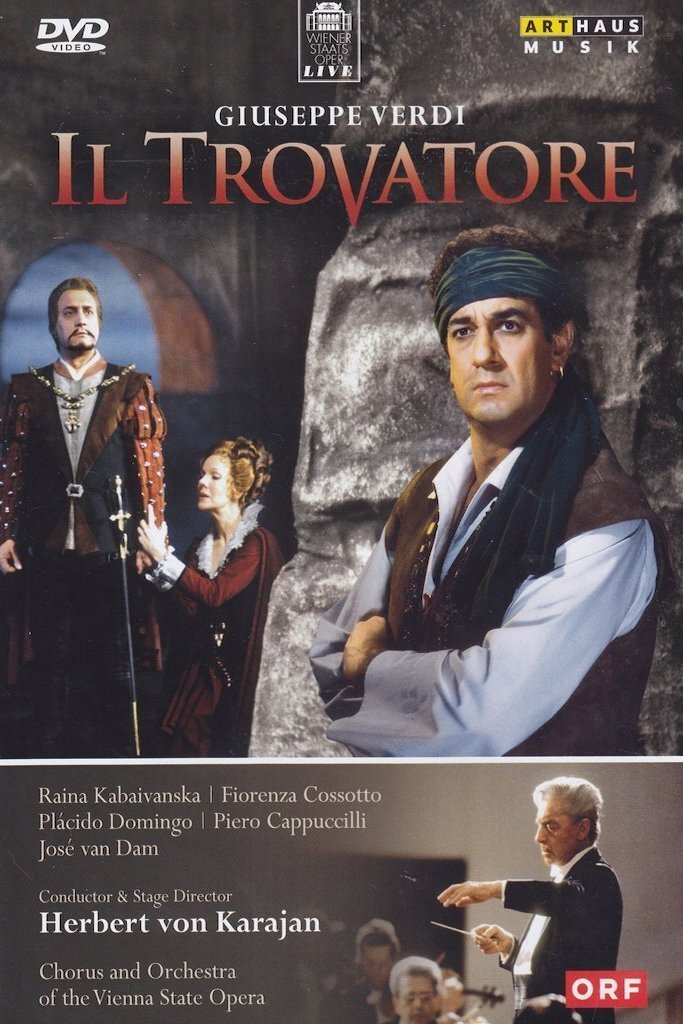
游吟诗人 1978年维也纳国家歌剧院版 [演出] 豆瓣
所属 演出: 游吟诗人
语言: 意大利语 italian 剧团: Orchester der Wiener Staatsoper 维也纳国家歌剧院管弦乐团 ; Chor der Wiener Staatsoper 维也纳国家歌剧院合唱团 剧院: Wiener Staatsoper 维也纳国家歌剧院 导演: Herbert von Karajan
其它标题: 1978年维也纳国家歌剧院版 编剧: Salvadore Cammarano / Leone Emanuele Bardare 作曲: Giuseppe Verdi 演员: Plácido Domingo / Raina Kabaivanska
Place: Biscay and Aragon (Spain)
Time: Fifteenth century.
Act 1: The Duel
Scene 1: The guard room in the castle of Luna (The Palace of Aljafería, Zaragoza, Spain)
Ferrando, the captain of the guards, orders his men to keep watch while Count di Luna wanders restlessly beneath the windows of Leonora, lady-in-waiting to the Princess. Di Luna loves Leonora and is jealous of his successful rival, a troubadour whose identity he does not know. In order to keep the guards awake, Ferrando narrates the history of the count (Racconto: Di due figli vivea padre beato / "The good Count di Luna lived happily, the father of two sons"): many years ago, a gypsy was wrongfully accused of having bewitched the youngest of the di Luna children; the child had fallen sick, and for this the gypsy had been burnt alive as a witch, her protests of innocence ignored. Dying, she had commanded her daughter Azucena to avenge her, which she did by abducting the baby. Although the burnt bones of a child were found in the ashes of the pyre, the father refused to believe his son's death. Dying, the father commanded his firstborn, the new Count di Luna, to seek Azucena.
Scene 2: Garden in the palace of the princess
Leonora confesses her love for the Troubadour to her confidante, Ines (Cavatina:Tacea la notte placida / "The peaceful night lay silent"... Di tale amor / "A love that words can scarcely describe"), in which she tells how she fell in love with a mystery knight, victor at a tournament: lost track of him when a civil war broke out: then encountered him again, in disguise as a wandering troubadour who sang beneath her window. When they have gone, Count di Luna enters, intending to pay court to Leonora himself, but hears the voice of his rival, in the distance: (Deserto sulla terra / "Alone upon this earth"). Leonora in the darkness briefly mistakes the count for her lover, until the Troubadour himself enters the garden, and she rushes to his arms. The Count challenges his rival to reveal his true identity, which he does: Manrico, a knight now outlawed and under death sentence for his allegiance to a rival prince. Manrico in turn challenges him to call the guards, but the Count regards this encounter as a personal rather than political matter, and challenges Manrico instead to a duel over their common love. Leonora tries to intervene, but cannot stop them from fighting (Trio: Di geloso amor sprezzato / "The fire of jealous love" ).
Act 2: The Gypsy Woman
Scene 1: The gypsies' camp
The gypsies sing the Anvil Chorus: Vedi le fosche notturne / "See! The endless sky casts off her sombre nightly garb...". Azucena, the daughter of the Gypsy burnt by the count, is still haunted by her duty to avenge her mother (Canzone: Stride la vampa / "The flames are roaring!"). The Gypsies break camp while Azucena confesses to Manrico that after stealing the di Luna baby she had intended to burn the count's little son along with her mother, but overwhelmed by the screams and the gruesome scene of her mother's execution, she became confused and threw her own child into the flames instead (Racconto: Condotta ell'era in ceppi / "They dragged her in bonds").
Manrico realises that he is not the son of Azucena, but loves her as if she were indeed his mother, as she has always been faithful and loving to him - and, indeed, saved his life only recently, discovering him left for dead on a battlefield after being caught in ambush. Manrico tells Azucena that he defeated di Luna in their earlier duel, but was held back from killing him by a mysterious power (Duet: Mal reggendo / "He was helpless under my savage attack"): and Azucena reproaches him for having stayed his hand then, especially since it was the Count's forces that defeated him in the subsequent battle of Pelilla. A messenger arrives and reports that Manrico's allies have taken Castle Castellor, which Manrico is ordered to hold in the name of his prince: and also that Leonora, who believes Manrico dead, is about to enter a convent and take the veil that night. Although Azucena tries to prevent him from leaving in his weak state (Ferma! Son io che parlo a te! / "I must talk to you"), Manrico rushes away to prevent her from carrying out this intent.
Scene 2: In front of the convent
Di Luna and his attendants intend to abduct Leonora and the Count sings of his love for her (Aria: Il balen del suo sorriso / "The light of her smile" ... Per me ora fatale / "Fatal hour of my life"). Leonora and the nuns appear in procession, but Manrico prevents di Luna from carrying out his plans and takes Leonora away with him, although once again leaving the Count behind unharmed, as the soldiers on both sides back down from bloodshed, the Count being held back by his own men.
Act 3: The Son of the Gypsy Woman
Scene 1: Di Luna's camp
Di Luna and his army are attacking the fortress Castellor where Manrico has taken refuge with Leonora (Chorus: Or co' dadi ma fra poco / "Now we play at dice"). Ferrando drags in Azucena, who has been captured wandering near the camp. When she hears di Luna’s name, Azucena’s reactions arouse suspicion and Ferrando recognizes her as the supposed murderer of the count’s brother. Azucena cries out to her son Manrico to rescue her and the count realizes that he has the means to flush his enemy out of the fortress. He orders his men to build a pyre and burn Azucena before the walls.
Scene 2: A chamber in the castle
Inside the castle, Manrico and Leonora are preparing to be married. She is frightened; the battle with di Luna is imminent and Manrico’s forces are outnumbered. He assures her of his love (Aria: Ah sì, ben mio, coll'essere / "Ah, yes, my love, in being yours"), even in the face of death. When news of Azucena’s capture reaches him, he summons his men and desperately prepares to attack (Cabaletta: Di quella pira l'orrendo foco / "The horrid flames of that pyre"). Leonora faints.
Act 4: The Punishment
Scene 1: Before the dungeon keep
Manrico has failed to free Azucena and has been imprisoned himself. Leonora attempts to free him (Aria: D'amor sull'ali rosee / "On the rosy wings of love"; Chorus & Duet: Miserere / "Lord, thy mercy on this soul") by begging di Luna for mercy and offers herself in place of her lover. She promises to give herself to the count, but secretly swallows poison from her ring in order to die before di Luna can possess her (Duet: Mira, d'acerbe lagrime / "See the bitter tears I shed").
Scene 2: In the dungeon
Manrico and Azucena are awaiting their execution. Manrico attempts to soothe Azucena, whose mind wanders to happier days in the mountains (Duet: Ai nostri monti ritorneremo / "Again to our mountains we shall return"). At last the gypsy slumbers. Leonora comes to Manrico and tells him that he is saved, begging him to escape. When he discovers she cannot accompany him, he refuses to leave his prison. He believes Leonora has betrayed him until he realizes that she has taken poison to remain true to him. As she dies in agony in Manrico's arms she confesses that she prefers to die with him than to marry another (Trio: Prima che d'altri vivere / "Rather than live as another's"). The count has heard Leonora's last words and orders Manrico's execution. Azucena awakes and tries to stop di Luna. Once Manrico is dead, she cries: Egli era tuo fratello! Sei vendicata, o madre. / "He was your brother ... You are avenged, oh mother!"