Giorgio Agamben — 作者 (102)
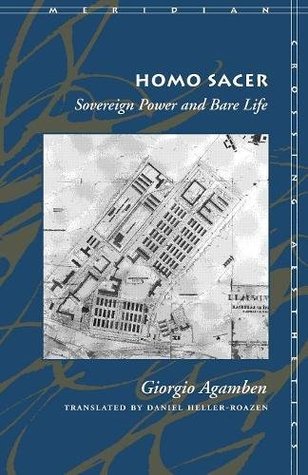
Homo Sacer [图书] 豆瓣
作者: Giorgio Agamben 译者: Daniel Heller-Roazen 出版社: Stanford University Press 1998 - 4
The work of Giorgio Agamben, one of Italy's most important and original philosophers, has been based on an uncommon erudition in classical traditions of philosophy and rhetoric, the grammarians of late antiquity, Christian theology, and modern philosophy. Recently, Agamben has begun to direct his thinking to the constitution of the social and to some concrete, ethico-political conclusions concerning the state of society today, and the place of the individual within it. In "Homo Sacer, " Agamben aims to connect the problem of pure possibility, potentiality, and power with the problem of political and social ethics in a context where the latter has lost its previous religious, metaphysical, and cultural grounding. Taking his cue from Foucault's fragmentary analysis of biopolitics, Agamben probes with great breadth, intensity, and acuteness the covert or implicit presence of an idea of biopolitics in the history of traditional political theory. He argues that from the earliest treatises of political theory, notably in Aristotle's notion of man as a political animal, and throughout the history of Western thinking about sovereignty (whether of the king or the state), a notion of sovereignty as power over "life" is implicit. The reason it remains merely implicit has to do, according to Agamben, with the way the sacred, or the idea of sacrality, becomes indissociable from the idea of sovereignty. Drawing upon Carl Schmitt's idea of the sovereign's status as the exception to the rules he safeguards, and on anthropological research that reveals the close interlinking of the sacred and the taboo, Agamben defines the sacred person as one who can be killed and yet not sacrificed--a paradox he sees as operative in the status of the modern individual living in a system that exerts control over the collective "naked life" of all individuals.
"What Is an Apparatus?" and Other Essays [图书] 豆瓣
作者: Giorgio Agamben 译者: David Kishik / Stefan Pedatella 出版社: Stanford University Press 2009 - 5
The three essays collected in this book offer a succinct introduction to Agamben's recent work through an investigation of Foucault's notion of the apparatus, a meditation on the intimate link of philosophy to friendship, and a reflection on contemporariness, or the singular relation one may have to one's own time.
"Apparatus" (dispositif in French) is at once a most ubiquitous and nebulous concept in Foucault's later thought. In a text bearing the same name ("What is a dispositif?") Deleuze managed to contribute its mystification, but Agamben's leading essay illuminates the notion: "I will call an apparatus," he writes, "literally anything that has in some way the capacity to capture, orient, determine, intercept, model, control, or secure the gestures, behaviors, opinions, or discourses of living beings." Seen from this perspective, Agamben's work, like Foucault's, may be described as the identification and investigation of apparatuses, together with incessant attempts to find new ways to dismantle them.
Though philosophy contains the notion of philos, or friend, in its very name, philosophers tend to be very skeptical about friendship. In his second essay, Agamben tries to dispel this skepticism by showing that at the heart of friendship and philosophy, but also at the core of politics, lies the same experience: the shared sensation of being.
Guided by the question, "What does it mean to be contemporary?" Agamben begins the third essay with a reading of Nietzsche's philosophy and Mandelstam's poetry, proceeding from these to an exploration of such diverse fields as fashion, neurophysiology, messianism and astrophysics.
The Coming Community [图书] 豆瓣 谷歌图书
La comunità che viene
作者: Giorgio Agamben 译者: Michael Hardt 出版社: University of Minnesota Press 1993 - 2
Unquestionably an influential thinker in Italy today, Giorgio Agamben has contributed to some of the most vital philosophical debates of our time. "The Coming Community" is an indispensable addition to the body of his work. How can we conceive a human community that lays no claim to identity - being American, being Muslim, being communist? How can a community be formed of singularities that refuse any criteria of belonging? Agamben draws on an eclectic and exciting set of sources to explore the status of human subjectivities outside of general identity. From St Thomas' analysis of halos to a stocking commercial shown in French cinemas, and from the Talmud's warning about entering paradise to the power of the multitude in Tiananmen Square, Agamben tracks down the singular subjectivity that is coming in the contemporary world and shaping the world to come. Agamben develops the concept of community and the social implications of his philosophical thought. "The Coming Community" offers both a philosophical mediation and the beginnings of a new foundation for ethics, one grounded beyond subjectivity, ideology, and the concepts of good and evil. Agamben's exploration is, in part, a contemporary and creative response to the work of Heidegger, Wittgenstein, Blanchot, Jean-Luc Nancy, and, more historically, Plato, Spinoza, and medieval scholars and theorists of Judeo-Christian scriptures. This volume is the first in a new series that encourages transdisciplinary exploration and destabilizes traditional boundaries between disciplines, nations, genders, races, humans, and machines. Giorgio Agamben currently teaches philosophy at the College International de Philosophie in Paris and at the University of Macerata (Italy). He is the author of "Language and Death" (Minnesota, 1991) and "Stanzas" (Minnesota, 1992). This book is intended for those in the fields of cultural theory, literary theory, philosophy.
Stanzas [图书] 豆瓣
作者: Giorgio Agamben / [意]吉奥乔·阿甘本 译者: Ronald L. Martinez 出版社: University of Minnesota Press 1992 - 11
Stanzas is a fascinating blend of philology, medieval physics and psychology, the psychoanalysis of toys, and contemporary linguistics and philosophy. In this unique work, Giorgio Agamben attempts to reconfigure the epistemological foundation of Western culture. He rereads Freud and Saussure to discover the impossibility of metalanguage and of synthesis that could be reflected in the transparency of signs. There is no “superior language” that can read the obscure scenes of the unconscious, and the “symbol” is always the return of the repressed in an improper signifier.
This impossibility leads Agamben to the problem of representation. He argues that because language is the locus of the production and storage of phantasms, all real objects are fractured by phantasmic itineraries that in turn divide poetry and philosophy, joy and knowledge.
L'avventura [图书] 豆瓣
作者: Giorgio Agamben 出版社: Nottetempo 2015 - 7
Ogni uomo si trova preso nell’avventura, ogni uomo ha, per questo, a che fare con Demone, Eros, Necessità e Speranza. Essi sono i volti – o le maschere – che l’avventura ogni volta gli presenta.
What Is Real? (Meridian [图书] 豆瓣
作者: Giorgio Agamben 译者: Lorenzo Chiesa 出版社: Stanford University Press 2018 - 10
Eighty years ago, Ettore Majorana, a brilliant student of Enrico Fermi, disappeared under mysterious circumstances while going by ship from Palermo to Naples. How is it possible that the most talented physicist of his generation vanished without leaving a trace? It has long been speculated that Majorana decided to abandon physics, disappearing because he had precociously realized that nuclear fission would inevitably lead to the atomic bomb. This book advances a different hypothesis. Through a careful analysis of Majorana's article "The Value of Statistical Laws in Physics and Social Sciences," which shows how in quantum physics reality is dissolved into probability, and in dialogue with Simone Weil's considerations on the topic, Giorgio Agamben suggests that, by disappearing into thin air, Majorana turned his very person into an exemplary cipher of the status of the real in our probabilistic universe. In so doing, the physicist posed a question to science that is still awaiting an answer: What is Real?
State of Exception [图书] 豆瓣
Stato di eccezione
作者: Giorgio Agamben 译者: Kevin Attell 出版社: University Of Chicago Press 2005 - 1
Two months after the attacks of 9/11, the Bush administration, in the midst of what it perceived to be a state of emergency, authorized the indefinite detention of noncitizens suspected of terrorist activities and their subsequent trials by a military commission. Here, distinguished Italian philosopher Giorgio Agamben uses such circumstances to argue that this unusual extension of power, or "state of exception," has historically been an underexamined and powerful strategy that has the potential to transform democracies into totalitarian states.
The sequel to Agamben's "Homo Sacer: Sovereign Power and Bare Life, State of Exception" is the first book to theorize the state of exception in historical and philosophical context. In Agamben's view, the majority of legal scholars and policymakers in Europe as well as the United States have wrongly rejected the necessity of such a theory, claiming instead that the state of exception is a pragmatic question. Agamben argues here that the state of exception, which was meant to be a provisional measure, became in the course of the twentieth century a normal paradigm of government. Writing nothing less than the history of the state of exception in its various national contexts throughout Western Europe and the United States, Agamben uses the work of Carl Schmitt as a foil for his reflections as well as that of Derrida, Benjamin, and Arendt.
In this highly topical book, Agamben ultimately arrives at original ideas about the future of democracy and casts a new light on the hidden relationship that ties law to violence.
Homo sacer [图书] 豆瓣
作者: Giorgio Agamben 出版社: Einaudi 2009 - 10
Ogni tentativo di ripensare le nostre categorie politiche deve muovere dalla consapevolezza che della distinzione classica fra zoé e bios, tra vita naturale ed esistenza politica (o tra l’uomo come semplice vivente e l’uomo come soggetto politico), non ne sappiamo piú nulla. Nel diritto romano arcaico homo sacer era un uomo che chiunque poteva uccidere senza commettere omicidio e che non doveva però essere messo a morte nelle forme prescritte dal rito. È la vita uccidibile e insacrificabile dell’«uomo sacro» a fornire qui la chiave per una rilettura critica della nostra tradizione politica. Quando la vita diventa la posta in gioco della politica e questa si trasforma in biopolitica, tutte le categorie fondamentali della nostra riflessione, dai diritti dell’uomo alla democrazia alla cittadinanza, entrano in un processo di svuotamento e di dislocazione il cui risultato sta oggi davanti ai nostri occhi. Seguendo il filo del rapporto costitutivo fra nuda vita e potere sovrano, da Aristotele ad Auschwitz, dall’Habeas corpus alle Dichiarazioni dei diritti, il libro di Agamben cerca di decifrare gli enigmi – prima di tutti il fascismo e il nazismo – che il nostro secolo ha proposto alla ragione storica. Fino a vedere, nel campo di concentramento, il paradigma biopolitico nascosto della modernità in cui città e casa sono diventate indiscernibili e la possibilità di distinguere tra il nostro corpo biologico e il nostro corpo politico ci è stata tolta una volta per tutte.
The Signature of All Things [图书] 豆瓣
作者: Giorgio Agamben 译者: Luca D'Isanto / Kevin Attell 出版社: Zone Books 2009
The Signature of All Things is Giorgio Agamben’s sustained reflection on method. To reflect on method implies for Agamben an archeological vigilance: a persistent form of thinking whose path is to expose, examine, and elaborate that which remains obscure, unthematized, even unsaid, in an author’s thought. To be archeologically vigilant, then, is to return to, even invent, a method attuned to a “world supported by a thick plot of resemblances and sympathies, analogies and correspondences.” The range of authors and of topics Agamben collects in this slim but dense volume exemplifies this search to create a science of signatures that exceeds either a semiology or hermeneutics vainly attempting to determine the pure and unmarked signs that signify univocally, neutrally, and eternally.
Three conceptual figures organize this treatise and the advent of Agamben’s own new method: the paradigm, the signature, and archeology. Each chapter is devoted to an investigation of one of these concepts whose genealogy Agamben carefully constructs transhistorically and from an interdisciplinary perspective. And at each moment of the text, Agamben pays tribute to Michel Foucault whose methods he rethinks and effectively uses to reformulate the logic of the concepts he isolates. The Signature of All Things reveals once again, how and why, Agamben is one of the most innovative thinkers writing today.
The Sacrament of Language [图书] 豆瓣
作者: Giorgio Agamben 译者: Adam Kotsko 出版社: Stanford University Press 2010
This book is a continuation of Giorgio Agamben's investigation of political theory, which began with the highly influential volume Homo Sacer: Sovereign Power and Bare Life. Having already traced the roots of the idea of sovereignty, sacredness, and economy, he now turns to a perhaps unlikely topic: the concept of the oath. Following the Italian scholar Paolo Prodi, Agamben sees the oath as foundational for Western politics and undertakes an exploration of the roots of the phenomenon of the oath in human experience. He rejects the common idea that the oath finds its origin in religion, arguing instead that the oath points toward a particular response to the experience of language, a response that gave birth to both religion and law as we now know them. This book is important not only for readers of Agamben or of continental philosophy more broadly, but for anyone interested in questions relating to the relationships among religion, law, and language.
Language and Death [图书] 豆瓣
Il linguaggio e la morte
作者: Giorgio Agamben / [意]吉奥乔·阿甘本 译者: Karen E. Pinkus / Michael Hardt 出版社: Univ Of Minnesota Press 2006 - 9
A formidable and influential work, Language and Death sheds a highly original light on issues central to Continental philosophy, literary theory, deconstruction, hermeneutics, and speech-act theory. Focusing especially on the incompatible philosophical systems of Hegel and Heidegger within the space of negativity, Giorgio Agamben offers a rigorous reading of numerous philosophical and poetic works to examine how these issues have been traditionally explored. Agamben argues that the human being is not just “speaking” and “mortal” but irreducibly “social” and “ethical.” Giorgio Agamben teaches philosophy at the Collège International de Philosophie in Paris and at the University of Macerata in Italy. He is the author of Means without End (2000), Stanzas (1993), and The Coming Community (1993), all published by the University of Minnesota Press. Karen E. Pinkus is professor of French and Italian at the University of Southern California. Michael Hardt is professor of literature and romance studies at Duke University.