陈洁 — 作者 (4)
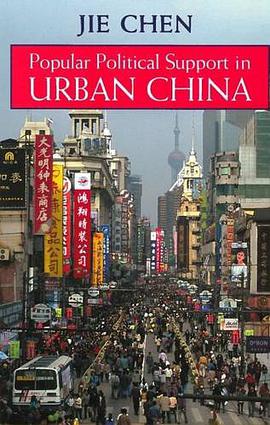
Popular Political Support in Urban China [图书] 豆瓣
作者: Jie Chen 出版社: Stanford University Press 2004 - 1
Has the current political system in the People’s Republic of China lost its legitimacy in the eyes of the Chinese public? On the basis of three carefully drawn surveys of Beijing residents between 1995 and 1999, the author finds that diffuse support for the current political system—based on attitudes toward institutions and values—remains strong, at least among city-dwellers, though it is gradually declining. Specific support for current political authorities, as measured by evaluations of their performance in major policy domains, is much weaker, with many citizens evaluating the authorities’ performance as mediocre.
In analyzing the longitudinal data presented here, the author finds that the same set of key sociodemographic attributes and sociopolitical orientations variably influence citizens’ attitudes toward the political system and their evaluations of leaders’ performance. Further, the study shows that citizens’ attitudes toward the system, on the one hand, and their evaluation of incumbents’ performance on the other, have different impacts on forms of political participation, such as voting and contacting authorities.
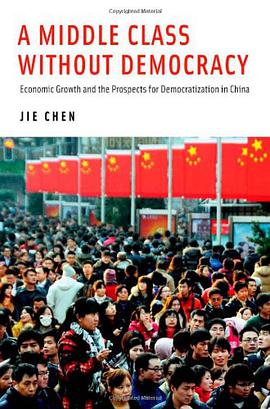
A Middle Class Without Democracy [图书] 豆瓣
作者: Jie Chen 出版社: Oxford University Press, USA 2013 - 4
What kind of role can the middle class play in potential democratization in such an undemocratic, late developing country as China? To answer this profound political as well as theoretical question, Jie Chen explores attitudinal and behavioral orientation of China's new middle class to democracy and democratization. Chen's work is based on a unique set of data collected from a probability-sample survey and in-depth interviews of residents in three major Chinese cities, Beijing, Chengdu and Xi'an—each of which represents a distinct level of economic development in urban China-in 2007 and 2008. The empirical findings derived from this data set confirm that (1) compared to other social classes, particularly lower classes, the new Chinese middle class-especially those employed in the state apparatus-tends to be more supportive of the current Party-state but less supportive of democratic values and institutions; (2) the new middle class's attitudes toward democracy may be accounted for by this class's close ideational and institutional ties with the state, and its perceived socioeconomic wellbeing, among other factors; (3) the lack of support for democracy among the middle class tends to cause this social class to act in favor of the current state but in opposition to democratic changes.
The most important political implication is that while China's middle class is not likely to serve as the harbinger of democracy now, its current attitudes toward democracy may change in the future. Such a crucial shift in the middle class's orientation toward democracy can take place, especially when its dependence on the Party-state decreases and perception of its own social and economic statuses turns pessimistic. The key theoretical implication from the findings suggests that the attitudinal and behavioral orientations of the middle class-as a whole and as a part-toward democratic change in late developing countries are contingent upon its relationship with the incumbent state and its perceived social/economic wellbeing, and the middle class's support for democracy in these countries is far from inevitable.
Allies of the State [图书] 豆瓣
作者: Jie Chen / Bruce J. Dickson 出版社: Harvard University Press 2010 - 6
Jie Chen and Bruce J. Dickson draw on extensive fieldwork as they explore the extent to which China’s private sector supports democracy, surveying more than 2,000 entrepreneurs in five coastal provinces with over 70 percent of China’s private enterprises.
The authors examine who the private entrepreneurs are, how the party-state shapes this group, and what their relationship to the state is. China’s entrepreneurs are closely tied to the state through political and financial relationships, and these ties shape their views toward democracy. While most entrepreneurs favor multi-candidate elections under the current one-party system, they do not support a system characterized by multi-party competition and political liberties, including the right to demonstrate. The key to regime support lies in the capitalists’ political beliefs and their assessment of the government’s policy performance. China’s capitalists tend to be conservative and status-quo oriented, not likely to serve as agents of democratization.
This is a valuable contribution not only to the debates over the prospects for democracy in China but also to understanding the process of democratization around the globe.