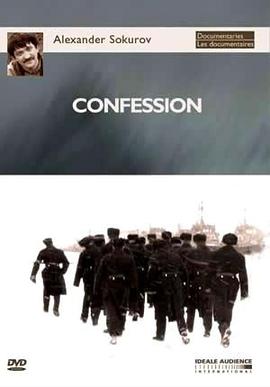
亚历山大·索科洛夫 — 导演 (58)
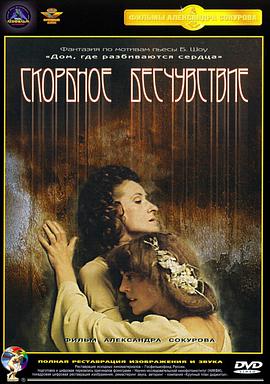
悲戚的冷漠 (1987) [电影] 豆瓣
Скорбное бесчувствие
导演: 亚历山大·索科洛夫 演员: 拉马兹·迟希克瓦泽 / Alla Osipenko
其它标题: Скорбное бесчувствие / Mournful Unconcern
In the title of this film we have the diagnosis of a mental illness. The title of George Bernard Shaw's play Heartbreak House is a formula-symbol introduced by the great British wit in order to describe Europe before the First World War. The Russian filmmaker discerned and brilliantly developed Russian Chekhovian roots of the play in his saturated with associations cinematographic composition. This was a feast of Sokurov's imagination and an anthology of almost all of his devises to be subsequently developed. Here one could find a model of a set, closely imitating the real surrounding, documentary shots juxtaposed to the deformed image, a mask of Shaw himself, and non-professional performers next to the celebrated Georgian actor Ramaz Tchkhickvadze.
The film had scandalized the powers that be as early as during the process of production which had been several times interrupted and banned by various structures of officialdom — until the film was eventually released in the beginning of Perestroika, in 1987. Perhaps nowadays one of the most important for the director themes — the defenselessness of man, hiding in the house as in a cocoon in the attempt to evade the horrors of history and the problems of existence — sounds more articulately than ever. And the defense — science, technic, culture — civilization — may crash any time and crush 'proud' humankind.
The film took part in the competition program of the XXXVII International Cinema Festival in Western Berlin in 1988 and got FIPRESSI award at the XV International Festival in Moscow and Special award in the memory of Andrei Tarkovsky (1987).
卑微的人生 (1997) [电影] 豆瓣
Смиренная жизнь
其它标题: Смиренная жизнь / A Humble Life
1997, 75 min., colour, BETACAM SP, Stereo
The Japan Foundation, North Foundation, Pandora Co., Ltd (Japan)
Special thanks to Hiroko Kodjima
scenario: A. Sokurov
camera: A. Fedorov
sound: S. Moshkov
editor: L. Semenova
“My journey to your sorrowful country cannot finish… even here in Russia.
I can't part with feelings which have captured me… as if my soul had been in search of Beauty and Kindness. If not — what for have I deserved this gift, this meeting…
I have arrived in the twilight. The noise of the wind and my tiredness didn't let me fall asleep.
I was lying on the floor, there was a small lamp at my head, the bedding had been thrown over the mat.
I don't know why, but I began to think about the war, and the scenes of unknown life appeared before me from the past… or, perhaps, from the future; Somebody’s children… somebody's mothers…
The summer was warm…
Then the morning came, windy, cold and sunny… I examined the house cautiously. It was empty…
Then, I remember, I turned back, having heard a creak.
It seemed she had not yet noticed me… I decided to come nearer.
I can remember well enough, how everything became interesting: walls, utensils, wind, light, sounds — all her life.
We agreed that she would let me stay near her all the time All the hours and minutes that I could spend in her old house. I sat near her with her permission. And it was really necessary: I could contem­plate her to my heart's content.”
Alexander Sokurov (from the author's text to the film)
A myth about lost harmony, which is always with us, though we often cannot feel it, is further developed in this film by Alexander Sokurov. The material used here is concrete and, at first sight, quite fit for TV. The whole work is unhurried and detailed report from an old solitary house, lost in the mountains, in the village of Aska, prefecture Nara, Japan, where an old woman, whose name is Umeno Matshueshi, lives alone. But filmmaker's creative task is quite opposed to the TV information stream. It is not only because this subject, this person couldn't be of any interest for any TV crew in any country (and least of all, perhaps, in modern Japan).
Sokurov's camera doesn't watch this character, doesn’t ask any questions, doesn’t surprise her, but extracts uninterrupted poetical image out of the trivial details of this physical reality, out of this extinct life and daily routine. The image is epic and lyrical at the same time. Refined simplicity of Japanese landscape, interior, a series of portraits are not a representation of “couleur local,” but only the sign of ideal technique of the ideal description, allowing to enter this life. The woman, who remains silent throughout the whole film, cooking and eating, kindling the fire and sewing, giving alms and combing her hair before us, recites in the final poem as a prayer: artless and sorrowful tanku about loneliness, about the constancy of losses and gainings. Sokurov shoots this unexpected stroke in his personage's portrait as a lyrical coda of his work.

苏联挽歌 (1989) [电影] 豆瓣
Советская элегия
其它标题: Советская элегия / Soviet Elegy
“It is a film from an extended series. It is hard to say who is the main character of “The Soviet Elegy.” There are more than a hundred faces of our compatriots. But, of course, it is not by chance that it is the destiny of a famous political figure, Boris Nikolayevitch Yeltsin, that bears a special accent in the film. Though he got to power following quite typical ways, his uncommon character puts him out of the ordinary, and in the author’s opinion it may be determined by his uncommon human nature. Our hero exists within the tragic pattern of the soviet socialist life. He is a character of a drama, of which he is one of the authors. “The Soviet Elegy” can hardly be called a documentary film in the proper sense. Of course, the author guarantees the accuracy of chronology, but he insists on an artistic mode of thinking, not on a political or historical investigation.”
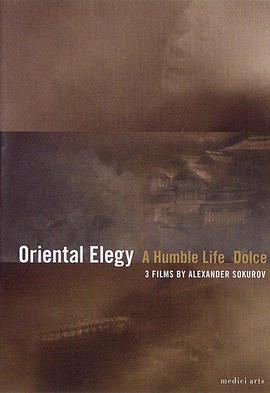
东方挽歌 (1996) [电影] 豆瓣 TMDB IMDb 维基数据
Восточная элегия
其它标题: Восточная элегия / Vostochnaya elegiya
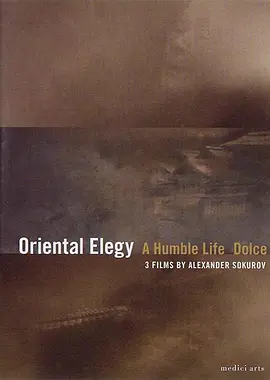
This wonderful visual poem unites many of Sokurov's best traits. Like most of his films, it is less about plot than the unfolding of a specific situation. Here, an observer who merely appears as a silhouette (though it seems to be Sokurov) travels to an old Japanese town on an island. It is an unearthly place, almost empty, old buildings, mist, probably the afterlife. The observer talks to three souls about their former lives which they see as burdensome and unhappy; but they talk in a light-hearted manner. There is a nocturnal feel to everything, the images have a washed-out quality, like varnished old paintings, and Sokurov deliberately keeps them sometimes out of focus (all trademarks of his); the soundtrack is a marvelous composition of gently howling wind, creaking wood and remote music, some classical, some Russian and Japanese folk. The entire movie is a dreamlike reflection on life and death and the view of the dead upon the living. Absolutely recommended for all who like Sokurov and Eastern European poetic film. (IMDB)
生命挽歌 (2006) [电影] 豆瓣
Элегия жизни. Ростропович. Вишневская.
导演: 亚历山大·索科洛夫 演员: 罗斯特罗波维奇 / 加琳娜·维什涅夫斯卡娅
其它标题: Элегия жизни. Ростропович. Вишневская. / 罗斯特罗波维奇80岁纪念:人生的祭典
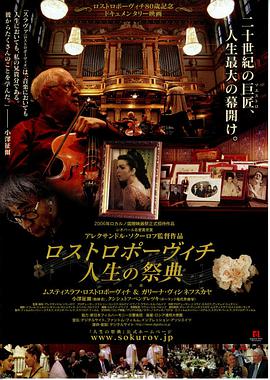
A documentary about the famous musician Mstislav Rostropovich and his wife, Galina Vishnevskaya.
莫斯科挽歌 (1987) [电影] 豆瓣
Московская элегия
其它标题: Московская элегия / The Moscow Elegy
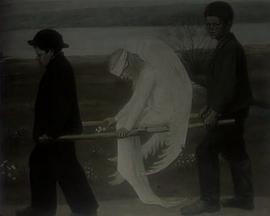
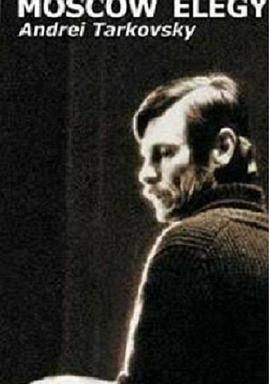
電影大師塔科夫斯基作品雖多次獲得國際影展大獎肯定,卻因表現風格及美學立場於俄國國內屢受挫折,他於1983年赴義大利拍攝《鄉愁》時,為表抗議於是決定不再返回祖國。被譽為塔氏傳人的蘇古諾夫,在塔氏病危的生命末期,藉由照片、新聞、訪談、電影片段、幕後花絮等素材,將塔氏對人生、對電影的摯誠與悲憫揉合於本片,作了完美的註腳。而一段塔科夫斯基親身演出電影的珍貴畫面,更是獻給影迷們最大的驚喜。
亚力山娜 (2007) [电影] 维基数据 IMDb 豆瓣 TMDB
Александра
6.8 (5 个评分) 导演: 亚历山大·索科洛夫 演员: Vasiliy Shevtsov / Raisa Gichaeva
其它标题: Александра / 亚历珊卓
1999年,第二次车臣爆发,无论处于何种目的,然战火所到之地,生灵涂炭,凄惨荒凉。
年事已高的俄罗斯老妇人亚力山娜(Galina Vishnevskaya 加利娜•维希涅夫斯卡娅 饰)独自踏上路程,从家乡远赴车臣的军营探望7年未见的孙子丹尼斯(Vasily Shevtsov 饰)。丹尼斯如今已荣升为陆军军官,祖孙俩情深意笃,却无法回避岁月和理念所产生出来的隔膜。亚力山娜独自步出军营,放眼望去,满眼尽是破败和凄凉……
本片荣获2008年Fajr电影节最佳表演奖(Galina Vishnevskaya)。
走近南高加索事件 (1990) [电影] 豆瓣
К событиям в Закавказье
其它标题: К событиям в Закавказье / Ленинградская кинохроника № 5. Спецвыпуск
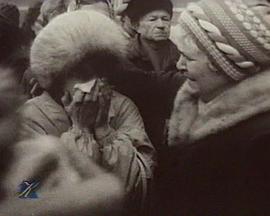
Специальный выпуск ленинградской кинохроники Сокуров сделал оперативно, получив материал из Краснодара, где оператор снял митинг протеста матерей призванных в российскую армию ребят, направляемых в зоны межкавказских конфликтов. Вся лента — персональное кинематографическое воззвание режиссера к президенту Горбачеву и к власти, смысл этого воззвания распространяется не только на данный конкретный факт социального конфликта.
Одна из важнейших для Сокурова исторических тем: невозможно безнаказанно вклиниваться в дела других народов, быть буфером национальных распрей — здесь потребовала не эстетического контекста, но прямой гражданской речи. Краснодарские кадры, смонтированные с изображением самого Сокурова на фоне петербургского вьюжного пейзажа, — это гражданский автопортрет режиссера на фоне отечественного неблагополучия, взрывы которого еще впереди, и долг художника о них предупредить.
晚祭 (1987) [电影] 豆瓣
Жертва вечерняя
其它标题: Жертва вечерняя / The Evening Sacrifice
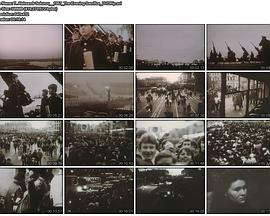
Описание: Майскую демонстрацию трудящихся и салют — один из ритуальных праздников советской России — Сокуров снимает как изнанку официозного жанра отечественной кинохроники. Парад народного единства он показал как усталую массовку, распадающуюся без режиссерской направляющей руки и без цели. Вспышки немотивированного веселья, как и случайные знаки тревоги даны в беглых зарисовках толпы, угрожающе неприкаянной и щемяще жалкой.
Часть вместо целого, индивидуальные черты всеобщего лица, из деталей вырастающий символ — эти постулаты монтажного советского кино, разработанные Эйзенштейном в изображении человеческой массы, хора и протагониста советской эпохи, Сокуров пересматривает в аспекте нового времени и нового — собственного стиля. Хор как социальная категория уже несостоятелен, а протагонист отсутствует. Здесь лица отдельны и одиноки даже в законодательном общем ликовании. Впрочем, и хор и солист в картину массового праздника вплетены рукою автора–режиссера: в фонограмму финальных кадров Сокуров включил запись церковного песнопения — покаянную молитву «Жертва вечерняя». Но эти голоса уже не от мира сего. Это, скорее, звуки потустороннего сочувствия, это салют из мира Творца и Творчества. Первоначальное название картины — «Салют».
Фильм — участник кинофорума «Молодое кино» в рамках ХХХVIII Международного кинофестиваля в западном Берлине (1988).
士兵之梦 (1995) [电影] 豆瓣
Солдатский сон
其它标题: Солдатский сон / Soldatskiy son
1995, 12 min., colour, BETACAM SP
North Foundation
camera: Alexander Burov
sound: Sergei Moshkov
Musical excerpts from W. A. Mozart, L. van Beethoven, O.&nbsolMessiaen, R. Wagner, P. Tchaikovsky, T. Takemitsu.
This lyrical small film came out of the material edited for the larger video documentary “Spiritual Voices.” The completed film consisted of fives parts with a total duration of about five hours. “A Soldier's Dreams” became one of its scenes.
This smaller film was created as a kind of gift to the film critic and historian Dr. Hans Schlegel, who has done so much for me and for so many other Eastern European cinematographers.
The first screening of this film took place in Oberhausen.
Alexander Sokurov
This film is a “sketch” for the five hour documentary “Spiritual Voices.” The material, shot by Sokurov's crew on the border of Afghanistan as Russian soldiers carry on with their frontier patrol duties, becomes a parable. The young soldiers resting after their duties personify the difficult and grave task which burdens youth: to ensure peace and calm. A young person on the border between life and death is a recurring poetic motif in Alexander Sokurov's feature films. Here the documentary footage is transformed into
“a soldier on the border of peace and war.” It is a tragic theme — and a very Russian one.
简单挽歌 (1990) [电影] 豆瓣
Простая элегия
其它标题: Простая элегия
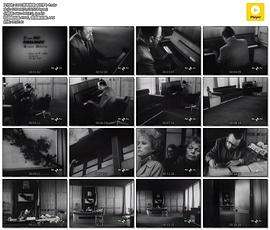
“Simple Elegy” is simple in form — also, probably, is it simple in content. It is compiled from documentary footage shot in 1990 when Russia imposed an economic blockade on Lithuania. We filmed in the building which houses the Supreme Council of Lithuania and in the streets of Vilnius. There are two protagonists in the film, the People and the Chief of State: the Lithuanians and Mr. Vitautas Landsbergis. This new leader of the Lithuanian state is an attractive figure. Landsbergis is an historian of culture and music. He received a classical education. Perhaps every state should seek to have such a person of education at its head. Yet we who made this film did not have any political intentions, only, quite naturally, artistic ones… It is important to note that “Simply Elegy” is a film in the “Elegy” series.
Alexander Sokurov (from the author's summary)
The office of the President of Lithuania, 1990. Inside, silence reigns, contrasting to the shouting of the crowds outside the windows of the governmental building. At the same time, this silence is mirrored by the intense silence of several women, whose faces remain on the screen for a long time. The silence is broken by music. The President plays the piano — the Nocturnes, composed by his famous compatriot, Ciurlionis. The President, musician and politician, has plunged himself into deep mediation (recalling aspects of “Soviet Elegy”) — a kind of phenomena of our times, something that Sokurov searches for and hopes to capture: something that remains and can still be rescued.
坚忍的航程 (1998) [电影] 豆瓣
Povinnost - TV mini-series
其它标题: Povinnost - TV mini-series / 忏悔
From the Commander's diary
in 5 parts (52 min. each)
1998, 260 min., colour, BETACAM SP, Stereo
Studio Nadezda, Roskomkino, with the participation of Lenfilm
scenario: A.Sokurov
camera: A.Fedorov
sound: S.Moshkov
editor: L.Semenova
producer: S.Voloshina
“The Commander could not decide whether he should keep a diary and record the occurrences in his life. What if someone were to read it by chance?”
帝国 (1987) [电影] 豆瓣
Ампир
其它标题: Ампир / Empire
Short film Empire is based on a radio drama Sorry, Wrong Number by the American writer Lucille Fletcher. Actually, Sokurov draws on a single theme forming the background for the story of the thriller — the woman's illness… The heroine is bed–ridden and her only means of communication with the outside world is her telephone — until a killer interrupts the conversation…
Sokurov removes all the dialogues, leaving us alone with the heroine — “a living skeleton” among the refined, with a touch of Modern–style, furnishings — who is listening to a radio broadcasting of Traviata, with its pleas for mercy and love. An elegant coffin–home is the spatial centre and symbolization of the entire film. And inside the coffin we certainly see the actress — the famous Russian ballerina Alla Osipenko who plays not only the heroine but also her own self.
This metaphoric cinema–image bears an allusion to the great “handicapped” Sarah Bernhardt who was reported to sleep in a coffin, as well as to the entire complex of aesthetised Decadence, converting an apology of Death into a lifestyle. Here is the key to the code of the title. Empire is a style that attempted to reanimate the dead ancient harmony. The heroine of Sokurov's film communicates with her phone as the only partner, and sort of interferes with the beyond, attracting this air — intangible yet saturated with danger. It is from the radio air that she accumulates both pleasure and tranquillity — the aria of dying yet beloved Violetta, while the killer's silhouette materializes from the phone air. A chamber pot, overturned and spilt by the killer in haste, remains the only evidence of human activities in this boudoir of Death. Sokurov's metaphor, clad in naturalistic details, produces the effect of ironic disclosure: “a wet spot” is left after a symbol.
The film was shot as a study work of a VGIK student S.Sidorov. At that time Sokurov did not have a chance to launch a project of his own, therefore he used this possibility to work. Visual conception of this film anticipates a considerable number of Sokurov's future experiments: light that models the space, levelling of colours, correlation of contrasting textures.
玛利亚 (1988) [电影] 豆瓣
Мария
导演: 亚历山大·索科洛夫 演员: Лесь Сердюк
其它标题: Мария / Maria
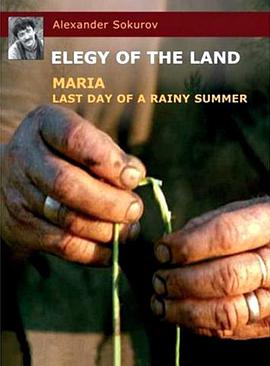
蘇古諾夫的第一部紀錄片,當時在地方電視台工作的他,跑到鄉間紀錄主人翁瑪莉亞的農村生活,最後成為他在莫斯科電影學校的畢業作品。在影片第一部份完成後九年,蘇古諾夫重回該地繼續拍攝,發現人事景物全非,唯一不變的,是農村的生活水平,貧困一如以往。在導演關懷注視的鏡頭下,原本被期待成為「樣板政宣電影」的本片,卻悄悄揭露了包裹在美麗糖衣下的幾分現實和哀傷。
朗读《围困之书》 (2009) [电影] 豆瓣
Читаем блокадную книгу
导演: 亚历山大·索科洛夫 演员: Oleg Basilashvili / Marina Moshkova
其它标题: Читаем блокадную книгу / Chitaem 'Blokadnuyu knigu'
Amateur actors read stories from a book describing the 900-day siege of Leningrad during World War II.
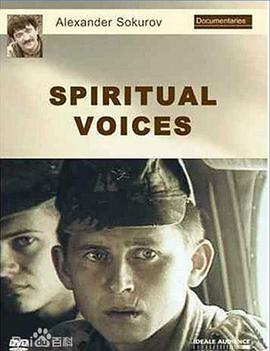
精神之歌 (1995) [电影] 豆瓣
Духовные голоса. Из дневников войны. Повествование в пяти частях.
其它标题: Духовные голоса. Из дневников войны. Повествование в пяти частях. / 灵魂之声
1994年, Sokurov随俄军被分配到塔吉克斯坦和阿富汗交界处的边境军用岗进行实地拍摄。虽然1989年俄军从阿富汗战争中撤出,但仍然有隐蔽的敌人在边境尾 随。当不知名的武装部落偶尔与俄军发生小规模冲突时,Sokurov的拍摄记录了冲突的间歇,让人感到十分困扰。他有力地捕捉了俄军被孤立时的情景,部队 被折磨得无力的心情,以及严酷的环境。如诗般却又伴随着哀怨。此系列记录片被分为五集。
三兄妹 (2013) [电影] 豆瓣
Два брата и сестра
其它标题: Два брата и сестра / Two Brothers and a Sister
索科洛夫將完成「家庭三部曲」的第三作(前兩作分別為《母與子》和《父子迷情》)。本片由俄羅斯ТВС投資拍攝。
圣彼得堡挽歌 (1989) [电影] 豆瓣
Петербургская элегия
其它标题: Петербургская элегия
Описание: «Фильм — из серии документальных фильмов, задуманных как рассказ о прошлой и современной жизни России, ее культуры, истории. «Петербургская элегия» состоит из двух частей: рассказа о семейной жизни Ф. И. Шаляпина и эмоционального обобщения жизни современных ленинградцев. В некотором смысле этот фильм расширяет наше знание о личной жизни великого соотечественника и является продолжением первого фильма из серии «Элегий». Фильм смонтирован в повествовательной манере: автор комментирует фото и архивные документы, предлагает внимательно, неторопливо вглядеться в лицо одного из главных персонажей фильма — Федора Федоровича Шаляпина, старого голливудского актера, живущего в Италии и приехавшего в Ленинград через 60 лет. В лице сына мы узнаем черты гениального отца и в то же время замечаем, что перед нами обыкновенный человек…»
Александр Сокуров (из авторской аннотации к фильму)
Вглядывание в наш современный мир с некой потусторонней точки становится еще пристальней, еще отрешенней в «Петербургской элегии». Здесь нам показали мир, утративший опору, растерянные человеческие лица и глаза, не видящие перспективы. Это мир, в котором нет гения, мир без художника. Поэтому так важны в этой картине съемки неподвижной камерой современной людской массы, скученной в одном месте, но текучей, зыбкой — в броуновском движении площади, магазина. Важны и современные пейзажи бывшей имперской столицы: обезлюдевшие, холодные. Теплый в них только пар, клубящийся из канализационных люков.
Поводом к фильму , как и в фильме «Элегия», стал визит в Ленинград одного из членов Шаляпинской семьи. На этот раз сына певца от первого брака. Федор Федорович большую часть своей жизни провел в Италии. Петербург, откуда в начале 20–х годов навсегда уехал его отец, для него один из долгожданных маршрутов путешественника.
Частная жизнь, семейные проблемы творческой личности — такая сторона ее связи с обществом, которая во многом предвосхищает будущее этого общества, задает его генетический код. Сохранение духовных качеств рода, нации, человечества — сохранение таких людей, как Шаляпин — главная задача любого общества. Это подспудная тема фильмов Александра Сокурова о своих знаменитых соотечественниках.
Александра Тучинская
轻柔 (2000) [电影] 豆瓣
Дольче
其它标题: Дольче / Dolce...
dolce…
1999, 60 min, colour, Betacam SP, Stereo
Studio Bereg
Quest (Japan)
producer: Yudji Kogure
international project manager Hiroko Kodjima
written by Alexander Sokurov
camera: Koshiro Otsu
sound: Sergei Moshkov
editors: Alexei Jankowski, Sergei Ivanov
Summary
The film deals with real people: the well–known Japanese writer Toshio Shimao, who died in 1986, his widow and their daughter. Yet the film's documentary approach is only the framework for a penetrating biographical portrait; video is used here in an “intimate” way, to capture the inner worlds of the characters. The dramatic events of the writer's life and work make for a story which itself reveals the quintessence of the film–maker's reflections on Japan and the Japanese people. The principal narrative strand is a lyrical monologue, that of the heroine, Miho Shimao, the writer's wife. She lives on a solitary island far into the ocean, with her handicapped daughter, shunning visitors.
She discovers herself through self–analysis, a form of catharsis brought on by the spiritual denudation of this existence. This proves to be the pivotal event in her life — a confined life, where actions have come to mean less than emotions.
The film–maker here reveals the contours of memory, the contrasts of feelings and the nuances of the psyche in an impressionist manner. The only way to enter this world, to be able to approach its exquisite flavour and perverse pain, is to make a film akin to a lyrical piece of music, with tenderness, “dolce.”
Alexandra Tuchniskaya
Translated into English with assistance from Benjamin Halligan.