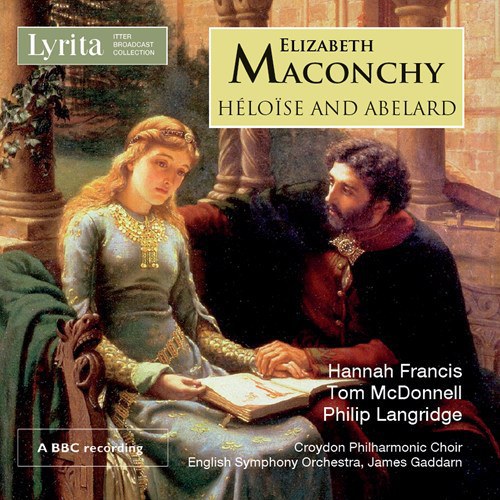
Described in the very extensive and detailed booklet note by Paul Conway as her “Magnum Opus” and a “consummate achievement”, Elizabeth Maconchy’s Héloïse and Abelard was first performed in Croydon on 3rd March 1979, recorded on that occasion by the BBC and broadcast eight months’ later. This mono recording is taken from that broadcast.
It is over a quarter of a century since I last reviewed a recording featuring music by Elizabeth Maconchy – on that occasion it was a disc of four of her 13 string quartets (which Conway describes as being “central to her output”) - and I certainly can’t recall having heard any of her music in the concert hall in all of that time. The 2000 edition of Grove assessed her place in history somewhat patronisingly as an “English composer of Irish descent, mother of Nicola Lefanu”, and while the BBC occasionally trots out recordings of her music, they are usually in programmes devoted to women composers. There was a flurry of releases (mostly, it has to be said, re-releases) around the time of her centenary, a decade ago, but very little of her music has since appeared on disc. Which is a great pity for not only did she produce a very substantial and wide-ranging output, but it is characterised by a firm and determined hand and fine workmanship.
Although it seems not to have been performed live since 2008 there is much to admire about Héloïse and Abelard. This takes the form of a nine-section cantata tracing the tragic love between a philosopher and his student. Maconchy stresses that she has drawn up a libretto which deals only in factual sources without romantic embellishment, but if the words tell the story without elaboration, the music more than makes up for it. Maconchy’s powerful, emotionally-charged, erotic, and intense writing, especially in the last five sections of the work, is anything but dispassionate.
Héloïse and Abelard opens with high drama, the chorus singing Latin words about the “pleasant spring time” but the music telling us that some great and terrible drama is about to unfold. We then move to the cloister of Notre Dame where Abelard, having just completed a lecture to his students, is confronted by Héloïse who begs to study philosophy with him. Here we are introduced to the three soloists. Hannah Francis is ideally cast as the young, innocent and admiring Héloïse, although her diction is often quite cloudy. Her instant admiration for her tutor sounds like the hero-worship of an adolescent girl, yet as the work proceeds, her strength of personality and her very adult approach to love and passion are conveyed equally convincingly. Convincing is not a word I would use to describe Tom McDonnell’s portrayal of Abelard. He certainly does have impeccable diction, but vocally he sounds too elderly and hearty to be the convincing object of a young girl’s affections, and there seems no real conviction behind his later declarations of love (“I desire to keep you, whom I love beyond measure”). Totally convincing in the role of Canon Fulbert (Héloïse’s uncle and Abelard’s eventual nemesis), Philip Langridge brings authority and substance. If there is a problem it lies in a voice which we have come to associate rather closely with Benjamin Britten’s music; but more of that later.
In the third section – “In Canon Fulbert’s House” – the love between Abelard and Héloïse is beautifully conveyed through some sumptuous orchestral writing and, not least, by Francis’s gorgeous vocal purity, especially as she recounts her feelings when alone in the woods. It is the orchestra in a brief, sparse and at times strident Interlude which conveys Fulbert’s fury at both learning that teacher and pupil are lovers and that his niece is pregnant. But this is immediately countered by the next scene, “In Brittany”, in which the chorus women and Héloïse nurse the young baby before Abelard’s return from Paris. Again, though, while the text says one thing, the music says another; this is not a joyful birth nor a love which can survive. An acidic undertone informs just about everything the orchestra plays in this outwardly gentle movement, although there is a lurking sense that McDonnell is not best vocally suited to the role of ardent lover – it is hard to accept as sincere when he sings “When we are together I can think of nothing but our love”. However, there is a noticeable hardening of tone as Francis asks “Why did neither you nor my uncle think to consult me [about this proposed marriage]?”, and the hefty brass adds real venom to her outburst, “I prefer love to wedlock, and freedom to chains”. When she does eventually concede to the marriage, ominous orchestral chords tell us that things are not going to be good.
Fulbert’s anger with Abelard is vocally explosive in the next movement – “In Fulbert’s House in Paris” – and here we have perhaps the musical highlight of this performance; a brilliant virtuoso display from Langridge, whose hatred of Abelard, we learn, is fuelled more by his own desire for his niece than Abelard’s own treachery. His final command to have Abelard castrated leads directly into the next section where the crowd bewails Abelard’s fate and calls for vengeance against Fulbert in a remarkably controlled piece of choral writing – with an undercurrent of mob rule created by some background choral speaking.
Once again Maconchy shows a deft hand at dramatic pacing by following this outburst of violence with the peaceful chanting of nuns “At the Convent”, although a gritty woodwind undercurrent tells us that Héloïse is far from at peace with herself. Two of Abelard’s own texts follow, sung as choral hymns but with bitter harmonic underlay and desolate oboe descants. The final part is the funeral oration sung over Abelard’s grave, and it is just unfortunate that at the very end, Francis has a bit of a pitch wobble and sinks unconvincingly below the body of the chorus.
Buried deep within the very extensive and informative booklet notes which come with this release is a quote about Maconchy being concerned with “forceful, logical argument rather than emotion”. If that is true of some of her purely instrumental music, it is certainly not the case here. And while much of the music in the earlier sections of the work sounds barely distinguishable from the music of Benjamin Britten (something which this performance does nothing to disguise) as we move towards the ultimate tragedy, Maconchy’s music takes on a very different hue. There is passion and emotional depth here, showing a composer profoundly involved with the text and its repercussions on contemporary society. It could be suggested that this is a musical telling of a famous love story seen very much from a female perspective, but that would be to undermine the very intensity of Maconchy’s music, which depicts more the harshness and cruelty of a heartless moral code than the individual actions of men in their dealings with one particularly forceful female.
And what of the recording and performance? As always with a mono recording, there is that initial shock when a large sound seems horribly condensed within a single sound source. In this case, however, that shock is not merely the result of the recording, but of the performance. With the best will in the world, the Croydon Philharmonic Choir in 1979 cannot be said to have been one of the world’s leading choral societies, and it is perhaps unfortunate that they are at their most exposed in the very opening. Ragged ensemble, shaky intonation and muffled diction all give this a slightly shambolic feel; and while there is no significant improvement in their singing in later choral sections, by the time those later sections arrive, we have become so attuned to the musical idiom that it is both difficult and wrong to isolate the choral singing. What James Gaddarn achieves is a level of intensity and focus which this recording captures. I would wish to hear this work in a more fuller and broader sound, but as it stands this is a highly valuable release of a major choral work by a British composer, both of whom have fallen into relative obscurity.
Marc Rochester