世界观
Probabilistic Knowledge 豆瓣
作者: Sarah Moss 出版社: Oxford University Press 2018 - 2
A ground-breaking innovation in epistemology
Moss shows how the idea of probabilistic knowledge and belief illuminates issues in many areas of philosophy
Traditional philosophical discussions of knowledge have focused on the epistemic status of full beliefs. Sarah Moss argues that in addition to full beliefs, credences can constitute knowledge. For instance, your 0.4 credence that it is raining outside can constitute knowledge, in just the same way that your full beliefs can. In addition, you can know that it might be raining, and that if it is raining then it is probably cloudy, where this knowledge is not knowledge of propositions, but of probabilistic contents.
The notion of probabilistic content introduced in this book plays a central role not only in epistemology, but in the philosophy of mind and language as well. Just as tradition holds that you believe and assert propositions, you can believe and assert probabilistic contents. Accepting that we can believe, assert, and know probabilistic contents has significant consequences for many philosophical debates, including debates about the relationship between full belief and credence, the semantics of epistemic modals and conditionals, the contents of perceptual experience, peer disagreement, pragmatic encroachment, perceptual dogmatism, and transformative experience. In addition, accepting probabilistic knowledge can help us discredit negative evaluations of female speech, explain why merely statistical evidence is insufficient for legal proof, and identify epistemic norms violated by acts of racial profiling. Hence the central theses of this book not only help us better understand the nature of our own mental states, but also help us better understand the nature of our responsibilities to each other.
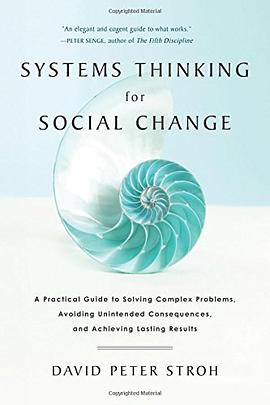
Systems Thinking For Social Change 豆瓣
作者: David Peter Stroh 出版社: Chelsea Green Publishing 2015 - 10
Donors, leaders of nonprofits, and public policy makers usually have the best of intentions to serve society and improve social conditions. But often their solutions fall far short of what they want to accomplish and what is truly needed. Moreover, the answers they propose and fund often produce the opposite of what they want over time. We end up with temporary shelters that increase homelessness, drug busts that increase drug-related crime, or food aid that increases starvation.
How do these unintended consequences come about and how can we avoid them? By applying conventional thinking to complex social problems, we often perpetuate the very problems we try so hard to solve, but it is possible to think differently, and get different results.
Systems Thinking for Social Change enables readers to contribute more effectively to society by helping them understand what systems thinking is and why it is so important in their work. It also gives concrete guidance on how to incorporate systems thinking in problem solving, decision making, and strategic planning without becoming a technical expert.
Systems thinking leader David Stroh walks readers through techniques he has used to help people improve their efforts to end homelessness, improve public health, strengthen education, design a system for early childhood development, protect child welfare, develop rural economies, facilitate the reentry of formerly incarcerated people into society, resolve identity-based conflicts, and more.
The result is a highly readable, effective guide to understanding systems and using that knowledge to get the results you want.
Review
“I don't know of another book in this field that presents the ideas of systems thinking in such a clear and practical way, with so many real-world examples."--Janice Molloy, managing editor, Reflections: The SoL NorthAmerica Journal on Knowledge, Learning, and Change
Publishers Weekly-
"This dense volume will be of genuine use to many in the nonprofit world ... Stroh has a valuable insight to impart: Becoming a more effective systems thinker is not just an analytical task 'but also an emotional, physical, and ultimately spiritual one.' For those dedicated enough to stay with Stroh's message, this book will be a useful beginning.”
“Stroh has offered an important gem in his new book, Systems Thinking for Social Change. Both illuminating and immediately useful, the book shares the key dynamics and success factors gleaned from his long career of working with organizations struggling with society’s most persistent issues. A must read for anyone whose aim is to make a difference on the ground.”--Kristina Wile, co-president, Leverage Networks, and managing partner, Systems Thinking Collaborative
“If there is only one book you read on systems thinking, it should be Systems Thinking for Social Change. If you’re new to systems thinking, I consider this a must read. If you’ve been involved in systems thinking for some time and want a renewed and extended perspective, I highly recommend it. Stroh’s new work covers all the relevant areas appropriate for a solid introduction to systems thinking, though it doesn’t stop there. It makes a serious contribution by detailing a number of real-world situations that have been investigated and improved using the approach presented in the book. And it does very well something that I’ve not seen done before: it not only shows how to map the current system, but also shows how to then create a revised map of how the system is intended to work in the future. This approach ends up identifying where measurements should be made on an ongoing basis to ascertain whether the system is undergoing the intended transformation.”--Gene Bellinger, director, Systems Thinking World, Inc.
“The philanthropic sector has shifted from a ‘charity’ mindset to a focus on changing systems to create sustainable change. Systems Thinking for Social Change offers practical tools for those serious about improving communities and organizations. It doesn’t minimize the complexity, but rather empowers social-change agents with tools to understand the complexity and identify the leverage points.”--Teresa Behrens, director, Institute for Foundation and Donor Learning
“Over fifteen years ago, David Stroh was instrumental in introducing systems thinking to the peace-building field, using tools that have proven to be powerful for improving the effectiveness of our work. This book is a valuable resource for our field ― a must read for all practitioners who have been seeking practical and easy-to-understand guidance on using systems thinking for conflict analysis and strategic planning for better impacts.”--Diana Chigas, professor of practice, Fletcher School of Law and Diplomacy at Tufts University, and co-director of collaborative learning, CDA Collaborative Learning Projects
“This is a must read for public leaders and citizens who are interested in the learning disciplines required for a sustainable, proactive approach to preserving our shared resources.”--Georgianna Bishop, president, The Public Sector Consortium
“For those who have worked for many years in the social-service sector, and who have grown cynical or disillusioned as to whether it is even possible to effect major social change, David Peter Stroh’s book, Systems Thinking for Social Change, is a must read―a clear, thoughtful, and practical guide for those desiring to create lasting social change. But reader beware! Systems thinking is more than a new way of thinking. As Stroh puts it, it is a new way of being. It requires the ability to look at things in a new way, to interact with others differently, to have a clear vision of where you want to go, a willingness to see things the way they are and, finally, the courage to take responsibility for why the system as is isn’t working. If you want to help create long-lasting, effective social change, if you want to say ‘we’re doing it―we’re actually making progress,’ then read this book.”--Anne Miskey, executive director, Funders Together to End Homelessness
“David Stroh, in his invaluable new book, shows that good intentions are not enough for those who aspire to make lasting progress on fundamental social issues―and also how the language and tools of systems theory can provide a deeper understanding of the root causes and help identify the leverage points for productive and sustainable change.”--Russell Eisenstat, executive director, Center for Higher Ambition Leadership
“Societal problems are a swirl of causes, effects, interactions, and contributing relationships. Yet, too often, simplistic answers are applied by the well-intended that only touch on one strand of what is (in reality) a complex and interconnected web. Stroh’s work provides an actionable guide on how to model these relationships―and more importantly how to have a meaningful and lasting impact on them.”--Jason E. Glass, superintendent and chief learner, Eagle County Schools
爱欲与启蒙的迷醉 豆瓣
作者: 贝尔格 译者: 乔汀 出版社: 华夏出版社 2016 - 2
柏拉图的《会饮篇》是阐述柏拉图及苏格拉底哲学思想的重要对话,其中借一次宴会上献给爱神的七篇颂词,探讨了对爱与美的认识。本书对《会饮篇》进行了重新解读,着力挖掘原文中较为隐微但不可小觑的重要主题,即雅典启蒙思想与苏格拉底思想的冲突。雅典启蒙思想作为前苏格拉底时代流行于雅典的思潮,是苏格拉底哲学思想诞生的重要背景。但在以往的研究中,更受关注的是苏格拉底本人的思想,而雅典启蒙这一重要的思想背景却受到了弱化处理。本书按照《会饮篇》原文的顺序,详细整理了每位发言者背后所代表的雅典启蒙思想;在对苏格拉底的压轴发言进行详细分析时,明确指出了苏格拉底思想与雅典启蒙思想的根本冲突,并揭露了后者的局限性。正是这种不可调和的冲突导致苏格拉底走向了遭受审判、欣然赴死的结局。
游戏与理智 豆瓣
Toys and Reasons: Stages in the Ritualization of Experience
作者: 爱利克•埃里克森(Erik H. Erikson) 译者: 罗山 出版社: 世界图书出版公司 2017 - 4
在被深深的怀疑所笼罩的某一历史时期,爱利克•埃里克森对那些曾滋养了某些纪元,而在其他纪元缺失的共同愿景的本质和结构进行了探究。从孩子的玩具世界到成人的梦想生活,从艺术家的想象到科学家的推理,他对人类关于游戏和愿景的倾向进行了说明。最后,他对一个具有普遍意义的共同愿景——美国梦的起源和结构进行了详细阐述。这种世界观既包括愿景,又包括反愿景,二者相互对抗,赋予了共同的现实以连贯的意义,并释放了个体和公共的力量。
埃里克森认为,由世界观所提供的时空定向是对个体心理的内在工作的一个恭维,适应了它的多种功能。在关键的一章中,作者通过描述日常生活中的仪式化的各个阶段,将世界观的系统发生学起源和个体发生学起源联系起来。他强调了仪式化对于个体发展与关键机构的维持之有趣和令人信服的力量。此外,他还指出了人类互动向自我欺骗和共谋发展,仪式化向仪式主义发展,愿景向噩梦发展的倾向。为了阐明与(在科技时代变得更加普遍和更加深刻的)世界观合作或对抗的意识或无意识动机,埃里克森呼吁跨学科的合作。
数学悖论与三次数学危机 豆瓣
作者: 韩雪涛 出版社: 人民邮电出版社 2016 - 9
本书介绍数学中的三大悖论(毕达哥拉斯悖论、贝克莱悖论、罗素悖论)与三次数学危机,以时间为序,以环环相扣的数学家轶事为纲,带大家了解数学发展史,理解悖论的巨大作用,以及认识欧几里得几何、无理数、微积分、集合论等的来龙去脉。书中穿插大量数学家的逸事,融知识性与趣味性于一体。本书这一版专门添加附录介绍了哥德尔证明。
数学 豆瓣
Mathematics: A Very Short Introduction
8.7 (30 个评分) 作者: [英] Timothy Gowers 译者: 刘熙 出版社: 译林出版社 2014 - 3
所有人在日常生活中都会接触到数学问题,多数人却又对之心存畏惧。在这本极为易读又充满趣味的小书中,蒂莫西·高尔斯解释了高等数学与我们在中小学所学的数学知识之间的一些最为根本的、主要是哲学性的区别,让我们能更好地理解那些听起来带有悖论的概念,比如“无限”“弯曲空间”“虚数”等。从基本的观念,到哲学探究,再到与数学共同体相关的一般社会学问题,本书揭开了空间和数的神秘面纱之一角。
用计算的观点看世界 豆瓣
作者: 郦全民 出版社: 中山大学出版社 2009 - 3
《用计算的观点看世界》把哲学问题置于当前科学前言领域的成果和思想的大视野中来讲述,带领读者浏览并欣赏科学前沿园地中正在盛开的"计算主义"之花,一种新的认识世界的方式——计算机的世界观。我们已经习惯于认为科学地能够解答我们的许多疑惑和问题,但是有些问题依然存在,关于宇宙、世界、时空、信息、进化、生命、心智……的问题。