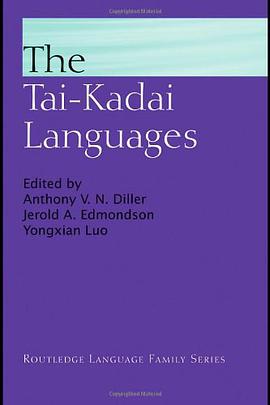
With close to 100 million speakers, Tai-Kadai constitutes one of the world's major language families. Made up of two national languages, Thai and Lao, and the so-called 'nationality languages' that represent minority 'nationalities' officially recognized in the People's Republic of China, it is a language group of immense interest and significance. Despite this, no single volume covering the Tai-Kadai languages has existed until now, and both Thai and Lao, as well as the 'nationality languages', lack comprehensive, dependable and up-to-date reference grammars. Addressing this, "The Tai-Kadai Languages" provides the clear, grammatical descriptions needed in the area.A one-of-a-kind resource, it presents a particularly important overview of Thai that includes extensive cross-referencing to other sections of the volume, sign-posting to sources in the bibliography, and can be seen as an abridged reference grammar in itself. A parallel grammatical study of Lao is also included, as are discussions of the 'nationality languages', surveys of further languages in the family with smaller numbers of speakers, and sections dealing with topics of comparative interest. Much-needed and highly useful, "The Tai-Kadai Languages" is a key work for professionals and students in linguistics, as well as anthropologists and area studies specialists.