Causal Inference 豆瓣 谷歌图书
作者:
Hernán MA
/
Robins JM
出版社:
Boca Raton: Chapman & Hall/CRC
2020
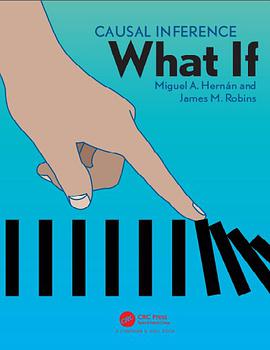
Causal inference is a complex scientific task that relies on evidence from multiple sources and a variety of methodological approaches. By providing a cohesive presentation of concepts and methods that are currently scattered across journals in several disciplines, Causal Inference: What If provides an introduction to causal inference for scientists who design studies and analyze data. The book is divided into three parts of increasing difficulty: causal inference without models, causal inference with models, and causal inference from complex longitudinal data.FEATURES:
- Emphasizes taking the causal question seriously enough to articulate it with sufficient precision
- Shows that causal inference from observational data relies on subject-matter knowledge and therefore cannot be reduced to a collection of recipes for data analysis
- Describes causal diagrams, both directed acyclic graphs and single-world intervention graphs
- Explains various data analysis approaches to estimate causal effects from individual-level data, including the g-formula, inverse probability weighting, g-estimation, instrumental variable estimation, outcome regression, and propensity score adjustment
- Includes software and real data examples, as well as 'Fine Points' and 'Technical Points' throughout to elaborate on certain key topicsCausal Inference: What If has been written for all scientists that make causal inferences, including epidemiologists, statisticians, psychologists, economists, sociologists, political scientists, computer scientists, and more. The book is substantially class-tested, as it has been used in dozens of universities to teach courses on causal inference at graduate and advanced undergraduate level.
- Emphasizes taking the causal question seriously enough to articulate it with sufficient precision
- Shows that causal inference from observational data relies on subject-matter knowledge and therefore cannot be reduced to a collection of recipes for data analysis
- Describes causal diagrams, both directed acyclic graphs and single-world intervention graphs
- Explains various data analysis approaches to estimate causal effects from individual-level data, including the g-formula, inverse probability weighting, g-estimation, instrumental variable estimation, outcome regression, and propensity score adjustment
- Includes software and real data examples, as well as 'Fine Points' and 'Technical Points' throughout to elaborate on certain key topicsCausal Inference: What If has been written for all scientists that make causal inferences, including epidemiologists, statisticians, psychologists, economists, sociologists, political scientists, computer scientists, and more. The book is substantially class-tested, as it has been used in dozens of universities to teach courses on causal inference at graduate and advanced undergraduate level.