国际经济学
国际经济学 豆瓣
作者: 保罗·R·克鲁格曼 / 茅瑞斯·奥伯斯法尔德 译者: 黄卫平 出版社: 中国人民大学出版社 2011 - 2
《国际经济学:理论与政策(第8版)(下册)(国际金融部分)》是一本经典的国际经济学教科书,它深刻洞悉了国际贸易和国际金融领域的最新变化和争议,在内容安排上既包含国际经济学的最新进展,又重视长期以来作为学科核心的传统理论与见解。《国际经济学:理论与政策(第8版)(下册)(国际金融部分)》配有大量的案例、专栏和图表,注重理论在实践中的应用。读者不需要具备广泛的经济学背景,只要学过经济学原理,就很容易理解。《国际经济学:理论与政策(第8版)(下册)(国际金融部分)》的新颖之处在于,它在以下几个方面提出了其他作者没能系统论述的新观点:1.汇率决定的资产市场分析方法;2.规模报酬递增与市场结构;3.政治学与贸易政策理论;4.国际宏观经济政策协调;5.世界资本市场与发展中国家;6.国际要素流动。《国际经济学:理论与政策(第8版)(下册)(国际金融部分)》分上下两册,上册是国际贸易部分(第2~11章),下册是国际金融部分(第12~22章),两部分自成体系,便于读者根据需要自行选择阅读。
国际经济学 豆瓣 Goodreads
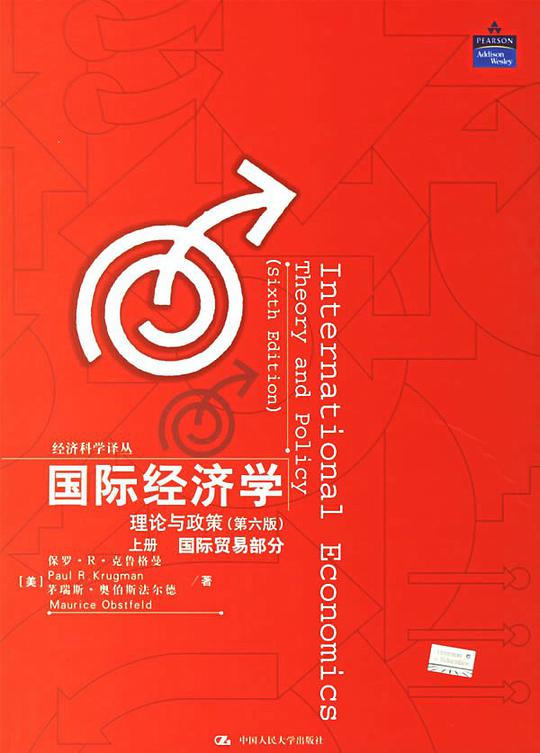
作者: [美]保罗·R·克鲁格曼等 译者: 海闻 出版社: 人民大学 2006 - 9
《国际经济学:理论与政策(第6版)(上册)(国际贸易部分)》(经济科学译丛)深刻洞悉了国际贸易和国际金融领域的变化和争议。著名经济学家保罗•克鲁格曼与茅瑞斯•奥伯斯法尔德所提供的分析方法与全球经济大事密切相连。本书核心章节主要关注理论,而随后的章节则把理论应用于分析过去和现在的主要政策问题。
第六版新增内容概览:
第9章,贸易政策中的政治经济学:分析了特殊利益集团的捐助在贸易政策制定中的影响作用,并对涉及世界贸易组织的内容进行了更新。
第11章,贸易政策中的争议:分析了战略性贸易政策理论以及为什么政府可以通过促进特定产业而获利。探索了当今关于全球化的争论。
第19章,宏观经济政策和浮动汇率制下的国际协调:简单、直观地讨论了汇率制度对国际政策的主要影响。
第20章,最优货币区和欧洲的经验:提供了关于欧洲单一货币体系的最新观点。
第22章,发展中国家:增长、危机和改革:详尽地阐述了2002年阿根廷货币的崩溃。
新增及更新的案例分析和专栏提供了对本书要点的实例说明,可以帮助读者更好地掌握本书的内容。
点击链接进入英文版:
International Economics: Theory and Policy
Advanced International Trade 豆瓣
作者: Robert C. Feenstra 出版社: Princeton University Press 2003
"Advanced International Trade" is the first major graduate textbook in international trade in a generation. Trade is a cornerstone concept in economics, taught in all departments both in the United States and abroad. The past twenty years have seen a number of new theoretical approaches that are essential to any graduate international trade course, and will be of interest in development economics and other fields. Here, Robert Feenstra steps beyond theory to consider empirical evidence as well. He covers all the basic material including the Ricardian and Hecksher-Ohlin models, extension to many goods and factors, and the role of tariffs, quotas, and other trade policies; recent material including imperfect competition, outsourcing, political economy, multinationals, and endogenous growth; and new material including the gravity equation and the organization of the firm in international trade. Throughout the book, special emphasis is placed on integrating the theoretical models with empirical evidence, and this is supplemented by theoretical and empirical exercises that appear with each chapter. "Advanced International Trade" is intended to bring readers to the forefront of knowledge in international trade and prepare them to undertake their own research. Both graduate students and faculty will find a wealth of topics that have previously only been covered in journal articles, and are dealt with here in a common and simple notation. In addition to known results, the book includes some particularly important unpublished results by various authors. Two appendices describe empirical methods applicable to research problems in international trade, methods that draw on index numbers and discrete choice models. Thoroughly up-to-date and marked by clear, straightforward prose, this book will be used widely - and enthusiastically.
The Globalization Paradox 豆瓣
作者: Dani Rodrik 出版社: W. W. Norton & Company 2011 - 2
Product Description
Surveying three centuries of economic history, a Harvard professor argues for a leaner global system that puts national democracies front and center. From the mercantile monopolies of seventeenth-century empires to the modern-day authority of the WTO, IMF, and World Bank, the nations of the world have struggled to effectively harness globalization's promise. The economic narratives that underpinned these eras—the gold standard, the Bretton Woods regime, the "Washington Consensus"—brought great success and great failure. In this eloquent challenge to the reigning wisdom on globalization, Dani Rodrik offers a new narrative, one that embraces an ineluctable tension: we cannot simultaneously pursue democracy, national self-determination, and economic globalization. When the social arrangements of democracies inevitably clash with the international demands of globalization, national priorities should take precedence. Combining history with insight, humor with good-natured critique, Rodrik's case for a customizable globalization supported by a light frame of international rules shows the way to a balanced prosperity as we confront today's global challenges in trade, finance, and labor markets.