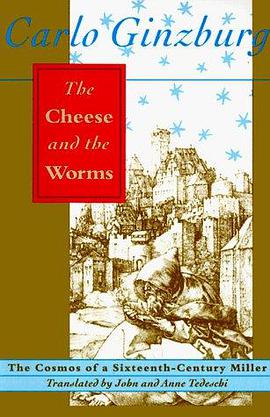
A survey of popular culture in 16th century Italy. Ginzburg’s study The Cheese & The Worms: The Cosmos of a Sixteenth-century Miller, first published in 1976, is one of those fascinating micro-histories which explores the remote lives of unknown and forgotten people. The story of Menocchio is one of a peasant life of obscurity but also one of strange and powerful ideas – confused and half-baked even – but powerful enough to bring him into conflict with the Inquisition and thereafter to the final purgatorial flames.
“I have said that, in my opinion, all was chaos … and out of that bulk a mass formed – just as cheese is made out of milk – and worms appeared in it, and these were the angels, and among that number of angels, there was also God, he too having been created out of that mass at the same time ….”
This was Menocchio’s own version of Genesis, recounted at his first interrogation: it has perhaps something in common with modern chaos theory. Sadly, the inquisitors did not appreciate the idea that God might have started out as a worm in a primordial curd. Nonetheless, this was Menocchio’s oft-repeated explanation, one he never recanted. More than an independent mind, Menocchio’s was a rebel spirit, harshly critical of Church and clergy and determined to have his say. His ‘learning’ was a fascinating hotch-potch of superstition, oral tradition, ‘strong’ ideas, misunderstood reading, peasant radicalism, paganism and ‘cottage cheese cosmology’. Ginzburg’s book details the patient mechanism of the Inquisition in Counter Reformation Italy as it sought to eradicate suspected heresy and heretical groups rather in the same way that Stalin suspected counter-revolution everywhere.
Bruno burned for the books he had written; Menocchio burned for the books he had misunderstood. Both burnings demonstrate among other things the truth of the old adage; a little learning can be a dangerous thing. Menocchio’s roasting generated more heat than light but at least it did not contradict the Laws of Thermodynamics. Today in Montereale the visitor will find the Domenico Scandella Social Centre. In the piazza there is a monument in the form of a large wheel of cheese with one slice missing. Our heretic has become a hero. Stephen Dedalus said of Bruno that, heretic or not, ‘he was terribly burnt’; so was the poor miller from Friuli.