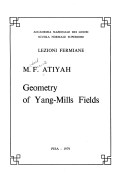
Geometry of Yang-Mills Fields Douban
author:
Michael F. Atiyah
publishing house:
Edizioni della Normale
2007
- 7
These Lecture Notes are an expanded version of the Fermi Lectures Atiyah gave at Scuola Normale Superiore in Pisa, the Loeb Lectures at Harvard and the Whittemore Lectures at Yale, in 1978. In all cases he was addressing a mixed audience of mathematicians and physicists and the presentation had to be tailored accordingly. Throughout, Atiyah presented the mathematical material in a somewhat unorthodox order, following a pattern which he felt would relate the new techniques to familiar ground for physicists.
The main new results presented in the lectures, namely the construction of all multi-istanton solutions of Yang-Mills fields, is the culmination of several years of fruitful interaction between many physicists and mathematicians. The major breakthrough came with the observation by Ward that the complex methods developed by Penrose in his “twistor programme” were ideally suited to the study of the Yang-Mills equations. The instanton problem was then seen to be equivalent to a problem in complex analysis and to one in algebraic geometry. Using the powerful methods of modern algebraic geometry it was not long before the problem was finally solved.
The main new results presented in the lectures, namely the construction of all multi-istanton solutions of Yang-Mills fields, is the culmination of several years of fruitful interaction between many physicists and mathematicians. The major breakthrough came with the observation by Ward that the complex methods developed by Penrose in his “twistor programme” were ideally suited to the study of the Yang-Mills equations. The instanton problem was then seen to be equivalent to a problem in complex analysis and to one in algebraic geometry. Using the powerful methods of modern algebraic geometry it was not long before the problem was finally solved.