文明社会研究
How Institutions Think 豆瓣 Goodreads
How Institutions Think (Frank W. Abrams Lectures)
作者: Mary Douglas 出版社: Syracuse University Press 1986 - 7
Do institutions think? If so, how do they do it? Do they have minds of their own? If so, what thoughts occupy these suprapersonal minds? Mary Douglas delves into these questions as she lays the groundwork for a theory of institutions. Usually the human reasoning process is explained with a focus on the individual mind; her focus is on culture. Using the works of Emile Durkheim and Ludwik Fleck as a foundation, "How Institutions Think" clarifies the extent to which thinking itself is dependent upon institutions. Different kinds of institutions allow individuals to think different kinds of thoughts and to respond to different emotions. It is just as difficult to explain how individuals come to share the categories of their thought as to explain how they ever manage to sink their private interests for a common good. Douglas forewarns us that institutions do not think independently, nor do they have purposes, nor can they build themselves. As we construct our institutions, we are squeezing each other's ideas into a common shape in order to prove their legitimacy by sheer numbers. She admonishes us not to take comfort in the thought that primitives may think through institutions, but moderrjs decide on important issues individually. Our legitimated institutions make major decisions, and these decisions always involve ethical principles.
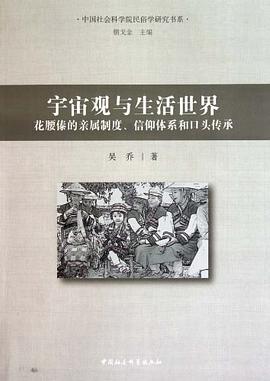
宇宙观与生活世界 豆瓣
作者: 吴乔 出版社: 中国社会科学出版社 2011 - 3
十万人口,僻处幽远,服饰绚烂,风俗特异。即使在民族风情绮丽纷呈的云南,花腰傣也是引人注目的族群。这其中,既有大众的兴趣,也有学术的关注。本书是力图结合两者的一种表述。
《宇宙观与生活世界》首先是一部民族志。要在有限的篇幅内,用清晰的线条描述完整的异文化之网络。牵引故事的时间线索是一个花腰傣女性的人生历程,它在亲属制度、信仰体系、社区生活等大背景上隐现,展开了个人,也展开了社会。
《宇宙观与生活世界》还是一本人类学理论著作。知微见著一向是人类学的长项,能从陌生的一小群人的文化结构观照整个人类的思维模式,以获自遥远的他者的知识来相对化我们自己。《宇宙观与生活世界》提出了时间观、空间观、人观、生命观、社会观等包含在“宇宙观”这个大问题之下的诸问题,并用案例和分析作了部分回答。
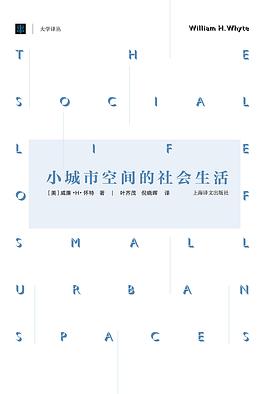
小城市空间的社会生活 豆瓣 Goodreads
THE SOCIAL LIFE OF SMALL URBAN SPACES
7.7 (7 个评分) 作者: [美] 威廉·H·怀特 译者: 叶齐茂 / 倪晓晖 出版社: 上海译文出版社 2016 - 3
In 1980, William H. Whyte published the findings from his revolutionary Street Life Project in The Social Life of Small Urban Spaces. Both the book and the accompanying film were instantly labeled classics, and launched a mini-revolution in the planning and study of public spaces. They have since become standard texts, and appear on syllabi and reading lists in urban planning, sociology, environmental design, and architecture departments around the world.


Project for Public Spaces, which grew out of Holly's Street Life Project and continues his work around the world, has acquired the reprint rights to Social Life, with the intent of making it available to the widest possible audience and ensuring that the Whyte family receive their fair share of Holly's legacy.


From the forward:


For more than 30 years, Project for Public Spaces has been using observations, surveys, interviews and workshops to study and transform public spaces around the world into community places. Every week we give presentations about why some public spaces work and why others don't, using the techniques, ideas, and memorable phrases from William H. "Holly" Whyte's The Social Life of Small Urban Spaces.


Holly Whyte was both our mentor and our friend. Perhaps his most important gift was the ability to show us how to discover for ourselves why some public spaces work and others don't. With the publication of The Social Life of Small Urban Spaces and its companion film in 1980, the world could see that through the basic tools of observation and interviews, we can learn an immense amount about how to make our cities more livable. In doing so, Holly Whyte laid the groundwork for a major movement to change the way public spaces are built and planned. It is our pleasure to offer this important book back to the world it is helping to transform.
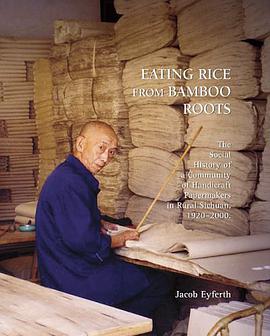
Eating Rice from Bamboo Roots 豆瓣
作者: Jacob Eyferth 出版社: Harvard University Asia Center 2009 - 6
This book charts the vicissitudes of a rural community of papermakers in Sichuan. The process of transforming bamboo into paper involves production-related and social skills, as well as the everyday skills that allowed these papermakers to survive in an era of tumultuous change. The Chinese revolution - understood as a series of interconnected political, social, and technological transformations - was, Jacob Eyferth argues, as much about the redistribution of skill, knowledge, and technical control as it was about the redistribution of land and political power. The larger context for this study is the 'rural-urban divide': the institutional, social, and economic cleavages that separate rural people from urbanites. This book traces the changes in the distribution of knowledge that led to a massive transfer of technical control from villages to cities, from primary producers to managerial elites, and from women to men. It asks how a vision of rural people as unskilled has affected their place in the body politic and contributed to their disenfranchisement. By viewing skill as a contested resource, subject to distribution struggles, it addresses the issue of how revolution, state-making, and marketization have changed rural China.