有用的书
Formations of the Secular 豆瓣
作者: Talal Asad 出版社: Stanford University Press 2003 - 2
Opening with the provocative query “what might an anthropology of the secular look like?” this book explores the concepts, practices, and political formations of secularism, with emphasis on the major historical shifts that have shaped secular sensibilities and attitudes in the modern West and the Middle East.
Talal Asad proceeds to dismantle commonly held assumptions about the secular and the terrain it allegedly covers. He argues that while anthropologists have oriented themselves to the study of the “strangeness of the non-European world” and to what are seen as non-rational dimensions of social life (things like myth, taboo, and religion),the modern and the secular have not been adequately examined.
The conclusion is that the secular cannot be viewed as a successor to religion, or be seen as on the side of the rational. It is a category with a multi-layered history, related to major premises of modernity, democracy, and the concept of human rights. This book will appeal to anthropologists, historians, religious studies scholars, as well as scholars working on modernity.
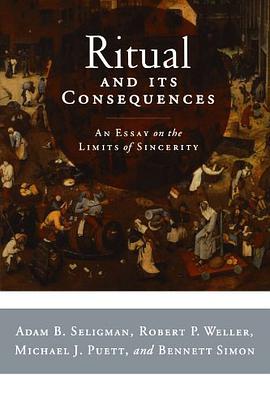
Ritual and Its Consequences 豆瓣
作者: Adam B. Seligman / Robert P. Weller 出版社: Oxford University Press 2008 - 3
Ritual is usually understood as pointing to some essence beyond the ritual act itself. This ambitious interdisciplinary study offers a convincing challenge to this understanding. The authors begin by seeking to explain how the conventional idea arose in the first place. They locate its origin in a post-Protestant and post-Enlightenment vision of ritual action that emphasizes rituals as merely external signs of interior states. This approach, say the authors, is part of a far larger way of relating to the self and to the world, which they label "sincerity." But ritual, they say, is the very opposite of sincerity because it consists of stylized, repetitive interactions that construct an "as if" world, a world of role, propriety, play, and even fantasy, rather than pointing to the world as it actually is. In fact, that is ritual's great contribution. Ritual modes of behavior make a shared social world possible by helping to navigate between diverse people and groups, rather than attempting to transcend and efface boundaries. After setting forth this argument, the authors go on to build on it by showing how sincerity and ritual are stand-ins for two very different ways of being in the world. Although both modes are always present to some degree, modernity has deeply privileged sincerity and authenticity. And, they say, we are now paying a heavy price for this extreme and often totalizing projection of personality in contemporary political life.
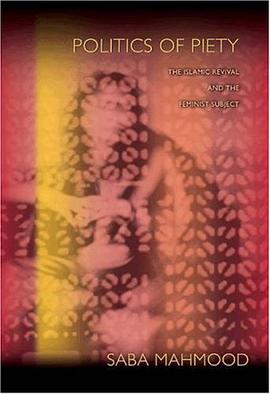
Politics of Piety 豆瓣
作者: Saba Mahmood 出版社: Princeton University Press 2005 - 10
Politics of Piety is a groundbreaking analysis of Islamist cultural politics through the ethnography of a thriving, grassroots women's piety movement in the mosques of Cairo, Egypt. Unlike those organized Islamist activities that seek to seize or transform the state, this is a moral reform movement whose orthodox practices are commonly viewed as inconsequential to Egypt's political landscape. Saba Mahmood's compelling exposition of these practices challenges this assumption by showing how the ethical and the political are indelibly linked within the context of such movements. Not only is this book a sensitive ethnography of a critical but largely ignored dimension of the Islamic revival, it is also an unflinching critique of the secular-liberal principles by which some people hold such movements to account. The book addresses three central questions: How do movements of moral reform help us rethink the normative liberal account of politics? How does the adherence of women to the patriarchal norms at the core of such movements parochialize key assumptions within feminist theory about freedom, agency, authority, and the human subject? How does a consideration of debates about embodied religious rituals among Islamists and their secular critics help us understand the conceptual relationship between bodily form and political imaginaries? Politics of Piety is essential reading for anyone interested in issues at the nexus of ethics and politics, embodiment and gender, and liberalism and postcolonialism.
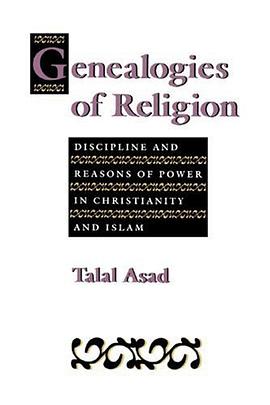
Genealogies of Religion 豆瓣
作者: Talal Asad 出版社: Johns Hopkins University Press 1993 - 8
In Geneologies of Religion, Talal Asad explores how religion as a historical category emerged in the West and has come to be applied as a universal concept.
The idea that religion has undergone a radical change since the Christian Reformation―from totalitarian and socially repressive to private and relatively benign―is a familiar part of the story of secularization. It is often invokved to explain and justify the liberal politics and world view of modernity. And it leads to the view that "politicized religions" threaten both reason and liberty. Asad's essays explore and question all these assumptions. He argues that "religion" is a construction of European modernity, a construction that authorizes―for Westerners and non-Westerners alike―particular forms of "history making."
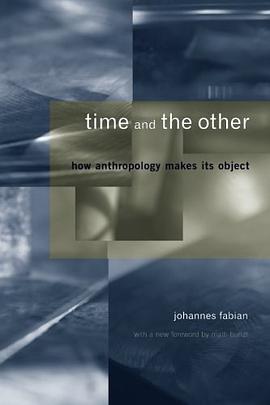
Time and the Other 豆瓣
作者: Johannes Fabian 出版社: Columbia University Press 2002 - 4
Fabian's study is a classic in the field that changed the way anthropologists relate to their subjects and is of immense value not only to anthropologists but to all those concerned with the study of man. A new foreward by Matti Bunzl brings the influence of Fabian's study up to the present. Time and the Other is a critique of the notions that anthropologists are "here and now," their objects of study are "there and then," and that the "other" exists in a time not contemporary with our own.
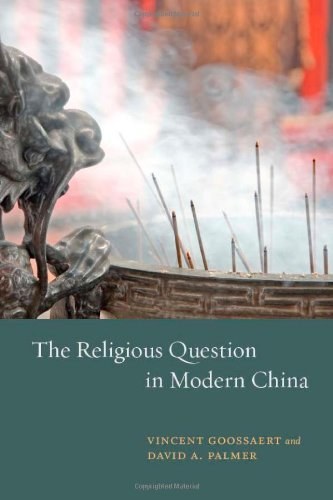
The Religious Question in Modern China 豆瓣 Goodreads
作者: Vincent Goossaert / David A. Palmer 出版社: University Of Chicago Press 2011 - 4
Recent events—from strife in Tibet and the rapid growth of Christianity in China to the spectacular expansion of Chinese Buddhist organizations around the globe—vividly demonstrate that one cannot understand the modern Chinese world without attending closely to the question of religion. The Religious Question in Modern China highlights parallels and contrasts between historical events, political regimes, and cultural movements to explore how religion has challenged and responded to secular Chinese modernity, from 1898 to the present.
 
Vincent Goossaert and David A. Palmer piece together the puzzle of religion in China not by looking separately at different religions in different contexts, but by writing a unified story of how religion has shaped, and in turn been shaped by, modern Chinese society. From Chinese medicine and the martial arts to communal temple cults and revivalist redemptive societies, the authors demonstrate that from the nineteenth century onward, as the Chinese state shifted, the religious landscape consistently resurfaced in a bewildering variety of old and new forms. The Religious Question in Modern China integrates historical, anthropological, and sociological perspectives in a comprehensive overview of China’s religious history that is certain to become an indispensible reference for specialists and students alike.