柏林



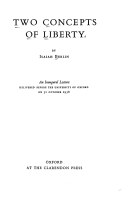
Two Concepts of Liberty Douban
author:
Isaiah Berlin
publishing house:
London Oxford University Press
1958
Two Concepts of Liberty was the inaugural lecture delivered by Isaiah Berlin before the University of Oxford on October 31, 1958. It was subsequently published as a 57-page pamphlet by Oxford at the Clarendon Press. It also appears in the collection of Berlin's papers entitled Four Essays on Liberty (1969) and was more recently reissued in a collection entitled simply Liberty (2002).
Berlin distinguished between two forms or concepts of liberty – negative liberty and positive liberty – and argued that the latter concept has often been used to cover up abuse, leading to the curtailment of people's negative liberties "for their own good".
Berlin believed that positive liberty nearly always gave rise to the abuse of power. For when a political leadership believes that they hold the philosophical key to a better future, this sublime end can be used to justify drastic and brutal means. Berlin saw the vanguard elite of the Soviet Union as a prime example of the dangers of 'positive liberty' and the concept can be seen as especially salient during the Cold War, where revolutionary sentiment was rife.
Berlin believed that a more precautious principle was needed, and that was 'negative liberty', where individuals are protected against radical or revolutionary messages, and thus have little grand or existential freedom but are granted the more 'internal' liberty to pursue recreational and consumer interests.
Berlin distinguished between two forms or concepts of liberty – negative liberty and positive liberty – and argued that the latter concept has often been used to cover up abuse, leading to the curtailment of people's negative liberties "for their own good".
Berlin believed that positive liberty nearly always gave rise to the abuse of power. For when a political leadership believes that they hold the philosophical key to a better future, this sublime end can be used to justify drastic and brutal means. Berlin saw the vanguard elite of the Soviet Union as a prime example of the dangers of 'positive liberty' and the concept can be seen as especially salient during the Cold War, where revolutionary sentiment was rife.
Berlin believed that a more precautious principle was needed, and that was 'negative liberty', where individuals are protected against radical or revolutionary messages, and thus have little grand or existential freedom but are granted the more 'internal' liberty to pursue recreational and consumer interests.