比较史
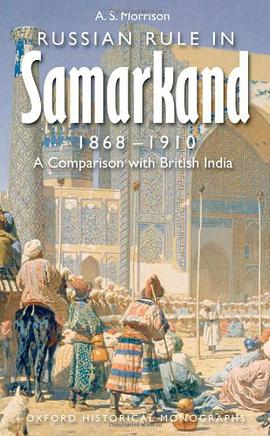
Russian Rule in Samarkand 1868-1910 豆瓣
作者: Alexander Morrison 出版社: Oxford University Press 2008 - 11
Russian Rule in Samarkand examines the structures, personnel, and ideologies of Russian imperialism in Turkestan, taking Samarkand and the surrounding region as a case-study. The creation of a colonial administration in Central Asia presented Russia with similar problems to those faced by the British in India, but different approaches to governance meant that the two regimes often stood in stark contrast to one another. While the Russian administration was characterised by corruption and inefficiency, British rule in India was often more violent, and its subjects much more heavily taxed. Opening with the background to the political situation in Central Asia and a narrative of the Russian conquest itself, the book moves on to analyse official attitudes to Islam and to pre-colonial elites, and the earliest attempts to establish a functioning system of revenue collection. Uncovering the religious and ethnic composition of the military bureaucracy, and the social background, education and training of its personnel, Alexander Morrison assesses the competence of these officers vis-a-vis their Anglo-Indian counterparts.Subsequent chapters look at the role of the so-called 'native administration' in governing the countryside and collecting taxes, the attempt to administer the complex systems of irrigation leading from the Zarafshan and Syr-Darya rivers, and the nature and functions of the Islamic judiciary under colonial rule. Based on extensive archival research in Russia, India, and Uzbekistan, and containing much rare source material translated from the original Russian, Russian Rule in Samarkand will be of interest to all those interested in the history of the Russian Empire and European Imperialism more generally.
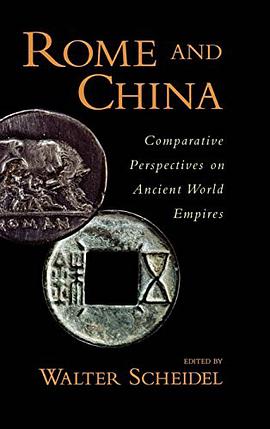
Rome and China: Comparative Perspectives on Ancient World Empires Goodreads 豆瓣
作者: Walter Scheidel 出版社: Oxford University Press 2008 - 2 其它标题: Rome and China
Transcending ethnic, linguistic, and religious boundaries, early empires shaped thousands of years of world history. Yet despite the global prominence of empire, individual cases are often studied in isolation. This series seeks to change the terms of the debate by promoting cross-cultural, comparative, and transdisciplinary perspectives on imperial state formation prior to the European colonial expansion.

Two thousand years ago, up to one-half of the human species was contained within two political systems, the Roman empire in western Eurasia (centered on the Mediterranean Sea) and the Han empire in eastern Eurasia (centered on the great North China Plain). Both empires were broadly comparable in terms of size and population, and even largely coextensive in chronological terms (221 BCE to 220 CE for the Qin/Han empire, c. 200 BCE to 395 CE for the unified Roman empire). At the most basic level of resolution, the circumstances of their creation are not very different. In the East, the Shang and Western Zhou periods created a shared cultural framework for the Warring States, with the gradual consolidation of numerous small polities into a handful of large kingdoms which were finally united by the westernmost marcher state of Qin. In the Mediterranean, we can observe comparable political fragmentation and gradual expansion of a unifying civilization, Greek in this case, followed by the
gradual formation of a handful of major warring states (the Hellenistic kingdoms in the east, Rome-Italy, Syracuse and Carthage in the west), and likewise eventual unification by the westernmost marcher state, the Roman-led Italian confederation. Subsequent destabilization occurred again in strikingly similar both empires came to be divided into two halves, one that contained the original core but was more exposed to the main barbarian periphery (the west in the Roman case, the north in China), and a traditionalist half in the east (Rome) and south (China).

These processes of initial convergence and subsequent divergence in Eurasian state formation have never been the object of systematic comparative analysis. This volume, which brings together experts in the history of the ancient Mediterranean and early China, makes a first step in this direction, by presenting a series of comparative case studies on clearly defined aspects of state formation in early eastern and western Eurasia, focusing on the process of initial developmental convergence. It includes a general introduction that makes the case for a comparative approach; a broad sketch of the character of state formation in western and eastern Eurasia during the final millennium of antiquity; and six thematically connected case studies of particularly salient aspects of this process.