翻譯理論
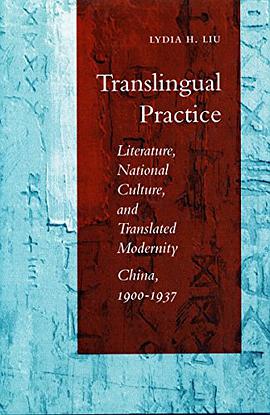
Translingual Practice 豆瓣
作者:
Lydia H. Liu
出版社:
Stanford University Press
1995
- 1
Are languages incommensurate? If so, how do people establish and maintain hypothetical equivalences between words and their meanings? What does it mean to translate one culture into the language of another on the basis of commonly conceived equivalences?This study -- bridging contemporary theory Chinese history, comparative literature, and culture studies -- analyzes the historical interactions among China, japan. and the West in terms of "translingual practice." By this term, the author refers to the process by which new words, meanings, discourses, and modes of representation arose, circulated, and acquired legitimacy in early modern China as it contacted/collided with European/Japanese languages and literatures. In reexamining the rise of modern Chinese literature in this context, the book asks three central questions: How did "modernity" and "the West" become legitimized in May Fourth literary discourse? What happened to native agency in this complex process of legitimation? How did the Chinese national culture imagine and interpret its own moment of unfolding?After the first chapter, which deals with the theoretical issues, ensuing chapters treat particular instances of translingual practice such as national character, individualism, stylistic innovations, first-person narration, and canon formation. The author reexamines the works of Lu Xun, Lao She, Shi Zhicun, Ding Ling, Xiao Hong, and others in this light, and concludes by probing the unprecedented conditions under which Chinese writers and critics moved from confidence in the absolute centrality of their civilization to rethinking Chinese literature and culture as one among many national literatures and cultures.Inshort, what does it mean to be Zhongguo ren (men and women of the Middle Kingdom) in terms of what is not of the Middle Kingdom?An appendix lists and classifies over 1,800 loanwords and neologisms introduced into modern Chinese before 1950, the largest annotated collection to be found a