Saints Of The Impossible 豆瓣
作者:
Alexander Irwin
出版社:
Univ Of Minnesota Press
2002
- 4
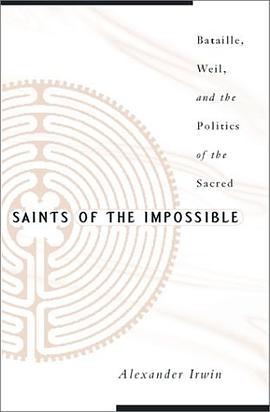
The transgressive writing of George Bataille (1897-1962) and the rigorous ethical philosophy of social activist and Christian mystic Simone Weil (1909-1943) seem to belong to different worlds. Yet in the political ferment of 1930s Paris, Bataille and Weil were intellectual adversaries who exerted a powerful fascination on each other. Saints of the Impossible provides the first in-depth comparison of Bataille's and Weil's thought, showing how an exploration of their relationship reveals new facets of the achievements of two of the twentieth century's leading intellectual figures and raises far-reaching questions about literary practice, politics, and religion.
Considering the seeming antithesis between Weil's heroic political engagement and Bataille's antipolitical aestheticism, Saints of the Impossible brings out the insufficiently recognized performative dimension of Weil's politics, while revealing the political reach of Bataille's mystical writings. As it opens a new perspective on both Weil and Bataille, the book also points to a new way of understanding the uses and abuses of sacred power and the performative in an era of philosophical disorientation, social chaos, and war.
Considering the seeming antithesis between Weil's heroic political engagement and Bataille's antipolitical aestheticism, Saints of the Impossible brings out the insufficiently recognized performative dimension of Weil's politics, while revealing the political reach of Bataille's mystical writings. As it opens a new perspective on both Weil and Bataille, the book also points to a new way of understanding the uses and abuses of sacred power and the performative in an era of philosophical disorientation, social chaos, and war.