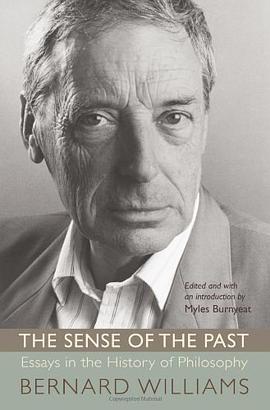
Bernard.Williams
The Sense of the Past 豆瓣
作者: Bernard Williams 出版社: Princeton University Press 2007
Before his death in 2003, Bernard Williams planned to publish a collection of historical essays, focusing primarily on the ancient world. This posthumous volume brings together a much wider selection, written over some forty years. His legacy lives on in this masterful work, the first collection ever published of Williams' essays on the history of philosophy. The subjects range from the sixth century B.C. to the twentieth A.D., from Homer to Wittgenstein by way of Socrates, Plato, Aristotle, Descartes, Hume, Sidgwick, Collingwood, and Nietzsche. Often one would be hard put to say which part is history, which philosophy. Both are involved throughout, because this is the history of philosophy written philosophically.Historical exposition goes hand in hand with philosophical scrutiny. Insights into the past counteract blind acceptance of present assumptions. In his touching and illuminating introduction, Myles Burnyeat writes of these essays: 'They show a depth of commitment to the history of philosophy seldom to be found nowadays in a thinker so prominent on the contemporary philosophical scene.' The result celebrates the interest and importance to philosophy today of its near and distant past. "The Sense of the Past" is one of three collections of essays by Bernard Williams published by Princeton University Press since his death. "In the Beginning Was the Deed: Realism and Moralism in Political Argument", selected, edited, and with an introduction by Geoffrey Hawthorn, and "Philosophy as a Humanistic Discipline", selected, edited, and with an introduction by A. W. Moore, make up the trio.
Truth and Truthfulness 豆瓣
作者: Bernard Williams 出版社: Princeton University Press 2004 - 2
What does it mean to be truthful? What role does truth play in our lives? What do we lose if we reject truthfulness? No philosopher is better suited to answer these questions than Bernard Williams. Writing with his characteristic combination of passion and elegant simplicity, he explores the value of truth and finds it to be both less and more than we might imagine. Modern culture exhibits two attitudes toward truth: suspicion of being deceived (no one wants to be fooled) and skepticism that objective truth exists at all (no one wants to be naive). This tension between a demand for truthfulness and the doubt that there is any truth to be found is not an abstract paradox. It has political consequences and signals a danger that our intellectual activities, particularly in the humanities, may tear themselves to pieces. Williams's approach, in the tradition of Nietzsche's genealogy, blends philosophy, history, and a fictional account of how the human concern with truth might have arisen. Without denying that we should worry about the contingency of much that we take for granted, he defends truth as an intellectual objective and a cultural value. He identifies two basic virtues of truth, Accuracy and Sincerity, the first of which aims at finding out the truth and the second at telling it. He describes different psychological and social forms that these virtues have taken and asks what ideas can make best sense of them today. "Truth and Truthfulness" presents a powerful challenge to the fashionable belief that truth has no value, but equally to the traditional faith that its value guarantees itself. Bernard Williams shows us that when we lose a sense of the value of truth, we lose a lot both politically and personally, and may well lose everything.