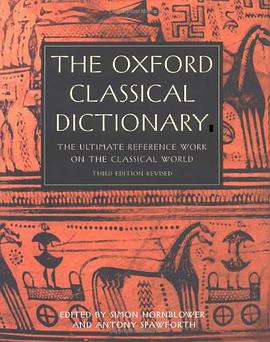
'offers not only that breakfast for the mind we keep hearing about, but lunch, tea, dinner, supper and non-stop snacks' Peter Green, Washington Times (reviewing the third edition). For almost half a century The Oxford Classical Dictionary has been regarded as the unrivalled one-volume reference work on all aspects of the Graeco-Roman world. As an authoritative reference to all there is to know about the ancients, the third edition of the Dictionary, published in 1996, has firmly maintained that position, taking into account the huge expansion in the scholarship and scope of classical studies. The value of the Dictionary in terms of factual detail is immense. It provides both scholars and non-specialists with a comprehensive source of reference which aims to answer all their questions about the classical world. In over 6,200 entries written by the very best of classical scholars from all over the world the Dictionary provides coverage of Greek and Roman history, literature, myth, religion, linguistics, philosophy, law, science, art and archaeology, and topics in near eastern studies, and late antiquity. The approach is interdisciplinary: all areas, regions, and cultures are represented beyond the core areas of Greece and Rome. As well as providing factual information the Dictionary contains many thematic entries, on subjects relevant to the 21st century such as nationalism, race, and ecology. The text is written in an accessible style and all Latin and Greek words have been translated. For this revised edition, the two editors Simon Hornblower and Antony Spawforth have made numerous small corrections and updates throughout, to make an outstanding work even better. The Dictionary covers: politics, government, economy - from political figures to political systems, terms and practices, histories of major states and empires, economic theory, agriculture, artisans and industry, trade and markets religion and mythology - deities and mythological creatures, beliefs and rituals, sanctuaries and sacred buildings, astrology and magic law and philosophy - from biographies of lawgivers and lawyers to legal terms and procedures, from major and minor philosophers to philosophical schools, terms, and concepts science and geography - scientists and scientific theory and practice, doctors and medicine, climate and landscape, natural disasters, regions and islands, cities and settlements, communications languages, literature, art, and architecture - languages and dialects, writers and literary terms and genres, orators and rhetorical theory and practice, drama and performance, art, painters and sculptors, architects, buildings and materials archaeology and historical writing - amphorae and pottery, shipwrecks and cemeteries, historians, and Greek and Roman historiography military history - generals, arms and armour, famous battles, attitudes to warfare social history, sex, and gender - women and the family, kinship, peasants and slaves, attitudes to sexuality