Sounds of Silence 豆瓣
作者:
Jutta M Hartmann
出版社:
Elsevier Science
2007
- 11
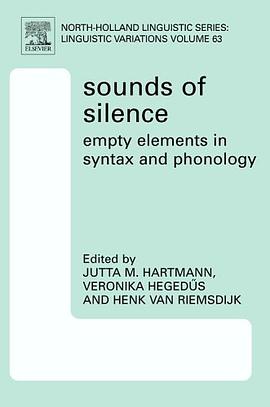
In the early 80s, largely due to Chomsky's Lectures on Government and Binding and ensuing research, a kind of encompassing theory of empty elements had emerged. This theory was largely concerned with silent subjects, silent pronominals, and various kinds of traces of movement. Since then, however, the picture has become more blurred. More types of empty elements were proposed, ellipsis phenomena began to receive some attention, and interface issues arose: are silent elements silent due to deletion (or failure to be spelled out) at the phonetic interface or are they independently existing items in the lexicon that simply fail to have a phonetic form?Furthermore, silent elements are also ubiquitous in phonology and similar questions arise: can syllables have empty nuclei, can segments fail to be pronounced when they are not properly attached to a slot in a (supra-) segmental structure? "Sounds of Silence" is an attempt to bring together a number of original contributions that all address such questions. And while a new encompassing theory is not yet in sight, this book helps pave the way. This book offers a study of "empty elements" in language use. The original contributions are from an international list of authors.