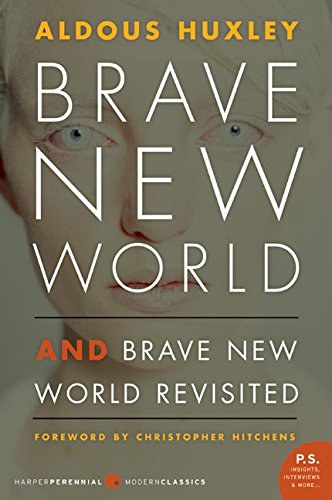
In 1958, Aldous Huxley wrote what might be called a sequel to his novel Brave New World, published in 1932, but it was a sequel that did not revisit the story or the characters, or re-enter the world of the novel. Instead, he revisited that world in a set of 12 essays. Taking a second look at specific aspects of the future Huxley imagined in Brave New World, Huxley meditated on how his fantasy seemed to be turning into reality, frighteningly and much more quickly than he had ever dreamed.
That he had been so prophetic in 1931 about the dystopian future gave Huxley no comfort. He was a far more serious man in 1958 -- at the age of 64 -- and the world was a very different place, transformed by the catastrophe of World War II, the advent of nuclear weapons and the grip of the Cold War. Looking behind the Iron Curtain, where people were not free but dominated by totalitarian power, Huxley could only bow to the grim prophecy of his friend (and, briefly, his student at Eton) George Orwell in the novel 1984. In the free world, however, the situation seemed even more to be one for despair. For it seemed to Huxley that people were well on their way to giving up their freedom and the sanctity of their individualism, in exchange for the illusions of comfort and sensory pleasure -- just as they had in Brave New World.
Huxley heard, in 1958, a world full of the noise of what he called singing commercials, flooding the mass media, much like the hypnopaedia that shaped conscious thought in the world of the novel. He saw people everywhere in greater numbers taking tranquilizer drugs, to surrender to the unacceptable aspects of modern life -- not unlike the drug called soma that everyone takes in the novel. The power of propaganda, he believed, had been validated by the rise of Hitler, and the postwar world was using it effectively to manipulate the masses. Overpopulation was already a critical issue in 1958, and Huxley saw the emergence of an overpopulated world in which the chaos was, more and more, being countered by centralized control -- closer, it seemed, to the future of Brave New World, where the ultimate controlling capitalist of Huxley´s early years, Henry Ford, had become the equivalent of God.
In the end, Brave New World Revisited despairs of what has come to pass, primarily modern humankind´s willingness to surrender freedom for pleasure. Huxley quotes from the episode of the Grand Inquisitor in The Brothers Karamazov -- ´For nothing,´ the Inquisitor insists, ´has ever been more insupportable for a man or a human society than freedom.´ Huxley worried that the cry of "Give me liberty or give me death" could easily be replaced by "Give me television and hamburgers, but don´t bother me with the responsibilities of liberty." He saw hope in the form of education, even the most pious, orthodox and inefficient kind of education -- education that can teach people to see beyond the easy slogans, efficient ends and anesthetic influences of propaganda. Perhaps the forces that now menace freedom are too strong to be resisted for every long, Huxley concluded. It is still our duty to do whatever we can to resist them.