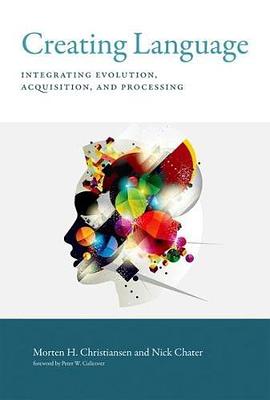
Creating Language 豆瓣
作者:
Morten H. Christiansen
/
Nick Chater
出版社:
The MIT Press
2016
- 3
Language is a hallmark of the human species; the flexibility and unbounded expressivity of our linguistic abilities is unique in the biological world. In this book, Morten Christiansen and Nick Chater argue that to understand this astonishing phenomenon, we must consider how language is created: moment by moment, in the generation and understanding of individual utterances; year by year, as new language learners acquire language skills; and generation by generation, as languages change, split, and fuse through the processes of cultural evolution. Christiansen and Chater propose a revolutionary new framework for understanding the evolution, acquisition, and processing of language, offering an integrated theory of how language creation is intertwined across these multiple timescales.
Christiansen and Chater argue that mainstream generative approaches to language do not provide compelling accounts of language evolution, acquisition, and processing. Their own account draws on important developments from across the language sciences, including statistical natural language processing, learnability theory, computational modeling, and psycholinguistic experiments with children and adults. Christiansen and Chater also consider some of the major implications of their theoretical approach for our understanding of how language works, offering alternative accounts of specific aspects of language, including the structure of the vocabulary, the importance of experience in language processing, and the nature of recursive linguistic structure.
Christiansen and Chater argue that mainstream generative approaches to language do not provide compelling accounts of language evolution, acquisition, and processing. Their own account draws on important developments from across the language sciences, including statistical natural language processing, learnability theory, computational modeling, and psycholinguistic experiments with children and adults. Christiansen and Chater also consider some of the major implications of their theoretical approach for our understanding of how language works, offering alternative accounts of specific aspects of language, including the structure of the vocabulary, the importance of experience in language processing, and the nature of recursive linguistic structure.